

Home Equity & HELOC
HELOC Payment Shock in Retirement: What Happens When the Draw Period Ends?

Introduction
A home equity line of credit (HELOC) can seem like an ideal way to access home equity in retirement. You borrow only what you need, keep your existing first mortgage in place, and have a revolving credit line available for home improvements, unexpected expenses, or other financial needs.
But there’s an important feature of traditional HELOCs that homeowners sometimes overlook: the draw period doesn’t last forever.
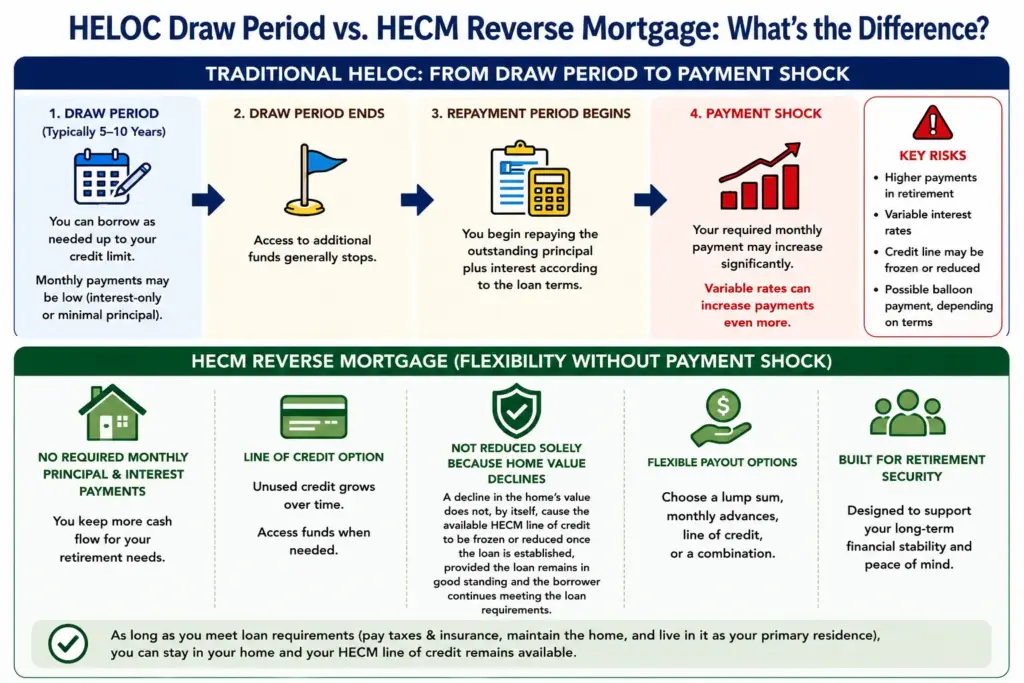
When the draw period ends, you generally can no longer access the credit line, and the loan enters its repayment period. Depending on the terms of your HELOC, your required monthly payment can increase significantly because you are now repaying principal as well as interest. The Consumer Financial Protection Bureau (CFPB) specifically warns that HELOC payments are often significantly higher once the repayment period begins.
For someone still working, a larger payment may be manageable. For a homeowner in retirement, however, an unexpected increase in required monthly expenses can have a much greater effect on cash flow.
That’s why older homeowners should understand not only how a HELOC works today, but what it could require from them years from now.
What Is a HELOC Draw Period?
A traditional HELOC generally has two distinct phases: the draw period and the repayment period.
During the draw period, you can borrow against your available credit line as needed, up to the lender’s established limit. A draw period may last 10 years, for example, although the actual term varies by lender and loan.
During this period, your minimum payment may be relatively low. Depending on the HELOC, payments may primarily cover interest or may include some principal.
That can make a HELOC particularly attractive during the early years.
The important question is:
What happens when those years are over?
What Happens When the HELOC Draw Period Ends?
When the draw period expires, the HELOC typically enters its repayment period.
At that point, two important changes can happen:
You may lose access to the credit line. You generally can no longer take additional draws from the HELOC.
Your required monthly payment may increase. Instead of making the minimum payment required during the draw period, you begin repaying the outstanding principal balance according to the loan’s repayment schedule.
The Consumer Financial Protection Bureau explains that repayment commonly takes place over a period such as 10 or 20 years, although some HELOCs can require the entire outstanding balance when the repayment period begins.
This transition can create what is commonly called payment shock.
Understanding HELOC Payment Shock
Imagine that you opened a HELOC years ago and gradually borrowed from it for home repairs, medical expenses, helping family members, or other needs.
During the draw period, the required payment may have fit comfortably into your monthly budget.
Then the draw period ends.
You can no longer borrow from the line, and your lender recalculates the payment so that the outstanding balance is repaid according to the remaining loan term.
Your monthly obligation could increase substantially.
There is another consideration: most HELOCs have variable interest rates. That means the interest rate—and therefore the required payment—can change over time.
For retirees trying to maintain predictable monthly expenses, the combination of a variable rate and a future repayment period deserves careful consideration.
Why Payment Shock Can Matter More in Retirement
Retirement changes the way many homeowners think about debt.
During your working years, an increase in a monthly payment might be easier to absorb through employment earnings. In retirement, maintaining predictable monthly expenses and preserving available cash flow often become more important.
A HELOC that was comfortable at age 65 could look very different when its draw period ends at age 75.
This is why evaluating a HELOC shouldn’t focus exclusively on:
“What will my payment be today?”
An equally important question is:
“What could my payment become later?”
Before opening or drawing substantially from a HELOC, ask the lender to explain the length of the draw period, how payments are calculated during that period, when repayment begins, how long repayment lasts, whether the rate is variable, and what your payment could look like based on different outstanding balances.
Federal rules require HELOC disclosures to address important terms, including the draw and repayment periods and how minimum payments are calculated.
HELOC Is Not Necessarily a Lifetime Line of Credit
Another misconception is that once you establish a HELOC, the available credit will necessarily remain there whenever you need it.
That isn’t always the case.
A lender may be permitted to reduce or freeze additional borrowing under certain circumstances, including a significant decline in the home’s value or certain changes in the borrower’s financial circumstances.
And when the contractual draw period ends, access to additional advances generally ends as well.
That distinction can be particularly important for someone who views a home equity line as an emergency reserve for later in retirement.
This is also an important difference when comparing a traditional HELOC with a HECM line of credit. A decline in the home’s market value does not, by itself, reduce or freeze an established HECM line of credit, provided the loan remains in good standing and the borrower continues to meet the loan requirements.
Why Many Older Homeowners Are More Familiar with HELOCs Than Reverse Mortgages
Traditional mortgages, home equity loans, and HELOCs have been familiar financial products for generations. Reverse mortgages, by comparison, remain less commonly used and are often misunderstood.
Some of that reluctance has roots in the history of the reverse mortgage industry. Earlier versions of reverse mortgages did not include all of the consumer protections associated with today’s FHA-insured Home Equity Conversion Mortgage (HECM) program. Problems involving borrower suitability, property-charge defaults, and protections for certain non-borrowing spouses contributed to negative perceptions that still surround reverse mortgages today.
But the HECM program has changed significantly.
HUD implemented Financial Assessment requirements in 2015, requiring lenders to evaluate a borrower’s ability and willingness to meet ongoing property obligations such as property taxes and homeowners’ insurance. HUD has also added and strengthened protections involving qualifying non-borrowing spouses and certain servicing situations.
HECM borrowers must also complete counseling with an independent HUD-approved housing counseling agency before proceeding with the loan. Counseling is designed to help borrowers understand how the loan works, its costs, financial implications, alternatives, and their responsibilities as homeowners.
Today’s HECM should be evaluated based on today’s rules, safeguards, and loan structure—not solely on stories about reverse mortgages from decades ago.
HELOC vs HECM: One Important Difference for Retirees
A HELOC and a HECM reverse mortgage can both provide access to home equity, but they work very differently.
A traditional HELOC requires monthly payments and eventually reaches the end of its draw period. Once the repayment period begins, the required monthly payment can increase substantially because the outstanding principal must be repaid according to the loan terms.
An FHA-insured HECM does not require monthly principal and interest mortgage payments as long as the borrower continues to meet the loan requirements.*
Instead, interest and applicable fees are added to the loan balance over time. The loan generally becomes due and payable when the last borrower permanently leaves the home, sells the property, or passes away.
This means a HECM does not have the traditional HELOC scenario in which the draw period expires and the outstanding balance transitions into an amortizing repayment period with potentially much higher required monthly payments.
For a homeowner focused on maintaining cash-flow flexibility throughout retirement, that’s an important distinction.
Borrowers must continue to pay property taxes and homeowners insurance, maintain the home, occupy it as their primary residence, and meet applicable loan requirements.
What About a HECM Line of Credit?
An adjustable-rate HECM can also include a line-of-credit option, but it works very differently from a traditional HELOC.
Rather than having a traditional draw period followed by a repayment period with required monthly principal and interest payments, available HECM line-of-credit funds remain accessible as long as the loan remains in good standing and the borrower continues to meet the loan requirements.
Another important distinction is that a HECM line of credit is not subject to fluctuations in the home’s market value in the same way a traditional HELOC can be. A traditional HELOC may be frozen or reduced under certain circumstances, including a significant decline in the home’s value. With an FHA-insured HECM, a decline in the home’s value does not, by itself, reduce or freeze the available line of credit once the loan is established, provided the loan remains in good standing and the borrower continues to meet the loan requirements.
A HECM line of credit also has a unique growth feature. Unused borrowing capacity increases over time according to the terms of the loan, regardless of whether the home’s value increases or decreases. This growth is not interest earned by the homeowner; rather, it represents an increase in the amount available to borrow.
For an eligible homeowner who wants to establish a financial resource for later in retirement, these differences can be significant. A HECM line of credit provides access to available borrowing capacity without the traditional HELOC concerns of an expiring draw period, required monthly principal and interest payments, or a reduction in the credit line solely because the home’s market value declines.*
Borrowers must continue to pay property taxes and homeowners insurance, maintain the home, occupy it as their primary residence, and meet applicable loan requirements.
Does That Mean a Reverse Mortgage Is Always Better Than a HELOC?
No. A HELOC can be an excellent financial tool for the right homeowner.
Someone who needs a relatively small amount of money, has sufficient monthly cash flow, expects to repay the balance relatively quickly, and is comfortable with the loan’s future payment requirements may find that a traditional HELOC works very well.
A HECM has different costs, eligibility requirements, and long-term considerations. Because interest and applicable fees accrue to the loan balance, the amount owed generally grows over time and can reduce the equity remaining in the home.
The question isn’t:
“Which loan is better?”
A better question is:
“Which loan structure is better suited to the way I expect to live, manage cash flow, and use my home equity throughout retirement?”
Understanding the differences between the two can help you evaluate not only what works today, but what may continue to work as your retirement needs change.
Questions to Ask Before Choosing a HELOC in Retirement
Before opening a HELOC—or before making a substantial draw from one you already have—look beyond today’s required payment.
Ask your lender:
- When does the draw period end?
- How will my required payment be calculated after the draw period?
- Is the interest rate variable, and how often can it change?
- How long will I have to repay the outstanding balance?
- Could the loan require a balloon payment?
- Under what circumstances could the available credit line be frozen or reduced?
- What could my monthly payment look like at the beginning of the repayment period based on my anticipated balance?
Then consider those answers in the context of your expected retirement cash flow—not simply your financial situation today.
If you’re eligible for a HECM, it can also be worthwhile to compare a traditional HELOC with a reverse mortgage before making a decision. The two loans access home equity very differently, and understanding both the immediate and long-term implications can help you choose a structure that better supports your retirement goals.
Conclusion
A HELOC can provide convenient access to home equity, but the payment you make during the draw period may not be the payment you make for the life of the loan.
When the draw period ends, access to additional funds generally stops and repayment begins. For some homeowners, that transition can mean a significantly higher required monthly payment at a time when maintaining predictable retirement cash flow matters most.
A HECM reverse mortgage takes a different approach. There are no required monthly principal and interest mortgage payments, and there is no traditional HELOC-style payment shock caused by transitioning from a draw period into an amortizing repayment period.*
That doesn’t make a HECM the right answer for everyone. But it does mean older homeowners shouldn’t dismiss today’s reverse mortgages based solely on what they may have heard about them years ago. Today’s FHA-insured HECM includes important consumer protections and deserves to be evaluated alongside other home-equity options based on your current needs and long-term retirement goals.
Your home equity is an important retirement asset. The goal isn’t simply to access it—it’s to choose a strategy that continues to work for you in the years ahead.
Borrowers must continue to pay property taxes and homeowners insurance, maintain the home, occupy it as their primary residence, and meet applicable loan requirements.
Frequently Asked Questions
What is a HELOC draw period?
The draw period is the portion of a HELOC during which you can borrow against your available credit line. A draw period might last 10 years, for example, although terms vary by lender. After the draw period ends, you generally can no longer take additional draws and the loan enters its repayment period.
What happens to my HELOC payment when the draw period ends?
Your required payment can increase significantly because you begin repaying the outstanding principal according to the loan’s repayment schedule. Depending on the HELOC agreement, repayment may occur over a number of years or, in some cases, the outstanding balance may become due when the repayment period begins.
What is HELOC payment shock?
HELOC payment shock describes a substantial increase in the required monthly payment, often associated with the transition from the draw period to the repayment period. Variable interest rates can also affect the required payment.
Can my HELOC lender freeze or reduce my credit line?
Under certain circumstances, yes. A significant decline in the home’s value or certain changes in the borrower’s financial circumstances can affect continued access to additional credit, depending on the terms of the HELOC and applicable requirements.
Does a HECM line of credit have a draw period like a traditional HELOC?
No. A HECM line of credit does not operate with the traditional HELOC structure of a draw period followed by an amortizing repayment period with required monthly principal and interest payments.
Can a HECM line of credit be reduced if my home’s value declines?
A decline in the home’s market value does not, by itself, reduce or freeze an established HECM line of credit. Available borrowing capacity remains subject to the terms of the loan, and the borrower must continue to meet the loan requirements.
Does a HECM line of credit grow over time?
Yes. Unused HECM line-of-credit borrowing capacity can increase over time according to the terms of the loan. This growth is not interest earned by the homeowner; rather, it increases the amount available to borrow.
Does a HECM reverse mortgage require monthly mortgage payments?
A HECM does not require monthly principal and interest mortgage payments. Borrowers must continue to pay property taxes and homeowners insurance, maintain the home, occupy it as their primary residence, and meet applicable loan requirements.
Why do reverse mortgages still have a negative reputation?
Some perceptions of reverse mortgages developed from problems associated with earlier versions of the product and borrower experiences before several of today’s HECM protections were implemented. HUD has since added and strengthened requirements involving financial assessment, property charges, certain non-borrowing spouses, and other consumer protections. HECM borrowers must also complete counseling with an independent HUD-approved housing counseling agency.
Should I replace my HELOC with a reverse mortgage?
Not necessarily. The right choice depends on factors such as your age, available home equity, existing mortgage and HELOC balances, monthly cash flow, future borrowing needs, plans for the home, and long-term financial goals. Comparing both loan structures can help you understand how each could affect your finances today and later in retirement.
Where can I learn more about how a reverse mortgage works?
To learn more, read my step-by-step guide to how a reverse mortgage works, including eligibility, counseling, the loan process, payout options, and borrower responsibilities. You can also review the 10 Key Reverse Mortgage Pros and Cons Every Senior Should Know to explore the advantages and considerations in more detail.
Have questions about this?
Talk to a Certified Reverse Mortgage Professional — directly.
When you call, you reach me — not a call center. Free 30-minute consult by phone, video, or in person. No SSN, no credit pull, no obligation.
Schedule a consult