

hecm vs heloc
HECM vs. HELOC: Compare Payment Timing, Access, and Retirement Fit

Build a Withdrawal-Timing Map
The HECM and HELOC comparison begins with your retirement cash flow, not with a product verdict. The useful question is how access to home equity would fit alongside your income, existing mortgage, monthly budget, long-term plans, and willingness to make monthly payments.
The map places key events in order: funds become available, HELOC payments begin after borrowing starts, and the draw period ends. For an FHA-insured HECM, it records the selected way to receive funds and the absence of required monthly principal and interest payments. A HELOC may provide access as you need it, while an HECM may offer different ways to receive funds and different payment timing. Those differences matter more than a general label such as flexible or affordable.
Use these questions to organize the decision:
- Do you need a defined amount at one time, recurring access, or a combination of payment options?
- Can your household make required monthly principal and interest payments if borrowing begins?
- What existing mortgage balance or other debt would remain alongside new borrowing?
- Which income, credit, equity, occupancy, and counseling factors apply to the product under consideration?
- How does each option fit your plans for the home and its equity over the long term?
This article provides general education. It does not establish your eligibility, estimate available funds, determine a payment, or recommend what you should do with your home.
Name the HECM and HELOC Before Comparing Them
Most reverse mortgages today are Home Equity Conversion Mortgages (HECMs), federally insured by HUD’s Federal Housing Administration (FHA); non-HECM reverse mortgages may have different requirements and features. This article compares the FHA-insured HECM with a HELOC. HECM rules should not be applied to jumbo, proprietary, or hybrid retirement mortgage products.
A Home Equity Conversion Mortgage (HECM)—commonly known as a reverse mortgage—is an FHA-insured loan that allows eligible homeowners to access a portion of their home equity through a cash lump sum, line of credit, monthly payments, or a combination of these options. HECM borrowers are generally age 62+, with provisions for eligible non-borrowing spouses under 62. This age description applies to the FHA-insured HECM, not to non-HECM products.
A HELOC is revolving credit in which your home serves as collateral. A lender approves a credit limit, and you draw from that limit rather than receiving every dollar at the beginning. A HELOC lets you access money as you need it, up to a limit determined by the lender.
A lender may set a HELOC limit using a percentage—say, 75 percent—of your home’s appraised value, minus the balance owed on your existing mortgage. The 75 percent figure is an example used in the CFPB guide, not a promise about your limit. Your actual limit is a lender decision based on the property and your financial information.
Compare How Funds Become Available
HECM funds may be arranged as a cash lump sum, a line of credit, monthly payments, or a combination of these choices. The selected structure determines how money becomes available, so begin with the purpose and timing of the funds rather than with a headline loan amount.
A lump sum and recurring monthly payments answer different cash-flow questions. A line of credit creates another pattern: access can be reserved for future needs, subject to the terms of the specific HECM. The existence of a payment option does not establish the amount you would receive or whether you would qualify.
A HELOC lets you access money as you need it, up to a lender-determined credit limit. That structure may fit a need whose timing or amount is not known in advance, but available credit is not the same as cash already received.
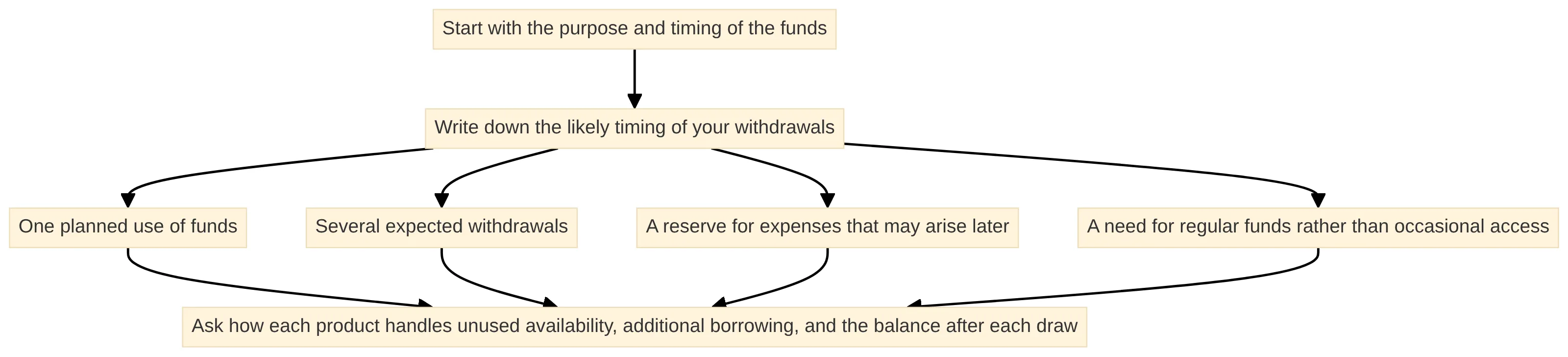
Write down the likely timing of your withdrawals:
- One planned use of funds.
- Several expected withdrawals.
- A reserve for expenses that may arise later.
- A need for regular funds rather than occasional access.
Then ask how each product handles unused availability, additional borrowing, and the balance after each draw. Those are product-specific questions, not conclusions that follow from the words HECM or HELOC alone.
For a clearer comparison, label each planned amount as one of three things: money already received, unused availability, or borrowing that may be requested later. A HELOC limit is not the same as funds already drawn. Likewise, an FHA-insured HECM payment choice does not establish a particular amount or guarantee that a household will qualify. This labeling makes it easier to compare the timing of access with the timing of obligations instead of treating every available option as current cash.
Put Payment Timing Beside the Access Decision
Payment timing is one of the clearest points of difference between the two products. The table keeps access and repayment on the same page.
| Comparison point | FHA-insured HECM | HELOC |
|---|---|---|
| How funds become available | A cash lump sum, line of credit, monthly payments, or a combination of these options | Money is accessed as needed up to a lender-determined credit limit |
| Required monthly principal and interest payments | No required monthly principal and interest payments | Payments begin once you start borrowing |
| Payment pattern | Depends on the selected HECM payment structure and product terms | A variable rate is typical, and the repayment amount varies |
| Product documents determine the terms that apply to a particular household. |
For the FHA-insured HECM shown here, the absence of required monthly principal and interest payments does not mean the balance is never repaid.
The CFPB describes HELOC payments as beginning once you start borrowing. Many HELOC plans set a draw period, such as 10 years, during which you can borrow money.
A HELOC typically has a variable rate, the repayment amount varies, and repayment is often required when you sell your home. Ask for the terms that explain when the draw period ends, how repayment is calculated afterward, and what happens if the rate changes.
An FHA-insured HECM has no required monthly principal and interest payments, but that does not mean you have no ongoing homeowner responsibilities. Record the timing of funds, required principal and interest payments, possible payment changes, repayment events, and separate property costs for both options.
Treat the end of a HELOC draw period as a document-review checkpoint. The fact that a draw period ends does not by itself state the later payment amount. Ask whether additional borrowing remains available, how the outstanding balance is repaid, whether the rate can change, and which payment assumptions were used. Because repayment amounts vary, compare the stated post-draw terms with the household’s income and other obligations rather than carrying the draw-period payment forward. This is a timing distinction, not a prediction of a particular increase.
Ask What Each Product Examines During Qualification
HECM eligibility includes using the home as a primary residence, meeting credit history standards, and completing an independent HUD-approved counseling session.
These are general HECM eligibility factors, not an approval determination. The counseling requirement is a separate information step, and the HECM label does not establish what a particular household will receive or which conditions will apply to an application.
For comparison purposes, I separate what the HECM eligibility discussion addresses from what a lender still has to review. Primary-residence status describes how the home is used; credit history standards relate to the application; and independent HUD-approved counseling is an information step connected to the HECM process. None of those points establishes the amount, payment structure, or timing that would apply to a particular household. I keep those questions separate from the income-and-credit review used for a HELOC.
HELOC qualification examines a different set of repayment factors. For a HELOC, lenders may consider your income, debts, other financial obligations, and credit history when assessing your ability to repay principal and interest. HELOC qualification also includes income, credit score, debt-to-income ratio, and equity.
That distinction gives you a practical comparison question: is the household being evaluated around HECM eligibility factors, or around the income and credit capacity needed to repay a HELOC? Neither list answers the question by itself. Ask which documents and conditions apply to the specific product being discussed.
Keep the comparison symmetrical without making the products identical. For a HELOC, ask how income, debts, other obligations, credit history, credit score, debt-to-income ratio, and equity are being considered in the repayment review. For an HECM, ask how primary-residence status, credit history standards, independent HUD-approved counseling, and the selected payment structure relate to the discussion. These are general factors, not a promise of approval, a credit limit, or available HECM funds.
Keep Homeownership Responsibilities Visible
Homeownership responsibilities continue alongside an FHA-insured HECM. You keep title to the home while the lender places a lien, like any other mortgage. You continue to pay property taxes and homeowners insurance, maintain the home, and keep it as your primary residence.
The primary-residence condition is also part of the general HECM eligibility discussion. Payment flexibility does not remove these responsibilities. A comparison that discusses only monthly principal and interest payments leaves out conditions that can affect the loan.
A HELOC also uses the home as collateral. Its repayment structure therefore belongs beside the ordinary costs of owning the property, not in place of them. Ask how the HELOC documents describe property use, insurance, taxes, maintenance, and repayment after a sale.
Keep these items visible in your notes:
- Primary-residence requirements connected to the product.
- Property taxes and homeowners insurance.
- Home maintenance and property condition.
- The existing mortgage and any other liens.
- The payment obligation created by each new draw.
This list helps you organize a comparison. It does not determine whether either product is suitable for your household.
Examine Retirement Cash Flow and Long-Term Equity
Retirement cash flow is affected by when money becomes available and when repayment obligations arise. A HELOC begins payments once borrowing starts, and its variable rate and changing repayment amount may affect the monthly budget. An HECM has no required monthly principal and interest payments, but its other homeowner responsibilities continue.
Write the expected cash-flow effect beside each planned use of funds. Include regular income, existing mortgage payments, property costs, and any HELOC payments that could follow a draw-period change.
I also separate a payment obligation from the use of home equity. If a household draws on a HELOC, the draw starts the payment timeline described in the product documents. The amount borrowed, the rate structure, the end of the draw period, and the later repayment schedule belong in the monthly-budget review. With an FHA-insured HECM, the absence of required monthly principal and interest payments changes that monthly-payment question, but it does not settle the home’s long-term equity plan or the event that makes the loan due. In either comparison, note which facts are known, which terms must come from the product documents, and which household assumptions still need review.
Long-term home equity requires a separate set of questions. A HELOC balance changes as you borrow and repay, and repayment is often required when you sell the home. The selected payment structure, existing debt, age, income, and long-term goals all belong in the discussion.
Use questions rather than a projected result:
- What balance could remain after the planned borrowing?
- How could required payments affect funds available for other expenses?
- What happens to the plan if income, expenses, or the intended use of the home changes?
- How does each option fit your household’s long-term home-equity plans?
A useful review separates three time points. First, record what the household needs now and whether access is a one-time use, recurring borrowing, or a reserve for later. Second, record what happens while funds are being used: a HELOC payment begins once borrowing starts, while an FHA-insured HECM has no required monthly principal and interest payments but still carries ongoing homeowner responsibilities. Third, record the event that brings repayment into view, including the HELOC’s later repayment terms and the FHA-insured HECM becoming due when the last borrower permanently leaves the home, sells the property, or passes away.
This three-part view keeps a lower monthly payment obligation from being treated as the whole retirement fit. It also keeps access to equity separate from the household’s plans for the property, its existing debt, and the timing of any later repayment.
Test the Comparison Against Other Home-Equity Choices
A HELOC should be compared with more than an HECM in isolation. The CFPB says a home equity loan or HELOC might be a cheaper way to borrow against your equity in some circumstances, but these loans usually have monthly payments and qualification depends on income and credit.
That statement is not a ranking. It identifies a trade-off to examine: a possible borrowing-cost difference may sit beside a monthly repayment obligation and income-and-credit requirements. Ask what cost assumptions are being used, what payment schedule accompanies them, and how the comparison changes if the line’s rate or repayment amount changes.
Treat the word “cheaper” as a question about assumptions, not as a product label. Ask whether the comparison concerns the cost of borrowing, the required monthly payment, or the amount repaid over time. Those are different measures. A HELOC can require payments once borrowing begins, while an FHA-insured HECM’s lack of required monthly principal and interest payments changes the monthly-budget question. Neither observation supplies a rate, fee, balance, or total-cost result for a particular household. Ask for product-specific terms and place them beside timing, income, existing mortgage, and long-term goals before drawing a conclusion.
The CFPB recommends comparing all of your borrowing and housing options before making a final decision. Use that broader frame to consider whether waiting, another home-equity product, refinancing, or a housing change belongs in the discussion.
Timing also deserves attention. The CFPB cautions that taking out a reverse mortgage when you are too young may leave you without money later, when you may have less income and higher health care bills. The practical question is whether the timing and payment structure fit your household’s longer-term needs.
Use Questions Instead of a Product Verdict
A comparison checklist gives you a way to test the facts without deciding from a general description. Bring these questions to the conversation:
- What is the intended use of the funds, and will the need be one-time or recurring?
- How would the HECM payment choice or HELOC draw affect monthly cash flow?
- What existing mortgage, liens, debts, and property costs must be included?
- Which HECM factors apply: age, primary residence, credit history standards, and independent HUD-approved counseling?
- Which HELOC factors apply: income, debts, other obligations, credit history, credit score, debt-to-income ratio, and equity?
- When would HELOC payments begin, and what changes after the draw period?
- Which payment amounts or balance details are estimates rather than stated product terms?
After that first list, I use a separate timing check:
- For an FHA-insured HECM, when does the loan become due, and which event would apply to the household’s circumstances?
- For a HELOC, when does the draw period end, and how is repayment described afterward?
- Which homeowner responsibilities continue regardless of the selected payment structure?
- Which questions concern taxes, benefits, legal matters, or individualized financial guidance and therefore need the appropriate professional?
- What information about income, debts, credit, equity, occupancy, and the existing mortgage should be available for a product-specific discussion?
- Which assumptions should be stated plainly before comparing a payment schedule or a long-term home-equity plan?
This second pass keeps the conversation tied to timing and conditions. It also helps distinguish a question that can be answered from the product description from one that requires the lender’s documents or a separate professional review.
Pause for clarification when a comparison leaves out a material condition.
Also ask what happens after the initial access period, when a planned sale or move would affect repayment, and which assumptions were used to describe the balance. A comparison should identify the product, the payment timing, the ongoing property responsibilities, and the conditions that could affect a later outcome.
A written comparison can be organized under five headings: access, payment timing, qualification, homeowner responsibilities, and long-term equity. Under access, note whether funds are arranged as a cash lump sum, line of credit, monthly payments, or a combination for the FHA-insured HECM, and whether the HELOC is accessed as needed up to its lender-determined limit. Under payment timing, note when HELOC payments begin, how the draw period changes the repayment discussion, and when the HECM becomes due. Under qualification, keep HECM eligibility factors separate from the income, debt, credit, and equity factors used in a HELOC review. Under homeowner responsibilities, record taxes, insurance, maintenance, and primary-residence requirements. Under long-term equity, record the stated product terms and repayment events without turning a general description into a household result.
Treat omissions as prompts for follow-up. A comparison deserves another pass if it treats a HELOC credit limit as cash already received, leaves out the income-and-credit review for a HELOC, gives no explanation of what happens when the draw period ends, or compares a payment without stating whether it is required. The same is true if an HECM summary leaves out ongoing property responsibilities, the event that makes the loan due, or the distinction between an FHA-insured HECM and a non-HECM product. These are not reasons to select one option. They are practical signs that the comparison is incomplete. Ask for the missing term, assumption, or product boundary before using the comparison to plan retirement cash flow or home-equity use.
Keep the follow-up in the right lane. Product documents and the lending conversation address payment timing, qualification factors, and the terms of a particular HECM or HELOC. Independent HUD-approved counseling is part of the HECM information process. Questions about taxes, benefits, legal matters, or individualized financial guidance belong with the appropriate professional. Separating these lanes helps a general comparison remain education rather than a personalized determination.
Prepare for a Specific Comparison Conversation
A specific comparison conversation can begin with organized information rather than a product verdict. Prepare your approximate income sources, existing mortgage and other debts, property costs, intended use of funds, desired access pattern, willingness to make monthly payments, and plans for the home.
Before making a final decision, compare all of your borrowing and housing options. A tax professional, benefits specialist, or attorney can address questions in those separate areas. The goal is a comparison that reflects your household’s cash flow, income, existing mortgage, age, long-term goals, and desire to make monthly payments.
Neither an FHA-insured HECM nor a HELOC is automatically better. Put the timing, access, qualification factors, homeowner responsibilities, and long-term equity questions on the same page so the discussion can address your circumstances directly.
What Should I Ask Before Comparing an HECM With a HELOC?
How does a HELOC work?
A Home Equity Line of Credit (HELOC) is a form of revolving credit where your home serves as collateral. You can access money as needed, up to a limit determined by the lender, and you typically make monthly payments once you start borrowing.
What are the key differences in payment obligations between a HECM and a HELOC?
With a HECM, there are no required monthly principal and interest payments, while a HELOC requires payments to begin once you start borrowing, often leading to variable repayment amounts.
What should I consider when comparing a HECM and a HELOC?
Consider factors such as your cash flow needs, existing mortgage obligations, the timing of fund access, repayment structures, and how each option fits your long-term financial goals.
What ongoing responsibilities do I have with a HECM?
Homeowners with a HECM must continue to pay property taxes, homeowners insurance, and maintain the home as their primary residence.
Are there alternatives to a HECM or HELOC?
Yes, alternatives include cash-out refinancing or other home equity loans, but these options typically involve monthly payments and depend on income and credit qualifications.
Have questions about this?
Talk to a Certified Reverse Mortgage Professional — directly.
When you call, you reach me — not a call center. Free 30-minute consult by phone, video, or in person. No SSN, no credit pull, no obligation.
Schedule a consult