

Home Equity & HELOC
Can a Bank Freeze or Reduce Your HELOC? What Retirees Need to Know

Can a bank freeze your HELOC even if you’ve made every payment on time? Yes. Under certain circumstances, a lender can temporarily suspend additional borrowing or reduce your available credit limit.
That possibility surprises many homeowners, particularly retirees who opened a home equity line of credit to provide financial flexibility during retirement.
A HELOC can be a useful financial tool. It allows homeowners to access a portion of their home equity without necessarily refinancing an existing first mortgage. However, an approved credit limit isn’t the same as money sitting in a savings account.
For retirees who plan to use a HELOC as an emergency reserve, understanding when a bank can restrict access is an important part of retirement planning.
Quick Answer: Can a Bank Freeze Your HELOC?
Yes. A bank can freeze your HELOC or reduce its credit limit under specific circumstances permitted by federal lending regulations. These may include a significant decline in property value, a material change in financial circumstances that reasonably raises repayment concerns, or certain defaults under the loan agreement.
However, lenders cannot arbitrarily freeze a HELOC simply because they no longer want to extend credit. Federal Regulation Z establishes limits on when they can take these actions. Consumer Financial Protection Bureau+1
Why Would a Bank Freeze or Reduce Your HELOC?
Several circumstances can trigger restrictions on a traditional home equity line of credit.
1. Your Home’s Value Declines Significantly
Your home serves as collateral for a HELOC.
When a lender approves a credit line, it evaluates the property’s value, existing mortgage balances, and available equity.
If the home’s value declines significantly, the lender may determine that the property no longer provides sufficient collateral for the original credit limit.
For example, imagine a homeowner who opens a $150,000 HELOC based on a property worth $800,000.
Several years later, the local housing market weakens, and the home’s value declines substantially.
Even if the homeowner has excellent credit and makes every payment on time, the lender may have grounds to reduce or suspend additional borrowing.
Federal rules establish specific conditions for such restrictions. A small or insignificant decline in property value does not automatically justify a freeze. Consumer Financial Protection Bureau
2. Your Financial Circumstances Change
A significant deterioration in a borrower’s financial circumstances may also permit a lender to restrict future HELOC advances.
However, the regulation requires more than simply identifying a financial change. The lender must have a reasonable basis to believe that the borrower will be unable to fulfill the payment obligations because of that change.
Examples that may warrant review include:
- A substantial reduction in household income.
- Significant increases in outstanding debt.
- Financial difficulties affecting repayment capacity.
- Other material changes that create legitimate concerns about the borrower’s ability to meet loan obligations.
Retirement itself does not automatically justify freezing a HELOC.
Many retirees receive dependable income from Social Security, pensions, investments, and retirement accounts. The relevant question is whether a qualifying change in financial circumstances creates reasonable repayment concerns.
3. You Default on Certain Loan Obligations
A lender may also restrict borrowing when a borrower fails to meet qualifying obligations under the HELOC agreement.
Depending on the circumstances and loan terms, these may include certain payment defaults or failure to satisfy material obligations involving the property.
The lender’s rights depend on the contract and applicable law.
4. Other Circumstances Permitted by Federal Rules
Regulation Z also addresses additional situations, including certain government actions affecting the security interest, qualifying impairment of lien priority, and specific regulatory circumstances.
The key point is that a bank does not have unlimited discretion to freeze or reduce an open HELOC.
You can review the federal requirements under Regulation Z, Section 1026.40.
Can a Bank Freeze Your HELOC If You Have Never Missed a Payment?
Yes.
This is one of the most misunderstood aspects of traditional HELOCs.
A homeowner may have:
- An excellent payment history.
- A strong credit score.
- A substantial amount of home equity.
- No missed mortgage payments.
- A relatively small outstanding HELOC balance.
Yet a qualifying decline in property value or another legally permitted condition may still affect access to unused funds.
That distinction matters because your payment history and your right to future borrowing are not necessarily the same thing.
A traditional HELOC is a credit agreement secured by your home, not a guaranteed cash reserve.
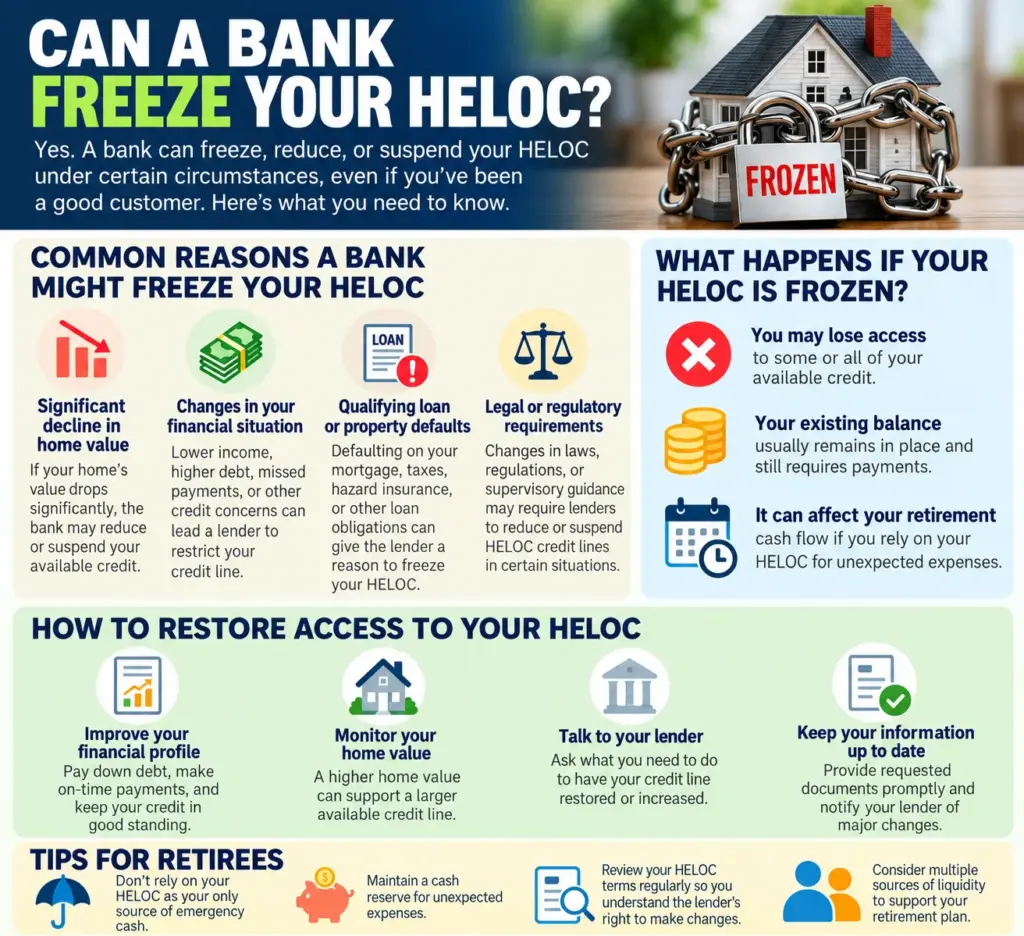
What Happens to Your HELOC Balance If the Bank Freezes Your Credit Line?
A HELOC freeze generally affects your ability to borrow additional money.
It does not automatically mean the lender can demand immediate repayment of the entire outstanding balance.
For example:
Example: A HELOC credit freeze
Approved credit limit
$150,000
Outstanding balance
$40,000
Unused credit before freeze
$110,000
Additional borrowing during freeze
$0
Illustrative example only. The existing $40,000 balance remains subject to the loan’s repayment terms. A temporary freeze alone does not necessarily accelerate repayment.
The homeowner still owes the outstanding $40,000 and must continue making required payments.
But the unused $110,000 may no longer be accessible while the freeze remains in effect.
For a retiree who planned to use that credit line for unexpected medical expenses, home repairs, or emergencies, the restriction could create a significant financial challenge.
Can a Bank Reduce Your HELOC Limit Without Closing the Account?
Yes.
A lender may reduce the credit limit rather than suspend all future borrowing, provided the conditions for doing so exist.
Suppose your original HELOC limit is $200,000, and you have borrowed $50,000.
A qualifying change in circumstances might lead the lender to reduce your credit limit to $75,000.
In that situation, your remaining borrowing capacity would fall from $150,000 to $25,000.
The lender generally cannot use a temporary credit-limit reduction to force a higher payment by reducing the limit below the outstanding balance. Federal rules distinguish these restrictions from the separate circumstances in which a lender may terminate a plan and accelerate repayment. Consumer Financial Protection Bureau
Does the Bank Have to Notify You Before Freezing Your HELOC?
Federal Regulation Z generally requires a lender to provide written notice of a qualifying HELOC freeze or credit-limit reduction within three business days after taking the action.
The notice must explain the specific reasons for the restriction and indicate whether the borrower must request reinstatement of borrowing privileges.
That means the notice does not necessarily have to arrive before the restriction takes effect.
If your HELOC has been frozen or reduced, review the notice carefully and contact your lender to understand the stated reason.
For the applicable requirements, see Regulation Z, Section 1026.9. Consumer Financial Protection Bureau
Can You Get a Frozen HELOC Reinstated?
Potentially, yes.
A qualifying HELOC freeze or credit-limit reduction is generally temporary under the federal rules governing these restrictions.
When the condition that justified the restriction no longer exists, the lender must restore borrowing privileges as soon as reasonably possible, assuming no other permissible reason for restricting the line remains.
Depending on the circumstances, you may be able to:
- Ask your lender for the specific reason. Request an explanation of what caused the restriction.
- Review your credit reports. Correct inaccurate information that may have contributed to the lender’s decision.
- Request a property-value review. If the lender relied on a decline in home value, ask whether a new appraisal or other acceptable valuation could support reinstatement.
- Provide updated financial information. If the concern involves repayment capacity, current income and financial documentation may help.
- Request reinstatement. Follow the lender’s required procedure and retain copies of correspondence.
Federal rules also restrict certain reinstatement fees and require lenders to restore privileges when the qualifying condition has ended. Consumer Financial Protection Bureau
Why HELOC Freezes Matter More During Retirement
A HELOC freeze can affect homeowners at any age.
However, retirees may face particular challenges when an anticipated source of funds becomes unavailable.
Retirement Income May Be Less Flexible
Many retirees rely on Social Security, pensions, and planned withdrawals from savings or investment accounts.
An unexpected expense may be harder to absorb when household income does not increase with changing financial needs.
Unexpected Expenses Don’t Wait
A new roof, major plumbing repair, or accessibility modification can create an immediate need for funds.
If a homeowner planned to use an unused HELOC for those expenses, a credit freeze could disrupt that plan.
Home Equity May Represent a Large Portion of Net Worth
Some retirees own valuable homes but hold relatively modest amounts in liquid savings.
This situation is sometimes described as being house rich and cash poor.
A HELOC may appear to solve the liquidity problem, but its availability depends on the terms of the credit agreement and applicable lending rules.
Market Conditions Can Affect Multiple Resources
A weakening housing market may reduce property values at the same time retirees are concerned about their investment portfolios or household expenses.
That makes the reliability of an emergency funding strategy especially important.
For additional context, read HELOC for Retirees: Is a Home Equity Line of Credit a Good Idea in Retirement?.
Can a Bank Freeze Your HELOC After You Retire?
A bank cannot freeze a HELOC simply because a borrower has reached retirement age or stopped working.
Federal lending rules prohibit arbitrary restrictions based solely on retirement status.
However, if a material change in financial circumstances meets the applicable regulatory standard, the lender may have grounds to restrict future advances.
This is why retirees should understand both the qualification requirements for obtaining a HELOC and the conditions governing continued access.
A homeowner who qualified while working may want to review the agreement before relying on the unused credit line as a long-term retirement reserve.
HELOC Freeze vs. End of Draw Period: What’s the Difference?
These are two different situations.
| HELOC freeze or reduction | End of HELOC draw period |
|---|---|
| May occur during the draw period | Occurs according to the loan schedule |
| Requires a permissible basis for a restriction | Happens when the contractual draw period ends |
| May temporarily restrict future borrowing | Generally ends future borrowing under the existing draw period |
| Existing balance remains subject to loan terms | Outstanding balance enters the contractual repayment phase |
| Borrowing privileges may be restored | New borrowing may require renewal or a new loan |
Understanding the difference can help homeowners avoid surprises.
For a detailed explanation, read What Happens When Your HELOC Draw Period Ends?.
Is a Reverse Mortgage Line of Credit Different From a Traditional HELOC?
Yes.
Although both provide access to home equity, they operate under different lending structures.
A traditional HELOC generally requires monthly payments, has a defined draw period, and may be subject to permissible freezes or credit-limit reductions.
An FHA-insured Home Equity Conversion Mortgage (HECM) line of credit works differently.
For eligible homeowners age 62 and older, an adjustable-rate HECM may provide a line of credit without required monthly principal and interest mortgage payments.
Unused HECM borrowing capacity can also grow according to the loan terms. That growth represents additional borrowing capacity, not investment earnings.
Unlike a traditional HELOC, the FHA-insured HECM line of credit does not have the same discretionary collateral-value or borrower-financial-condition freeze provisions. However, future advances remain subject to the HECM loan terms, available principal limit, and continued compliance with borrower obligations.
HECM borrowers must continue paying applicable property taxes, maintaining required homeowners insurance, keeping the property in good repair, and meeting occupancy and other loan requirements.
A HECM also involves costs, accumulating interest, and potential reductions in remaining home equity.
Learn more in HELOC vs. Reverse Mortgage: Which Is Better for Retirees?.
What About Proprietary Reverse Mortgage Lines of Credit?
Some proprietary reverse mortgage programs also offer lines of credit.
However, their terms can vary substantially.
Borrowers should verify whether a proprietary line of credit includes growth features, whether access can be restricted, how long the line remains available, and what circumstances affect future advances.
Do not assume that proprietary reverse mortgage lines of credit have the same protections or features as FHA-insured HECM lines.
Should Retirees Use a HELOC as an Emergency Fund?
A HELOC may provide useful supplemental liquidity, but relying on it as the only emergency reserve introduces risks.
Before treating a traditional HELOC as a long-term safety net, consider:
- Whether you have accessible cash savings.
- How much borrowing capacity you may need.
- Whether required payments fit your retirement budget.
- How a property-value decline could affect future access.
- What happens when the draw period ends.
- Whether other home equity options better support your long-term goals.
A HELOC can still be a reasonable choice, especially for shorter-term needs with a clear repayment plan.
The important distinction is between having access to a credit line today and assuming it will always be available tomorrow.
What Should You Do If Your Bank Freezes Your HELOC?
If you receive a freeze or credit-limit reduction notice, start by understanding the reason.
Then evaluate your options.
Depending on your circumstances, these may include requesting reinstatement, correcting inaccurate information, exploring refinancing, applying for another home equity product, or reviewing alternatives that better fit your retirement cash flow.
If your HELOC already has an outstanding balance, continue making required payments.
Do not assume a credit freeze cancels the debt or changes your payment obligations.
If the lender cannot explain a restriction or you believe it violates applicable rules, consider submitting a written complaint to the lender or the appropriate regulator.
Key Takeaways: Can a Bank Freeze Your HELOC?
- A bank can freeze your HELOC or reduce the credit limit under specific legally permitted circumstances.
- A significant decline in property value may justify a restriction.
- A qualifying deterioration in financial circumstances may also permit a freeze or reduction.
- A perfect payment history does not guarantee uninterrupted access to unused credit.
- Federal rules generally require written notice and limit when lenders can impose restrictions.
- A qualifying temporary freeze does not automatically make the entire balance immediately due.
- Retirees should avoid assuming an unused HELOC will always function as a guaranteed emergency reserve.
- HECM reverse mortgage lines of credit have different structures and protections, although they also carry costs and borrower obligations.
Frequently Asked Questions
Can a bank freeze your HELOC without warning?
A bank may impose a qualifying restriction before you receive written notice. Federal rules generally require notice within three business days after the action, including the specific reasons for the restriction.
Can a bank freeze your HELOC if you have excellent credit?
Yes. Excellent credit does not prevent a lender from imposing a restriction when another legally permitted condition exists, such as a significant decline in property value.
Can a bank reduce your HELOC because home prices fall?
Yes, but federal rules require a significant decline in property value. A minor decrease alone does not automatically justify reducing or freezing the line.
Can a lender freeze a HELOC simply because you retired?
No. Retirement alone is not sufficient. A financial-circumstances restriction must satisfy the applicable legal requirements, including a reasonable basis for repayment concerns.
Do you still have to make payments on a frozen HELOC?
Yes. A temporary freeze generally restricts additional borrowing, not the obligation to repay amounts already borrowed under the loan agreement.
Can a frozen HELOC be reopened?
Yes, potentially. When the condition that justified the temporary restriction ends, federal rules generally require restoration of borrowing privileges, provided no other permissible reason for restricting the line exists.
Is a HECM reverse mortgage line of credit safer than a HELOC?
The structures have different risks and protections. A HECM line of credit does not operate under the same HELOC freeze rules and does not require monthly principal and interest payments, but it has borrowing costs, loan obligations, and long-term equity considerations. The appropriate choice depends on the homeowner’s needs.
Final Thoughts: Your Home Equity Should Support Your Retirement Goals
A traditional HELOC can be a valuable financial resource.
For homeowners who comfortably qualify, understand the payment requirements, and have a clear repayment plan, it may be an excellent way to access home equity.
But retirees should understand an important limitation: an unused HELOC is not the same as guaranteed cash available for future expenses.
The possibility of a credit freeze, a reduced credit limit, or the eventual end of the draw period deserves consideration before relying on a HELOC as a long-term retirement resource.
The goal isn’t to discourage homeowners from using HELOCs.
It’s to help them make informed decisions about how home equity fits into their retirement plans.
If you’re approaching retirement or already retired, I can help you compare traditional HELOCs, retirement-focused HELOCs, HECM reverse mortgages, and proprietary retirement mortgage options.
Understanding how each option works can help you choose a strategy that supports your cash flow, flexibility, and long-term financial goals.
Have questions about this?
Talk to a Certified Reverse Mortgage Professional — directly.
When you call, you reach me — not a call center. Free 30-minute consult by phone, video, or in person. No SSN, no credit pull, no obligation.
Schedule a consult