

Home Equity & HELOC
HELOC for Retirees: Is a Home Equity Line of Credit a Good Idea in Retirement?

A HELOC for retirees can seem like a natural way to access home equity without selling a home or refinancing an existing mortgage. For homeowners who have used traditional mortgages and home equity lines throughout their lives, a HELOC may also feel familiar.
And in many cases, a HELOC can be a useful financial tool.
But retirement changes the financial equation.
Instead of primarily asking, “Can I qualify for a HELOC?” retirees may benefit from asking a broader question:
“Is a HELOC the best way for me to access my home equity during retirement?”
The answer depends on how the money will be used, how long it may be needed, whether monthly payments fit comfortably into retirement cash flow, and what other home equity options are available.
Quick Answer: Is a HELOC a Good Idea for Retirees?
A HELOC isn’t inherently good or bad for retirees. The important question is whether its payment structure, interest-rate risk, qualification requirements, and access to future funds fit your retirement plan.
For some homeowners, the answer will be yes. For others, a retirement-focused HELOC, reverse mortgage, or another home equity strategy may provide a better fit.
How Does a HELOC for Retirees Work?
A home equity line of credit, or HELOC, is a revolving line of credit secured by your home.
Instead of receiving all of the money at once, you receive an approved credit limit and can generally borrow against that line during a specified draw period.
Many HELOCs have variable interest rates. As rates change, the cost of borrowing and the required payment can change as well.
During the draw period, some HELOCs may require relatively small payments. Once that period ends, however, the loan enters its repayment period, and payments can increase significantly as the borrower begins repaying principal as well as interest.
That transition is particularly important for retirees to understand.
The Consumer Financial Protection Bureau notes that HELOC payments are often significantly higher once the repayment period begins. Depending on the terms of the HELOC, some borrowers may even face a balloon payment.
Can Retirees Qualify for a HELOC in Retirement?
Yes. Being retired does not automatically prevent someone from qualifying for a traditional HELOC.
Depending on lender requirements, qualifying income may include sources such as:
- Social Security
- Pensions
- Retirement-account distributions
- Investment income
- Annuities
- Other documented income
The lender will typically evaluate income along with credit, existing debts, the home’s value, and available equity.
That’s an important distinction between having substantial home equity and qualifying to borrow against it.
A homeowner might own a valuable home with a relatively small mortgage balance and still have difficulty meeting traditional lending requirements if documented retirement income doesn’t support the required payment.
That is one reason home equity decisions can change after retirement.
Why a HELOC for Retirees Can Be Attractive
There are legitimate reasons a retiree may choose a HELOC.
You Only Pay Interest on What You Borrow
Unlike taking a large lump-sum loan, a HELOC generally allows you to access funds as they’re needed.
If you have a $100,000 credit line but only use $20,000, interest is generally charged on the amount you’ve actually borrowed rather than the entire credit limit.
You May Be Able to Keep Your Existing First Mortgage
This can be especially appealing to homeowners who have a low-rate first mortgage.
Instead of refinancing the entire mortgage balance to access additional equity, a HELOC can potentially sit behind the existing first mortgage.
A HELOC Can Work Well for Short-Term Needs
A HELOC may make sense when the homeowner has a specific use for the funds and a realistic plan for repayment.
Examples might include home repairs, renovations, temporary cash needs, or expenses that will be repaid from another anticipated source.
Upfront Costs May Be Lower
Traditional HELOCs can have lower initial costs than some other home equity strategies, although fees and terms vary by lender.
For someone who needs relatively little money for a short period, that can be an important consideration.
Why a HELOC for Retirees Requires Different Planning
A HELOC that makes sense at age 50 may not necessarily be the best financial tool at age 70.
The product hasn’t necessarily changed.
Your financial life has.
Retirement Income May Be Less Flexible
While working, an unexpected increase in a monthly expense may be manageable through employment income.
During retirement, income may come primarily from Social Security, pensions, retirement accounts, and investments.
Adding another required monthly payment can affect retirement cash flow and, in some cases, increase the amount that needs to be withdrawn from investments.
Variable Interest Rates Can Affect Cash Flow
Traditional HELOCs commonly have variable interest rates.
That means the required payment can change as interest rates change. For retirees trying to maintain predictable expenses, that uncertainty deserves consideration.
The HELOC Draw Period Doesn’t Last Forever
This may be one of the most overlooked HELOC issues.
Eventually, the draw period ends.
At that point, you generally can no longer borrow additional funds from the line and begin repaying the outstanding balance according to the loan terms.
Monthly payments can increase significantly when principal repayment begins.
Consider someone who opens a 10-year HELOC at age 65. The transition to the repayment period could arrive at age 75—potentially at a time when preserving retirement cash flow has become even more important.
Understanding what happens later can be just as important as evaluating the HELOC payment today.
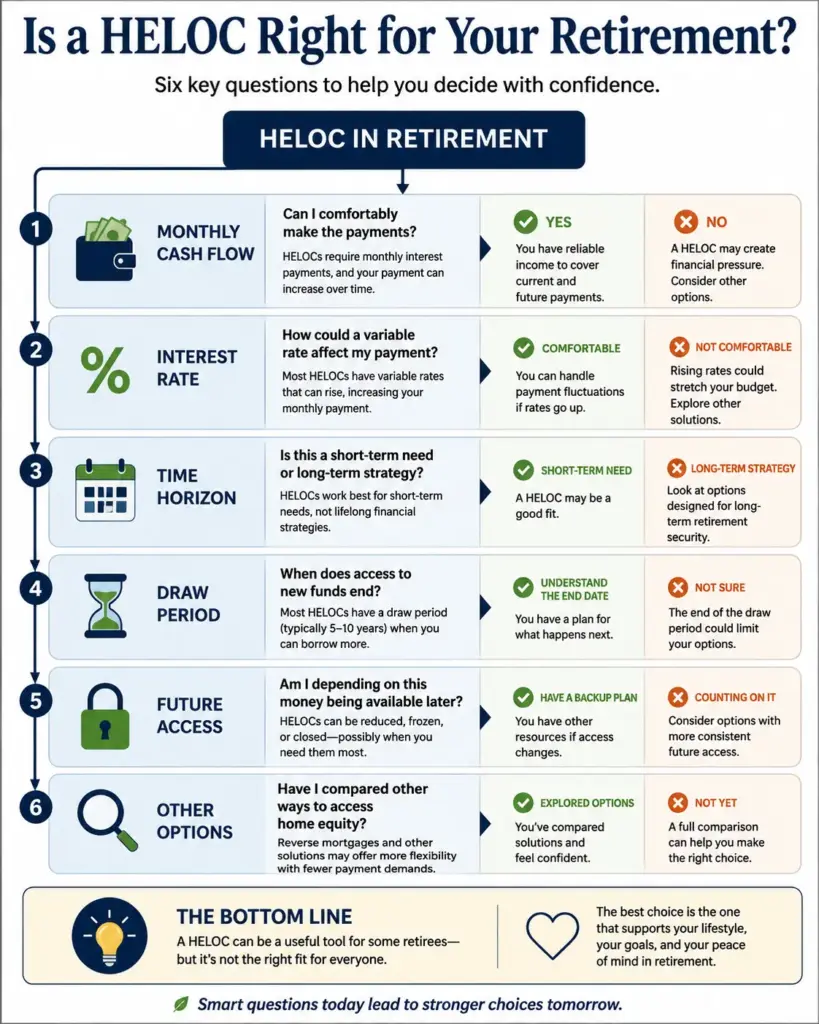
Can a Bank Freeze or Reduce Your HELOC?
This surprises many homeowners.
An approved HELOC should not necessarily be viewed the same way as cash sitting in a savings account.
Under certain circumstances, a lender may restrict future access to the line.
For example, federal consumer guidance explains that additional borrowing may be restricted following a significant decline in the home’s value. A lender may also restrict additional advances under certain circumstances involving changes in the borrower’s financial condition.
That’s particularly important when a retiree intends to use an unused HELOC as an emergency reserve many years into the future.
HELOC Alternatives for Retirees: Other Ways to Access Home Equity
Older homeowners today have more choices than simply:
Sell the house, refinance the mortgage, or get a traditional HELOC.
Depending on age, equity, income, goals, property type, and program eligibility, other possibilities may include:
- A retirement-focused HELOC
- A home equity loan
- A cash-out refinance
- A HECM reverse mortgage
- A proprietary reverse mortgage
- Certain second-position or hybrid retirement mortgage products
- Selling or downsizing
Each option has different costs, qualification requirements, payment structures, and long-term considerations.
Home equity can also play a larger role in retirement planning, particularly when it’s coordinated with income, investments, taxes, and long-term financial goals.
The objective shouldn’t be to find the product with the most attractive individual feature.
It should be to determine which structure best supports the homeowner’s retirement plan.
HELOC vs. Reverse Mortgage: One Important Difference
A traditional HELOC requires monthly payments according to the terms of the loan.
For eligible homeowners, a reverse mortgage generally does not require monthly principal and interest mortgage payments while the loan remains in good standing. Borrowers must continue meeting loan obligations, including paying applicable property taxes and homeowners insurance and maintaining the home.
That difference can matter significantly during retirement.
But it does not automatically make a reverse mortgage better.
Reverse mortgages have their own considerations, including borrowing costs, a loan balance that generally increases as funds are advanced and interest and applicable charges accrue, and the potential for less home equity to remain for heirs.
A HELOC, meanwhile, may offer lower upfront costs and can be an excellent choice for someone who comfortably qualifies, can manage the payments, and has a clear repayment strategy.
The right comparison depends on what the homeowner is trying to accomplish.
What About a HELOC Designed Specifically for Seniors?
Traditional HELOCs are no longer the only HELOC option available to older homeowners.
Newer retirement-focused HELOC programs have been developed around the financial circumstances of homeowners in or approaching retirement.
Depending on the program, features may differ from traditional HELOCs in areas such as qualification, payment structure, and how interest rates are established.
This distinction is important because a traditional HELOC and a retirement-focused HELOC should not automatically be treated as the same product.
Learn more about how these newer options work in my guide, “HELOC for Seniors: A New Home Equity Solution Designed for Retirement Cash Flow.”
When Might a HELOC for Retirees Be a Good Choice?
A HELOC may be worth considering when:
- The monthly payment comfortably fits the retirement budget.
- The homeowner wants to preserve an existing first mortgage.
- The need for funds is relatively short-term.
- There is a clear strategy for repaying the borrowed amount.
- The homeowner understands that rates and payments may change.
- The borrower is comfortable with the eventual end of the draw period.
- The HELOC’s costs and structure compare favorably with available alternatives.
For those homeowners, a HELOC may be perfectly reasonable.
When Should a Retiree Compare Other Home Equity Options?
It may be worth expanding the comparison when:
- Required monthly payments would put pressure on retirement cash flow.
- The homeowner expects to need access to equity for many years.
- The HELOC is intended primarily as a long-term emergency reserve.
- Qualification based on traditional income or debt ratios is difficult.
- The homeowner is concerned about future payment increases.
- The goal is to reduce required monthly mortgage obligations.
- Preserving retirement investments during market downturns is part of the strategy.
- The homeowner wants to age in place and is planning for long-term financial flexibility.
In those situations, comparing a traditional HELOC with retirement-focused home equity options may reveal alternatives the homeowner didn’t know existed.
Don’t Start With the Loan. Start With the Goal.
This may be the most important part of the decision.
Instead of beginning with:
“Should I get a HELOC?”
Start with:
“What am I trying to accomplish with my home equity?”
Are you trying to pay for a new roof?
Create an emergency reserve?
Make aging-in-place improvements?
Pay off higher-cost debt?
Avoid selling investments during a market downturn?
Improve retirement cash flow?
Prepare for future healthcare or caregiving expenses?
Or simply create greater financial flexibility?
Once the goal is clear, it becomes much easier to compare the available strategies.
Key Takeaways
- Retirees can qualify for traditional HELOCs, but qualification generally depends on factors including income, credit, debts, and home equity.
- A HELOC can be an effective tool for short-term or clearly defined borrowing needs.
- Traditional HELOCs commonly have variable rates and required monthly payments.
- Payments may increase significantly when the draw period ends.
- Future access to an unused HELOC isn’t guaranteed under every circumstance.
- Retirees have more home equity options today than traditional refinancing and HELOCs alone.
- A traditional HELOC, retirement-focused HELOC, reverse mortgage, or another strategy may each be appropriate depending on the homeowner’s circumstances.
- The best place to start is with the retirement goal—not the loan product.
Frequently Asked Questions About HELOCs for Retirees
Is a HELOC a good idea for retirees?
It can be. A HELOC may work well for a retiree who comfortably qualifies, can manage the required payments, and has a clear reason and repayment strategy for borrowing. For longer-term retirement needs, it can also be worthwhile to compare a HELOC with other home equity options.
Can I get a HELOC if Social Security is my primary income?
Social Security may be considered qualifying income, subject to lender and program requirements. Qualification will also depend on other factors such as credit, debts, and available home equity.
Do I need to pay off my mortgage to get a HELOC?
Not necessarily. A HELOC is commonly placed in second lien position behind an existing first mortgage, provided the borrower meets the lender’s equity and qualification requirements.
What happens to a HELOC when the draw period ends?
You generally stop being able to borrow additional funds and enter the repayment period. Depending on the HELOC terms, monthly payments can increase significantly as principal repayment begins.
Is a HELOC better than a reverse mortgage?
Neither is universally better. A HELOC may offer lower upfront costs and can be appropriate for borrowers comfortable making monthly payments. A reverse mortgage may offer advantages for eligible homeowners whose priority is long-term access to home equity without required monthly principal and interest mortgage payments. Costs, long-term plans, cash flow, and estate considerations should all be compared.
Can a lender freeze my unused HELOC?
Under certain circumstances, yes. Federal rules allow lenders to restrict additional advances in certain situations, including a significant decline in property value or qualifying changes in the borrower’s financial circumstances.
Final Thoughts: Choosing a HELOC in Retirement
For generations, homeowners have been conditioned to think about home equity in a fairly predictable way:
Need money? Refinance the mortgage or open a HELOC.
Those options haven’t disappeared, and sometimes they’re still exactly the right choice.
But retirement creates a different set of priorities.
Cash flow, longevity, market risk, future access to funds, aging in place, and the desire to remain financially flexible can all change how home equity should be evaluated.
A HELOC for retirees may ultimately be the right answer in some situations.
The important thing is knowing that it’s not the only answer.
If you’re considering accessing home equity during retirement, I can help you compare the available options—including traditional and retirement-focused HELOCs, reverse mortgages, and other retirement mortgage strategies—so you can understand the differences before deciding what fits your goals.
Have questions about this?
Talk to a Certified Reverse Mortgage Professional — directly.
When you call, you reach me — not a call center. Free 30-minute consult by phone, video, or in person. No SSN, no credit pull, no obligation.
Schedule a consult