

Jumbo Reverse Mortgages
Jumbo Reverse Mortgage Line of Credit: How Does It Work?

Jumbo Reverse Mortgage Line of Credit: How Does It Work?
A jumbo reverse mortgage line of credit may offer homeowners with higher-value properties a flexible way to access a portion of their home equity during retirement.
Rather than receiving all available funds at once, eligible homeowners may be able to establish a credit line and request advances when they need them.
For retirees who have built substantial equity in their homes, this flexibility can help with unexpected expenses, home improvements, healthcare costs, or other retirement priorities.
However, not every proprietary reverse mortgage offers a line of credit, and the terms can differ significantly between programs.
Understanding those differences is essential before choosing a loan.
Quick Answer: A jumbo reverse mortgage line of credit allows eligible homeowners to access available loan proceeds as needed instead of taking the entire amount upfront. Some proprietary programs offer credit-line growth or other features, but availability, growth rates, draw requirements, and the length of the borrowing period depend on the specific loan. Unlike FHA-insured HECM credit lines, proprietary credit lines do not follow one standardized federal program structure.
What Is a Jumbo Reverse Mortgage Line of Credit?
A jumbo reverse mortgage line of credit is a borrowing feature available through certain proprietary reverse mortgage programs.
A proprietary reverse mortgage is a privately offered loan that does not carry FHA insurance. These programs typically serve homeowners with higher-value properties and substantial home equity.
A line of credit allows borrowers to access approved funds over time, subject to the loan’s terms.
For example, a homeowner may establish a proprietary reverse mortgage with $400,000 in available borrowing capacity.
Instead of taking all $400,000 immediately, the homeowner might initially draw $75,000 and leave the remaining borrowing capacity available for future needs.
Whether the remaining funds stay available, increase over time, or become subject to additional restrictions depends on the particular program.
That is why borrowers should review the actual credit-line provisions rather than assume all jumbo reverse mortgages work alike.
How Does a Jumbo Reverse Mortgage Line of Credit Work?
Although individual products differ, the general process involves several steps.
1. The Lender Evaluates Your Home and Financial Circumstances
The lender considers factors such as:
- Property value and location
- Age of the borrower or borrowers
- Existing mortgage balances
- Available home equity
- Interest rates
- Credit and financial qualifications
- Property eligibility
- Program-specific guidelines
Some proprietary reverse mortgages may be available to eligible homeowners beginning at age 55, depending on the product and state.
However, that minimum age does not apply to every program.
2. The Program Determines Available Proceeds
The lender calculates the amount of equity the homeowner may access under its program guidelines.
The amount available can differ substantially from the home’s total equity.
A homeowner with a $3 million property and a $500,000 mortgage balance does not automatically qualify to borrow the remaining $2.5 million in equity.
The lender’s calculation determines the actual available proceeds.
3. Existing Mortgage Obligations May Need to Be Satisfied
Most first-lien proprietary reverse mortgages require existing mortgages and other liens that must be cleared to be paid at closing.
The new reverse mortgage proceeds may accomplish that payoff.
Some specialized retirement mortgage products operate differently, so borrowers should verify the requirements for the particular loan.
4. The Homeowner Establishes the Credit Line
If the selected proprietary program offers a line of credit, the borrower may receive access to the available amount according to the loan terms.
Some programs allow draws over an extended period.
Others impose time limits, minimum draw amounts, or other restrictions.
5. The Homeowner Requests Advances as Needed
The borrower may request funds for eligible purposes according to the program’s draw procedures.
Interest generally accrues on amounts advanced and other financed charges, rather than automatically on the entire unused credit limit.
The actual interest calculation and fees depend on the loan agreement.
Does a Jumbo Reverse Mortgage Line of Credit Grow?
Some proprietary reverse mortgage credit lines offer growth features, but not all do.
This distinction deserves careful attention.
An FHA-insured HECM line of credit has a defined growth mechanism that can increase unused borrowing capacity over time.
Dan Hultquist explains the HECM line-of-credit growth concept in his Understanding Reverse — Chapter 30. The central principle is that the growth represents additional borrowing capacity, not money earned in an investment account. REVERSEplus
Proprietary programs may use different arrangements.
A proprietary credit line might:
- Grow for a specified number of years.
- Grow at a program-defined rate.
- Offer no growth feature.
- Have a fixed borrowing period.
- Include restrictions on future advances.
HUD’s housing counseling guidance specifically recognizes that proprietary reverse mortgage credit lines may have lower growth rates than HECMs or no growth at all. hud.gov
The HECM growth formula should never be applied automatically to a proprietary reverse mortgage.
Why Credit-Line Growth Matters
Suppose a homeowner establishes a proprietary reverse mortgage line of credit with $300,000 in unused borrowing capacity.
If the program offers a growth feature, that capacity may increase according to the applicable terms.
If the program does not offer growth, the available borrowing capacity may remain unchanged unless the borrower draws funds, fees affect availability, or another contractual adjustment applies.
These differences can materially affect long-term retirement planning.
Jumbo Reverse Mortgage Line of Credit vs. HECM Line of Credit
Both options may provide access to home equity without required monthly principal and interest mortgage payments.
However, their structures differ.
| Feature | HECM line of credit | Jumbo/proprietary line of credit |
|---|---|---|
| FHA insurance | Yes | No |
| Minimum borrower age | Generally 62 | May start at 55 with some programs |
| Home value considered | Subject to HECM maximum claim amount | May recognize higher property values |
| Credit-line growth | Defined HECM growth mechanism | Varies; may have limited or no growth |
| Borrowing period | Generally continues while loan remains in good standing and funds are available | Program-specific |
| Draw requirements | HECM rules and loan terms | Program-specific |
| Mortgage insurance | FHA mortgage insurance applies | No FHA mortgage insurance |
| Future advances | Governed by HECM rules | Governed by proprietary contract |
| Counseling | HUD-approved counseling required | Depends on program and applicable law |
For 2026, HUD established a nationwide HECM maximum claim amount of $1,249,125. That amount limits the property value considered in the HECM calculation, not the value of homes that may qualify. hud.gov
Proprietary programs may consider additional value for higher-priced homes, although they do not automatically provide larger proceeds.
For a broader comparison, read our article Jumbo Reverse Mortgage vs. HECM: What’s the Difference?
Can You Access More Home Equity With a Jumbo Reverse Mortgage Line of Credit?
Potentially.
Homeowners with higher-value properties sometimes discover that a proprietary reverse mortgage can provide access to more equity than a HECM.
However, this depends on the actual loan calculations.
Consider a hypothetical homeowner with:
Illustrative homeowner scenario
Home value
$3,000,000
Existing mortgage
$500,000
Home equity
$2,500,000
Age
70
Hypothetical figures for educational purposes, not a loan quote or proceeds estimate.
A HECM would calculate its principal limit using the applicable maximum claim amount rather than the full $3 million home value.
A proprietary reverse mortgage may recognize more of the home’s value.
However, the proprietary program’s age factors, rates, fees, and other requirements determine the actual proceeds.
The homeowner should compare both programs using current, individualized loan illustrations.
How Long Does a Jumbo Reverse Mortgage Line of Credit Stay Open?
This is one of the most important questions borrowers should ask.
There is no single borrowing-period rule that applies to every proprietary reverse mortgage line of credit.
Some programs may provide access while the loan remains in good standing, subject to available funds and contractual conditions.
Others may establish a defined draw period.
A product may also offer a growth feature for a shorter period than the period during which funds remain available.
For example, a proprietary loan might allow credit-line growth for a specified number of years while permitting draws afterward, subject to its terms.
That does not mean all proprietary credit lines work this way.
Before choosing a program, request written answers to these questions:
- How long can I request advances?
- Does unused borrowing capacity grow?
- If it grows, when does that growth stop?
- Are there minimum or maximum draw amounts?
- Can the lender restrict future advances?
- What happens if I use the entire available credit line?
These details matter more than simply seeing the words line of credit in a product description.
Can a Jumbo Reverse Mortgage Line of Credit Be Frozen?
Possibly, depending on the proprietary loan agreement and applicable law.
A traditional HELOC and a proprietary reverse mortgage are different financial products.
Traditional HELOCs operate under specific federal rules governing credit-limit reductions and suspensions.
Proprietary reverse mortgage credit lines operate according to their own contracts and applicable legal requirements.
Borrowers should ask whether future advances can be suspended, reduced, or terminated and under what circumstances.
This is especially important for homeowners who intend to use the credit line as an emergency reserve.
For additional context, see our article Can a Bank Freeze or Reduce Your HELOC? What Retirees Need to Know.
Do You Have to Make Monthly Payments on a Jumbo Reverse Mortgage Line of Credit?
Many proprietary reverse mortgage programs do not require monthly principal and interest mortgage payments while the borrower meets the loan requirements.
However, the loan still accrues interest and applicable fees.
Borrowers generally must continue to:
- Pay property taxes.
- Maintain required homeowners insurance.
- Maintain the property.
- Meet principal-residence requirements.
- Pay applicable property charges.
- Comply with the loan agreement.
Borrowers may be permitted to make voluntary principal or interest payments, depending on the product.
Those payments can reduce the outstanding loan balance, but whether they restore borrowing capacity depends on the specific program.
No required monthly principal and interest payments does not mean the loan has no costs or repayment obligations.
When Does a Jumbo Reverse Mortgage Line of Credit Have to Be Repaid?
A proprietary reverse mortgage generally becomes due following events identified in the loan agreement.
These commonly include:
- Sale of the home.
- The last borrower permanently leaving the property.
- Death of the last borrower, subject to any applicable spouse protections.
- Certain defaults or other events specified in the contract.
The outstanding balance includes amounts borrowed, accrued interest, and applicable financed charges.
Many proprietary reverse mortgages include non-recourse protections, but borrowers should verify those protections in the specific loan documents.
The homeowner’s estate and heirs should also understand their available repayment options.
What Can You Use a Jumbo Reverse Mortgage Line of Credit For?
Depending on the loan terms, available funds may support a variety of retirement objectives.
Home Improvements and Aging in Place
Homeowners may want to renovate bathrooms, improve accessibility, replace aging systems, or make other modifications that help them remain comfortably at home.
Unexpected Expenses
A line of credit may provide access to funds for major repairs or other unplanned expenses.
Retirement Cash-Flow Flexibility
Some retirees prefer to maintain a source of available funds rather than withdraw additional money from investment accounts during unfavorable market conditions.
Healthcare and Long-Term Planning
Homeowners may want additional financial flexibility for future healthcare expenses or support services.
Lifestyle and Family Priorities
Other homeowners may use available proceeds for travel, family assistance, or other personal objectives.
The key consideration is whether the benefits justify the borrowing costs and potential reduction in future home equity.
Can a Jumbo Reverse Mortgage Line of Credit Help Protect Retirement Investments?
It may provide another source of liquidity, but it should not be described as a guaranteed way to protect investments.
For example, a retiree may prefer not to sell investments during a temporary market decline.
Access to a home equity credit line could provide another way to fund expenses.
This approach is sometimes discussed as a retirement buffer asset strategy.
However, borrowing against home equity introduces interest costs and can reduce the equity available later.
A homeowner should evaluate those costs alongside the potential benefits of leaving investments untouched.
For a broader discussion, read How Home Equity Fits Into a Retirement Income Plan.
Is a Jumbo Reverse Mortgage Line of Credit Better Than Taking a Lump Sum?
Not necessarily.
A line of credit may offer flexibility for homeowners who do not need all available proceeds immediately.
Taking a lump sum may make more sense when the homeowner has a specific, substantial expense or an existing mortgage payoff.
The better choice depends on the program and the homeowner’s objectives.
A credit line may help avoid accruing interest on funds that remain undrawn, but borrowers should verify how their loan calculates interest, fees, and future availability.
Some proprietary programs may offer only lump-sum disbursements or other limited payment structures.
Borrowers should compare the actual options available to them rather than assume every proprietary program offers the same choices.
What Are the Costs and Risks of a Jumbo Reverse Mortgage Line of Credit?
Before opening a proprietary credit line, homeowners should understand the full financial commitment.
Interest and Loan Balance Growth
Interest accrues according to the loan terms.
Without voluntary payments, the outstanding balance generally increases over time as interest and applicable fees accumulate.
Closing Costs
Proprietary loans may include origination charges, appraisal fees, title charges, recording fees, and other expenses.
Although proprietary loans do not have FHA HECM mortgage insurance premiums, that does not automatically make them less expensive.
Reduced Future Home Equity
Borrowing against home equity may reduce the equity available when the home is sold or transferred.
Program-Specific Restrictions
Credit-line growth, draw periods, servicing requirements, and future advance provisions can differ.
Property Obligations
Failure to meet required property charges or other loan obligations can create serious consequences, including default and possible foreclosure.
Estate Planning Considerations
The loan balance and repayment terms may affect the homeowner’s heirs and estate.
Homeowners should consider these implications before deciding how much equity to borrow.
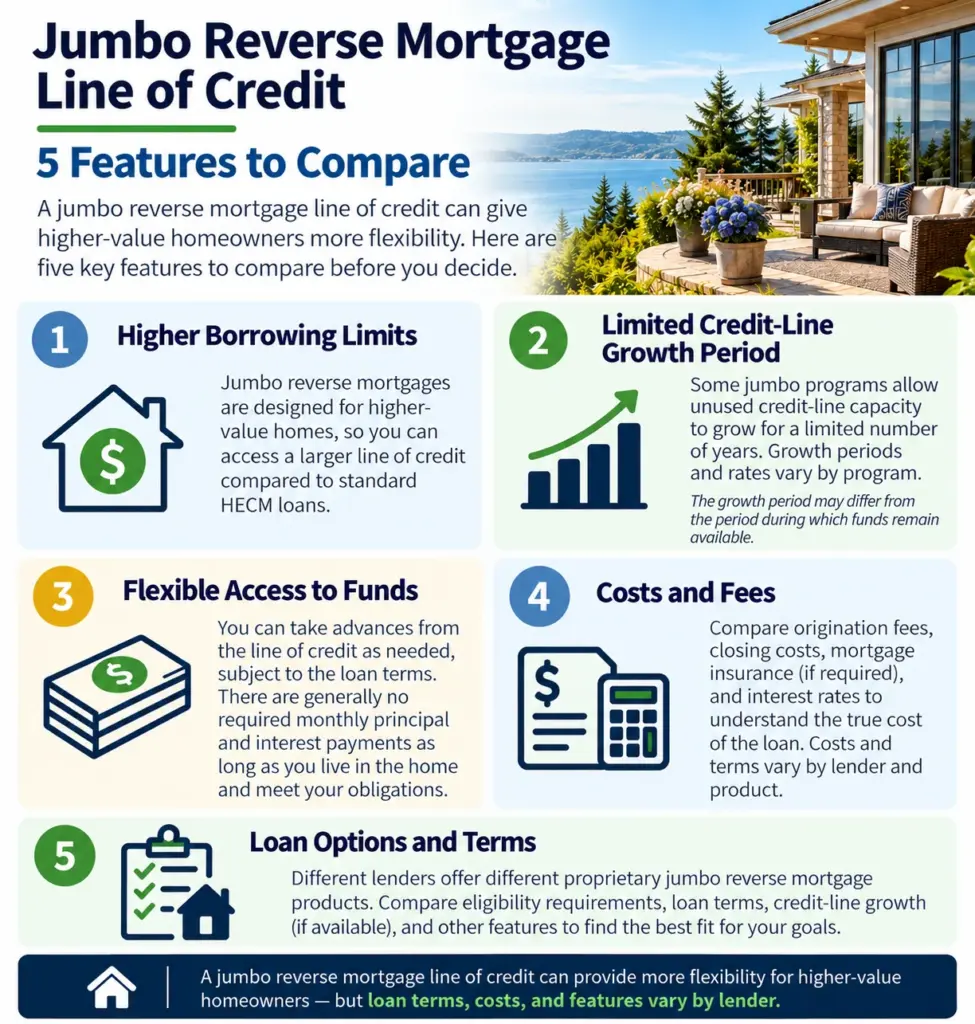
How to Compare Jumbo Reverse Mortgage Line of Credit Programs
Before selecting a proprietary credit line, compare the following features.
| Question | Why it matters |
|---|---|
| How much equity can I access? | Determines the available proceeds |
| Is a credit line available? | Not every proprietary program offers one |
| Does the unused line grow? | Affects future borrowing capacity |
| How long does growth continue? | Some features may be time-limited |
| How long can I draw funds? | Determines future access |
| Can future advances be restricted? | Important for emergency planning |
| What interest rate applies? | Affects borrowing costs |
| What are the closing costs? | Affects net proceeds and total expense |
| Are voluntary payments permitted? | May provide repayment flexibility |
| Is the loan non-recourse? | Important for borrower and heir protections |
| What happens when the borrower dies? | Important for estate planning |
A side-by-side comparison should identify the exact terms of each available product.
Key Takeaways
A jumbo reverse mortgage line of credit may provide flexible access to home equity for eligible homeowners with higher-value properties.
However, proprietary programs do not all offer the same features.
Some provide credit-line growth. Others may not.
Some allow access over an extended period, while others impose borrowing limits or time restrictions.
A proprietary reverse mortgage line of credit also differs from an FHA-insured HECM line of credit in its insurance, program rules, and potentially its consumer protections.
The most important step is to compare actual loan terms, available proceeds, borrowing periods, costs, and long-term implications.
Frequently Asked Questions
What Is a Jumbo Reverse Mortgage Line of Credit?
It is a borrowing feature available through certain proprietary reverse mortgage programs that allows eligible homeowners to access approved loan proceeds over time rather than taking the entire amount immediately.
Does a Jumbo Reverse Mortgage Line of Credit Grow?
Some proprietary programs offer growth features, while others do not. Growth rates, periods, and calculations depend on the specific program.
Can I Get a Jumbo Reverse Mortgage Line of Credit at Age 55?
Some proprietary reverse mortgage programs may accept eligible homeowners beginning at age 55 in certain states. However, not all programs offer credit lines, and age requirements vary.
Is a Jumbo Reverse Mortgage Line of Credit FHA-Insured?
No. Proprietary reverse mortgages are not FHA-insured. FHA insurance applies to eligible HECM loans.
Does a Jumbo Reverse Mortgage Line of Credit Have Monthly Payments?
Many proprietary reverse mortgages do not require monthly principal and interest payments while borrowers meet the loan obligations. Interest and applicable fees continue to accrue.
Can a Proprietary Reverse Mortgage Line of Credit Be Frozen?
Future advance restrictions depend on the specific loan agreement and applicable law. Borrowers should review the contract before relying on the credit line for long-term liquidity.
Is a Jumbo Reverse Mortgage Line of Credit Better Than a HECM?
Neither is automatically better. A proprietary program may recognize more of a higher-value home’s equity, while a HECM provides FHA insurance and standardized program features. Individual loan comparisons determine which option may be more appropriate.
Can I Use a Jumbo Reverse Mortgage Line of Credit for Home Improvements?
Generally, borrowers may use available proceeds for home improvements and other permitted purposes, subject to the specific loan agreement.
What Happens to the Credit Line When the Homeowner Dies?
The loan generally becomes due according to the contract, subject to applicable spouse protections and other requirements. The estate or heirs must address repayment, often through sale or refinancing of the property.
Final Thoughts: Flexibility Matters, but Loan Terms Matter More
A jumbo reverse mortgage line of credit can provide another way for eligible homeowners to use their home equity strategically during retirement.
For some, the greatest benefit may be the ability to access funds when needed rather than borrowing the entire available amount immediately.
For others, the value may come from preserving investment flexibility, paying off an existing mortgage, or preparing for future expenses.
However, the details of the credit line are essential.
Growth features, borrowing periods, interest rates, costs, and protections can vary significantly between proprietary reverse mortgage programs.
If you own a higher-value home and want to understand whether a jumbo reverse mortgage line of credit could fit your retirement plans, I can help you compare available proprietary programs alongside FHA-insured HECM options.
The goal is to understand your choices and select a strategy that supports your financial flexibility, your home, and your long-term retirement objectives.
Have questions about this?
Talk to a Certified Reverse Mortgage Professional — directly.
When you call, you reach me — not a call center. Free 30-minute consult by phone, video, or in person. No SSN, no credit pull, no obligation.
Schedule a consult