

Home Equity & HELOC
Jumbo Reverse Mortgage vs. HECM: What’s the Difference?

When comparing a jumbo reverse mortgage vs HECM, homeowners may discover significant differences in how much home value the program considers, minimum age requirements, FHA insurance, available proceeds, costs, property guidelines, and loan features.
The Home Equity Conversion Mortgage (HECM) remains the most common type of reverse mortgage. The Federal Housing Administration (FHA) insures HECMs. Private lenders also offer proprietary reverse mortgages, commonly called jumbo reverse mortgages, which do not carry FHA insurance and typically serve homeowners with higher-value properties. Consumer Financial Protection Bureau
For homeowners with substantial equity—particularly those with higher-value properties—understanding these differences can help identify which options deserve further consideration.
Both types of reverse mortgages may allow eligible homeowners to convert a portion of their home equity into available funds without required monthly principal and interest mortgage payments. However, the programs do not operate under identical rules.
Quick Answer: A HECM is an FHA-insured reverse mortgage available to eligible homeowners age 62 and older. A jumbo or proprietary reverse mortgage comes from a private lender and does not carry FHA insurance. Proprietary programs may provide additional options for higher-value homes and, depending on the particular program and state, may offer eligibility below age 62. Features, eligibility requirements, and protections vary by proprietary program.
Jumbo Reverse Mortgage vs. HECM: Understanding the Two Options
Before comparing the programs side by side, it helps to understand how each one works.
What Is a HECM Reverse Mortgage?
A Home Equity Conversion Mortgage, commonly called a HECM, is a reverse mortgage insured by the FHA, which is part of the U.S. Department of Housing and Urban Development.
The CFPB identifies HECMs as the most common type of reverse mortgage and distinguishes them from proprietary reverse mortgages because FHA federally insures the HECM program. Consumer Financial Protection Bureau
HECM borrowers must generally be at least 62 years old and satisfy applicable property, principal-residence, counseling, financial-assessment, and other FHA requirements. Consumer Financial Protection Bureau
Borrowers must also complete reverse mortgage counseling through a HUD-approved housing counseling agency before obtaining a HECM. Consumer Financial Protection Bureau
What Is a Jumbo Reverse Mortgage?
A jumbo reverse mortgage generally refers to a proprietary reverse mortgage offered by a private lender or investor rather than through the FHA HECM program.
The CFPB describes proprietary reverse mortgages as loans that are not federally insured and typically serve borrowers with higher home values. Consumer Financial Protection Bureau
People often use the word jumbo because these programs may serve homeowners whose property values extend beyond the amount the HECM program considers when calculating available proceeds.
Private lenders or investors establish proprietary program guidelines, so features can vary considerably among products.
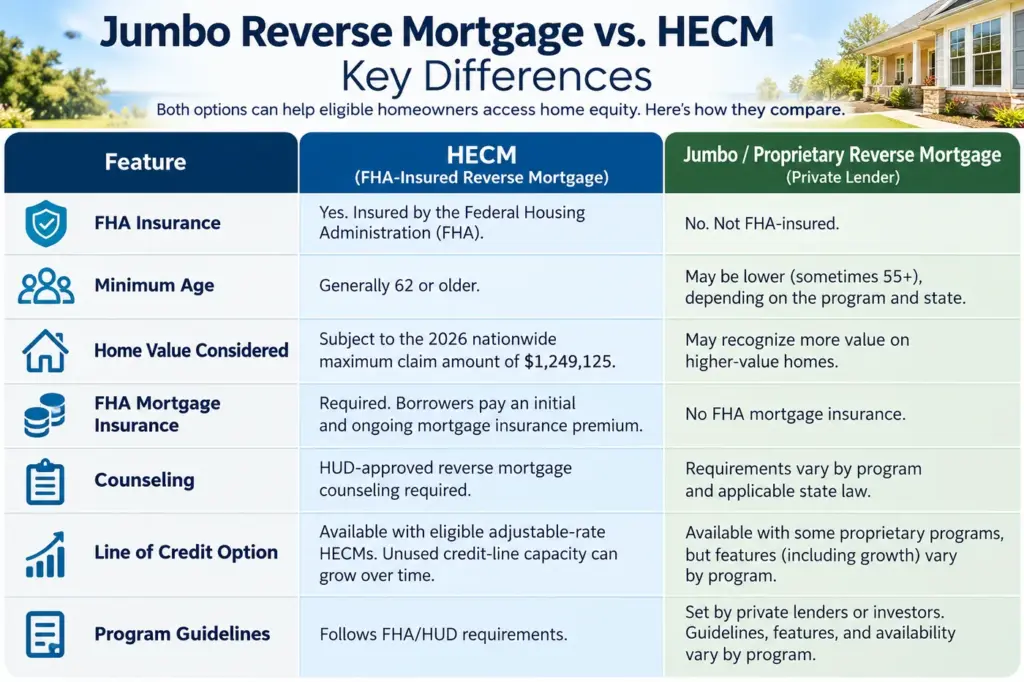
Jumbo Reverse Mortgage vs. HECM: Key Differences
| Feature | HECM | Jumbo/Proprietary Reverse Mortgage |
|---|---|---|
| Insurance | FHA-insured | Not FHA-insured |
| Minimum age | Generally 62 | May be as low as age 55, depending on the program and state |
| Home value considered | Subject to HECM maximum claim amount | May recognize more value on higher-value homes |
| Program rules | FHA/HUD requirements | Private program guidelines |
| FHA mortgage insurance | Required | No FHA HECM mortgage insurance |
| Counseling | HUD-approved counseling required | Requirements vary by program and applicable law |
| Line of credit | Available with eligible adjustable-rate HECMs | Available with some proprietary programs |
| Property eligibility | FHA/HECM requirements | Varies by program |
| Available proceeds | HECM formula determines proceeds | Proprietary program determines proceeds |
| Protections | Federal HECM protections | Review protections and terms for the specific program |
These differences become especially important when a homeowner has a high-value property, wants to evaluate access to additional equity, or falls below the HECM minimum borrower age.
How Much Home Value Can a HECM Consider in 2026?
For 2026, HUD set the nationwide HECM maximum claim amount at $1,249,125 for FHA case numbers assigned from January 1 through December 31, 2026. That amount applies nationwide, including Alaska, Hawaii, Guam, and the U.S. Virgin Islands. HUD
This does not mean your home cannot be worth more than $1,249,125.
A homeowner with a $2 million or $3 million property may still qualify for a HECM. However, the HECM calculation does not recognize property value above the applicable maximum claim amount when determining the principal limit.
That distinction makes the jumbo reverse mortgage vs HECM comparison particularly relevant for some higher-value homeowners.
A Simple Higher-Value Home Example
Suppose a homeowner owns a property worth $2 million.
For a HECM, the program would use no more than the 2026 maximum claim amount of $1,249,125 as the applicable value when determining the principal limit, even though the property itself is worth $2 million. HUD
A proprietary program may recognize additional property value above that amount when calculating available proceeds.
However, that does not automatically mean the jumbo reverse mortgage will provide more money.
Age, interest rates, program guidelines, existing liens, property type, and other factors can affect available proceeds. The best comparison uses the homeowner’s actual circumstances and current program terms.
Can a Jumbo Reverse Mortgage Provide More Proceeds Than a HECM?
Potentially.
For homeowners with substantial equity in higher-value properties, a proprietary reverse mortgage may provide access to additional equity because some programs recognize property values above the HECM maximum claim amount.
But jumbo does not automatically mean more proceeds.
A HECM may provide stronger proceeds in some situations, while a proprietary program may provide more in others.
Rather than choosing based on the word jumbo, compare:
- Available proceeds
- Interest rate
- Closing costs
- Existing liens that must be satisfied
- Line-of-credit features
- Future access to funds
- Loan protections
- Long-term objectives
The actual numbers matter more than the product name.
Jumbo Reverse Mortgage vs. HECM Age Requirements
Age represents another important difference.
A HECM is available to homeowners who are 62 or older, subject to the program’s other requirements. Consumer Financial Protection Bureau
Some proprietary reverse mortgage programs may accept younger borrowers—sometimes beginning at age 55—depending on the particular program and state.
That does not mean every homeowner age 55 or older qualifies for a proprietary reverse mortgage.
Minimum ages, state availability, equity requirements, property guidelines, and other eligibility rules vary by program.
For homeowners between ages 55 and 61, however, proprietary programs may provide possibilities that the HECM program does not currently offer.
Does a HECM Have FHA Mortgage Insurance?
Yes.
FHA mortgage insurance forms an important part of the HECM structure. HECM borrowers pay an initial mortgage insurance premium and an ongoing mortgage insurance premium that accrues with the loan balance.
AARP notes that HECM mortgage insurance protects against certain risks, including circumstances in which the loan balance exceeds the home’s value and situations in which a lender cannot make a required payment to the borrower. AARP Policy Book
A proprietary reverse mortgage does not carry FHA HECM mortgage insurance.
That means it does not include the HECM’s FHA mortgage insurance premium. However, homeowners should not assume that automatically makes a proprietary reverse mortgage less expensive.
Interest rates, lender charges, origination fees, closing costs, available proceeds, and long-term borrowing costs can differ.
Compare the complete loan, not one individual fee.
How Do Non-Recourse Protections Compare?
The FHA-insured HECM program includes established non-recourse protections.
The CFPB explains that when a HECM becomes due, the borrower or estate will not owe more than the value of the home when repayment occurs through the property, subject to the applicable HECM requirements. Consumer Financial Protection Bureau
Many proprietary reverse mortgages also include non-recourse provisions.
However, proprietary loans do not receive their protections through the FHA HECM insurance structure. Borrowers should review the specific program and loan documents rather than assume a proprietary loan provides protections identical to a HECM.
This distinction deserves particular attention when comparing a jumbo reverse mortgage vs HECM for a higher-value property.
Jumbo Reverse Mortgage vs. HECM Line of Credit
A line of credit can become one of the most important features to compare.
Eligible adjustable-rate HECMs may provide a line-of-credit option. Under the HECM structure, unused borrowing capacity can grow over time according to the loan terms. The CFPB confirms that unused HECM credit-line capacity can increase, allowing additional borrowing up to the maximum amount permitted under the mortgage. Consumer Financial Protection Bureau
That growth is not investment earnings or home appreciation. It represents increased borrowing capacity.
Some proprietary reverse mortgages also offer lines of credit, but their features can differ substantially.
Depending on the program, differences may include:
- How long the credit line remains available
- Whether unused borrowing capacity grows
- How long a growth feature lasts
- Minimum draw requirements
- Interest-rate structure
- Future advance requirements
- Available proceeds
Never assume that a proprietary line of credit works exactly like a HECM line of credit.
Do Both Reverse Mortgages Require Counseling?
HECM borrowers must complete counseling with a HUD-approved reverse mortgage counseling agency before obtaining the loan. Consumer Financial Protection Bureau
Proprietary reverse mortgage counseling requirements can vary according to the program and applicable state requirements.
The CFPB notes that many companies offering proprietary reverse mortgages emulate HECM consumer protections, including counseling, but proprietary loans do not all operate under the FHA HECM framework. Consumer Financial Protection Bureau
Homeowners should therefore confirm the counseling requirements for the specific proprietary program they are considering.
Jumbo Reverse Mortgage vs. HECM Property Requirements
Both HECM and proprietary reverse mortgages have property requirements, but they don’t necessarily use identical guidelines.
HECM properties must satisfy applicable FHA requirements.
Proprietary lenders establish their own property guidelines subject to applicable law. Depending on the program, this can create different possibilities for certain:
- Higher-value homes
- Condominiums
- Planned unit developments
- Properties with acreage
- Unique properties
However, a property that doesn’t qualify for a HECM does not automatically qualify for a proprietary reverse mortgage.
The property still must satisfy that particular proprietary program’s requirements.
Can You Use Either Reverse Mortgage to Purchase a Home?
HECM offers a HECM for Purchase option for eligible homeowners age 62 and older. HUD confirms that the nationwide 2026 maximum claim amount applies to traditional HECMs, HECMs for Purchase, and HECM-to-HECM refinances. HUD
Some proprietary reverse mortgage programs may also allow eligible borrowers to purchase a new home using a reverse mortgage structure.
Proprietary purchase programs may have different age, property, required-funds, and program requirements.
This can become particularly relevant when someone wants to right-size or move into a higher-value home during retirement.
What Responsibilities Do Reverse Mortgage Borrowers Have?
A reverse mortgage does not eliminate the homeowner’s responsibilities.
HECM borrowers must continue to:
- Pay property taxes and applicable property charges
- Maintain required homeowners insurance
- Keep the home in good repair
- Use the property as their principal residence
Failure to meet these obligations can place a HECM in default. Consumer Financial Protection Bureau
Proprietary reverse mortgages also impose borrower obligations according to their loan documents and applicable law.
Remember:
No required monthly principal and interest mortgage payment does not mean no ongoing homeowner expenses.
Which Reverse Mortgage Should a Higher-Value Homeowner Consider?
The comparison should begin with the homeowner’s goals rather than the product name.
A HECM May Deserve Consideration When:
- The homeowner is at least 62.
- The HECM provides sufficient proceeds.
- FHA insurance and standardized HECM protections are important.
- HECM payment options or the HECM line of credit fit the retirement strategy.
- The property satisfies HECM requirements.
A Jumbo Reverse Mortgage May Deserve Consideration When:
- The homeowner owns a higher-value property.
- A proprietary program may provide access to additional equity.
- The homeowner is younger than 62 and an eligible proprietary program is available.
- A particular proprietary property guideline creates another option.
- The proprietary program’s proceeds or features better match the homeowner’s objectives.
Neither list means one program is inherently better.
The more useful question is:
What does each available program actually provide for this homeowner?
Why Comparing Both Can Matter for Higher-Value Homes
Someone with a $2 million home shouldn’t automatically assume a proprietary reverse mortgage makes more sense simply because the property is valuable.
Likewise, that homeowner shouldn’t automatically choose a HECM without examining whether a proprietary program could recognize more of the home’s value.
A side-by-side comparison can examine:
- Available proceeds
- Interest rates
- Closing costs
- Line-of-credit features
- FHA mortgage insurance
- Property eligibility
- Age requirements
- Loan protections
- Future borrowing flexibility
- Purchase options
- Long-term loan balance implications
The CFPB likewise recommends comparing reverse mortgage options, fees, interest rates, and loan features before choosing a loan. Consumer Financial Protection Bureau
For additional retirement context, my guide to how home equity fits into a retirement income plan explains why the way homeowners access equity can matter to the broader retirement strategy.
Key Takeaways: Jumbo Reverse Mortgage vs. HECM
The central difference in the jumbo reverse mortgage vs HECM comparison is that FHA insures the HECM, while private lenders or investors offer proprietary reverse mortgages without FHA insurance. Consumer Financial Protection Bureau
For 2026, the nationwide HECM maximum claim amount is $1,249,125. Proprietary programs may recognize more of a higher-value property’s value when determining available proceeds. HUD
HECM borrowers must generally be at least 62, while some proprietary programs may offer options to younger homeowners depending on the program and state.
HECM features and protections follow FHA/HUD requirements. Proprietary features, eligibility rules, costs, and protections can vary by program.
Most importantly, a higher home value alone doesn’t determine which reverse mortgage structure makes more sense.
Actual numbers and loan terms do.
Frequently Asked Questions
Is a Jumbo Reverse Mortgage the Same as a HECM?
No. A HECM is an FHA-insured reverse mortgage. A jumbo reverse mortgage generally refers to a proprietary reverse mortgage offered through a private lender or investor without FHA insurance. Consumer Financial Protection Bureau
What Is the HECM Limit for 2026?
HUD set the 2026 nationwide HECM maximum claim amount at $1,249,125 for FHA case numbers assigned during calendar year 2026. HUD
Can My Home Be Worth More Than the HECM Maximum Claim Amount?
Yes. The HECM maximum claim amount does not cap your home’s value. Instead, it limits the property value used when determining the HECM principal limit.
Does a Jumbo Reverse Mortgage Provide More Money Than a HECM?
It may for some homeowners, particularly those with higher-value properties, but not always. Age, home value, interest rates, existing liens, program guidelines, and other factors influence available proceeds.
Can I Get a Jumbo Reverse Mortgage at Age 55?
Some proprietary programs may permit borrowers beginning at age 55 in eligible states, but this is not a universal rule. Minimum ages and availability vary by program and state.
Does a Jumbo Reverse Mortgage Have FHA Mortgage Insurance?
No. FHA does not insure proprietary jumbo reverse mortgages. Costs and protections depend on the particular program.
Are Jumbo Reverse Mortgages Non-Recourse?
Many proprietary programs include non-recourse provisions, but borrowers should verify the specific program and loan documents. Proprietary loans do not receive their protections through the FHA HECM insurance structure.
Can a Jumbo Reverse Mortgage Have a Line of Credit?
Some proprietary programs offer a line of credit. Availability, growth features, draw requirements, and other terms vary by product. Borrowers should not assume it works exactly like a HECM line of credit.
Is Counseling Required for a Jumbo Reverse Mortgage?
HECM borrowers must receive counseling through a HUD-approved reverse mortgage counseling agency. Proprietary counseling requirements vary by program and applicable state requirements. Consumer Financial Protection Bureau
Can I Use a Jumbo Reverse Mortgage to Buy a Home?
Some proprietary programs may permit reverse mortgages for purchase. Eligibility, property requirements, minimum age, required funds, and other terms depend on the particular program.
Final Thought
For homeowners with significant equity—especially those with higher-value homes—the reverse mortgage decision doesn’t have to begin and end with the HECM.
A HECM offers the structure and protections of an FHA-insured federal program. A proprietary jumbo reverse mortgage may provide different possibilities based on home value, age, property eligibility, available proceeds, or loan features.
The important step is to compare them accurately.
Look at the actual proceeds, costs, protections, line-of-credit features, property requirements, and long-term implications—not simply the words “HECM” or “jumbo.”
If you’re considering a reverse mortgage, I can help you compare HECM and proprietary options based on your home, age, equity, and retirement goals so you can understand the differences before deciding how—or whether—to move forward.
Have questions about this?
Talk to a Certified Reverse Mortgage Professional — directly.
When you call, you reach me — not a call center. Free 30-minute consult by phone, video, or in person. No SSN, no credit pull, no obligation.
Schedule a consult