

reverse morgages
How a Reverse Mortgage Works: What Changes Now, What Continues, and What Happens Later

Build an event-to-question record around the reverse-mortgage timeline
Use a four-part event record to turn the reverse-mortgage timeline into specific questions and the information needed to answer them. For each stage, write the question, note the document or guidance that answers it, and leave a follow-up field for what remains open.
- Now: What purpose would access to home equity address?
- While you live in the home: Which property responsibilities continue?
- Balance: How could interest and applicable charges change the balance?
- Later: What questions about repayment and the home need answers?
Keep the applicable program beside each question so an answer for one program is not applied to another. The record organizes questions for independent HUD-approved counseling and an eligible lender’s review; it does not determine eligibility or predict a result.
Use the worksheet as four labeled boxes:
- Now: What purpose would access to home equity address?
- While you live in the home: Which property responsibilities continue, and how could the balance change?
- Product and comparison: Is the option an FHA-insured HECM, and what differs if a traditional HELOC is considered?
- Later: What questions about repayment, the home, and heirs need to be answered?
Bring the questions to independent HUD-approved counseling and an eligible lender’s review. The worksheet organizes the discussion; it does not determine eligibility or predict a result. Its purpose is to keep the product, ongoing responsibilities, balance, comparison, and later questions in one view.
Name the FHA-insured HECM before describing how it works
A Home Equity Conversion Mortgage (HECM)—commonly known as a reverse mortgage—is an FHA-insured loan. This worksheet focuses on the HECM because “reverse mortgage” can also refer to non-HECM products with different requirements and features.
A conventional mortgage generally involves scheduled monthly payments toward principal and interest. With an FHA-insured HECM, the borrower generally has no required monthly principal-and-interest payment; interest and applicable fees are added to the loan balance over time, and the proceeds remain a loan rather than a transfer of ownership. Do not transfer HECM rules to a proprietary, jumbo, hybrid, or other program.
An HECM is still a mortgage, and repayment is deferred until a future event rather than made through required monthly principal and interest payments. The proceeds are a loan against home equity, not a transfer of ownership. That distinction helps you ask more precise questions about the product you are actually considering.
A reverse mortgage changes the timing of repayment, but it does not remove the lien or the responsibility to meet the program’s property requirements. A HELOC is also secured by the home, yet it is a separate product with its own payment and draw-period rules.
Reading the product name carefully prevents several categories from being blended together. FHA insurance identifies the HECM program; it does not make a jumbo or proprietary program an HECM. The payment format, eligibility review, costs, and later repayment terms must be discussed for the exact product named in the documents.
Overview
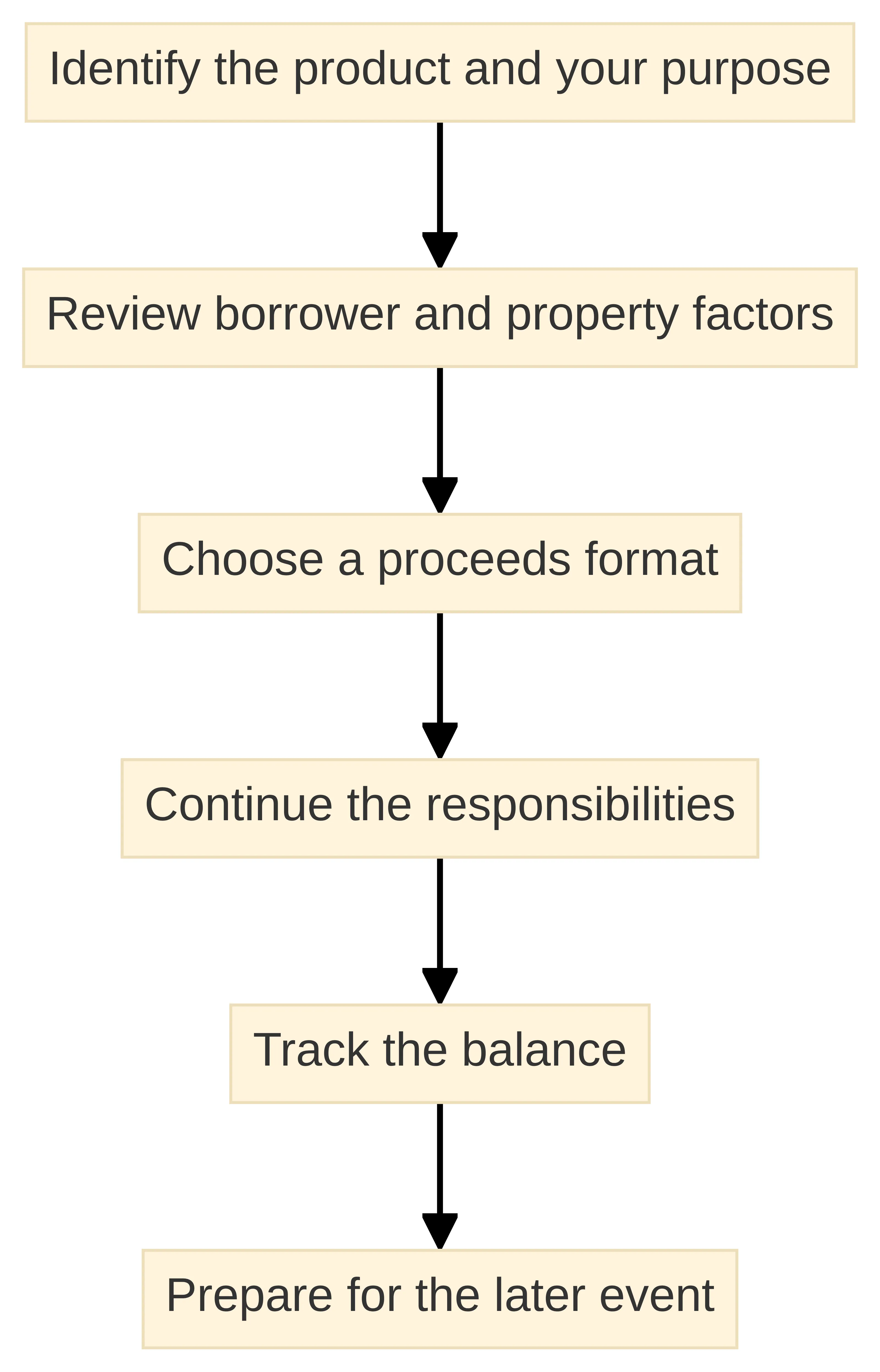
The worksheet uses six checkpoints rather than a single product summary:
- Name the product and purpose. Record whether the discussion concerns an FHA-insured HECM or another product, then state what question access to equity is meant to address.
- Record the starting facts. Note the property, principal-residence use, ownership, existing mortgage, property condition, and financial obligations for review.
- Record the access arrangement. Write down how the approved structure would make funds available, without treating that format as a promise of a particular amount or result.
- Record the ongoing side. Place access to funds beside the responsibilities that continue: property taxes, homeowners insurance, home maintenance, and principal-residence use.
- Record the balance side. Note that interest and applicable charges can be added over time, so the balance generally grows while the loan remains outstanding.
- Prepare the later questions. List the program terms and circumstances that govern repayment, then record what the homeowner and heirs need to understand.
This is a worksheet, not an approval test. A housing counselor can explain general requirements, but only an eligible lender can determine whether you qualify. Exact terms, costs, and later outcomes depend on the product, your documents, the property, and the circumstances at the time repayment becomes due.
This sequence is a map, not an approval test. Exact terms, costs, and later outcomes depend on the product, your documents, the property, and the circumstances at the time repayment becomes due.
You can use the sequence to separate questions that are often mixed together: what you may access now, what you must continue doing while you live in the home, how the balance may change, and what happens when the loan becomes due. Each question belongs to a different part of the review.
Keep ownership of the home separate from the loan secured by it
You keep title to your home with a reverse mortgage. The home serves as security for the loan, and the lender places a lien, much as it does with other mortgages. A lien gives the lender a secured interest in the property; it does not mean the lender owns the home while you live there and meet the loan’s requirements.
This distinction answers one of the first questions many families ask: “Do I still own the house?” For an FHA-insured HECM, ownership and debt are separate concepts. You remain responsible for the property, while the loan balance records what will need to be repaid later.
Keeping title also means the property remains part of your household decisions. You still need to use the home as your principal residence, maintain it, and keep required property charges current. If your plans change and you permanently leave, sell, or die, the loan moves into its repayment stage. The ownership question therefore belongs beside the occupancy and maintenance questions, not apart from them.
Title also affects the questions you bring to a family discussion. Ask who will keep property records, who understands the lien, and who would help locate the loan documents if the property’s status changes. Those are practical ownership and recordkeeping questions, separate from the lender’s later determination of what is due.
Address existing mortgage debt at the FHA-insured HECM closing
An existing mortgage does not automatically end the discussion, but its balance must be paid off when the FHA-insured HECM closes. The payoff can come from your funds or from reverse-mortgage proceeds. In general, you must own the home outright or have a mortgage balance that can be paid off at closing.
That payoff changes the monthly picture without making the old debt disappear as a separate obligation. The existing mortgage is settled at closing, while the HECM balance reflects the amount used for that payoff along with other amounts added under the loan terms.
Before discussing a specific HECM, gather the current mortgage statement, payoff information, and details about any other liens or property charges. Ask how the proposed proceeds would be applied and what amount would remain available afterward. A lender must review the actual figures; general information cannot establish whether your balance is low enough or how much you could access.
Separate the payoff question from the access question. First ask what must be paid to close the existing debt. Then ask how the remaining structure would provide funds, what charges could be added to the new balance, and what property responsibilities would continue.
Choose how reverse-mortgage proceeds may be received and used
The format should be discussed alongside the purpose, timing, and amount of funds you may need. A format describes access; it does not establish that you will qualify for a particular amount.
A line of credit may suit a need that arrives over time, while a lump sum may address a defined use at closing. Monthly draws may be considered when you want scheduled access. These are descriptions of possible structures, not recommendations for your household.
Reverse-mortgage proceeds may be used for purposes such as property taxes, insurance, repairs, medical costs, and living expenses. The use you have in mind should be stated plainly during counseling and lender review, especially if the proceeds will address an existing mortgage or ongoing property charge.
Write down three details before you compare payment formats:
- What expense or retirement goal are you addressing?
- Do you need all available funds at once or access over time?
- What property responsibilities must remain funded after closing?
The answers give you a practical starting point without turning a general description into an individualized lending recommendation.
Access and use are separate decisions. A line of credit describes when you may request funds, while the loan balance reflects amounts borrowed and charges added under the program terms. A monthly draw describes a scheduled payment format; it does not mean the proceeds are income or establish that the amount will meet a particular budget.
Ask how the selected format affects the amount available at closing, future access, charges added to the balance, and the records you should keep. Have the explanation match the FHA-insured HECM terms rather than a different reverse-mortgage program.
Track the balance while the homeowner remains in the property
A reverse mortgage generally has no required monthly principal and interest payments, but interest and applicable fees are added to the loan balance, so the balance grows over time. For an FHA-insured HECM, principal borrowed, interest, mortgage-insurance premiums, certain property charges, and servicing fees can be added to the balance under the program terms.
The balance is therefore part of the product’s basic operation, not a distant detail. Each amount you access, each applicable charge added to the account, and the passage of time can affect what is owed later. The balance may eventually equal or exceed the home’s value.
A growing balance can reduce the home equity ultimately available to heirs. That does not predict the future value of your home or the exact amount due. It does mean that your review should place the proposed access to equity beside the equity that may remain later.
Ask for an explanation of which amounts are added to the balance, when they are added, and how unused access differs from borrowed proceeds. Keep those questions with your mortgage statement and property records so you can compare the loan’s present use with its later effect.
A useful balance record has four separate lines: amounts borrowed, interest, mortgage-insurance charges, and other applicable fees or property charges. Ask which line each amount belongs to and whether it is paid separately or added to the balance. This does not calculate your future balance, but it gives you a clear format for comparing statements and questions over time.
Do not treat the balance as the same thing as the home’s value. The balance is the debt recorded under the loan; the property’s future value is a separate question. Both matter when you discuss later repayment and the equity that may remain.
Keep property responsibilities beside payment flexibility
No required monthly principal and interest payments does not mean that every housing expense disappears. With a reverse mortgage, you must continue paying property taxes and homeowners insurance, use the home as your principal residence, and maintain the property. You also remain responsible for monitoring property charges and addressing required repairs or assessments.
These duties belong beside any discussion of payment flexibility. If property taxes or insurance are not paid, if the home is not maintained, or if the property stops being your principal residence, the loan status can be affected. Ask how the program addresses each responsibility and what records you should keep.
Use this short record before counseling or lender review:
- Current property-tax status and payment dates
- Homeowners-insurance policy and renewal date
- Repairs or maintenance that may need attention
- Any property assessments, liens, or other charges
- Your plan for keeping the home as your principal residence
For an FHA-insured HECM, these responsibilities sit alongside non-recourse protection. The protection does not remove the duties; it addresses the amount that can be owed after the loan becomes due.
Some arrangements may use a set-aside: part of the available loan proceeds is reserved for specified property charges. A set-aside does not make the homeowner’s responsibility disappear. Ask whether the lender or another party will make the payment, how the payment will appear in the records, how long the reserved funds are expected to last, and what the homeowner must do after they are used. The approved arrangement should be read alongside the continuing duties to pay property taxes and homeowners insurance and maintain the home. This separates two questions that are easy to combine: whether a charge can be funded from loan proceeds, and who remains responsible for making sure the charge is paid.
Ask who is responsible for each recurring payment, how a payment is documented, and what happens if a charge is placed in a set-aside or paid from loan proceeds. Keep copies of tax, insurance, repair, and assessment records. A clear responsibility list helps distinguish the absence of required monthly principal-and-interest payments from the continuing costs of owning and maintaining the home.
Use general eligibility factors without turning them into an approval test
Before obtaining a reverse mortgage, you must receive counseling from a HUD-approved reverse-mortgage counselor. Counseling gives you a place to discuss your goals, spouse or partner, family members or dependents, alternatives, and the product’s requirements.
Counseling is an educational step, not a lender’s qualification decision. That boundary protects the difference between education and an approval decision. You can prepare documents and questions in advance, but neither this article nor a counseling conversation establishes your eligibility.
Organize the facts that a later review may need to address:
- Who owns the home and who lives there
- Whether the home is your principal residence
- The current mortgage balance and any other liens
- Property taxes, insurance, assessments, and repairs
- Federal debt or other financial obligations that require explanation
- Household members whose housing needs may be affected
This record prepares better questions. It does not convert general factors into a qualification result.
Age also belongs in the product-specific record. HECM borrowers are generally age 62+, with provisions for eligible non-borrowing spouses under 62. Some proprietary programs start at age 55. That wording is a boundary, not a conclusion about an individual application: proprietary-program terms must not be substituted for FHA-insured HECM rules. Record which product is being discussed before using any age or property statement.
For the property review, ask which documents establish principal-residence use, ownership, mortgage payoff, taxes, insurance, assessments, condition, and repairs. If the explanation uses a general requirement, label it as a question for the eligible lender rather than an answer about qualification. This keeps counseling’s educational role separate from the lender’s eligibility determination and makes it easier to identify which facts still need documentation.
Compare a reverse mortgage with a traditional HELOC without ranking either
Use the worksheet’s comparison checkpoint to test both options at the points that matter over time: access to funds, payment demands, balance changes, upfront costs, and later home equity. A traditional HELOC and an FHA-insured HECM both use home equity, but their requirements differ. Neither is “better.” Record the facts for each option against your cash flow, finances, time horizon, retirement goals, and plans for the property, then take unanswered questions to counseling or lender review.
The table below is a comparison page for the worksheet, not a ranking:
| Question | FHA-insured HECM | Traditional HELOC |
|---|---|---|
| What happens to regular payments? | Generally, there are no required monthly principal and interest payments, while property and loan obligations continue. | Monthly payments are generally required. |
| How can the balance change? | Interest and applicable charges can be added to the balance over time. | The balance reflects amounts drawn and the terms of the HELOC. |
| What happens after the draw period? | The HECM follows its own program rules and becomes due when the applicable maturity event occurs. | |
| How do upfront costs compare? | Reverse-mortgage costs depend on the specific program and terms. | A traditional HELOC generally has lower upfront costs than a reverse mortgage. |
| What may happen to later home equity? | A reverse mortgage may reduce the equity ultimately available to heirs. | The effect depends on the balance, payments, and property circumstances. |
| What should decide the comparison? | Your cash-flow needs, responsibilities, goals, time horizon, and property plans. | The same personal and property factors, including your ability to make monthly payments. |
The table gives you a structure for discussion, not a product ranking. Ask how each option would affect your monthly budget, existing mortgage, access to funds, property responsibilities, and later equity. We prepare personalized comparisons instead of recommending the same solution for everyone.
Include the draw-period question in any HELOC discussion. Compare that transition with the payment and maturity rules for the FHA-insured HECM rather than assuming the products follow the same timeline.
One specific timing question belongs in the HELOC column: what happens when the traditional HELOC’s draw period ends and the loan enters repayment? The payment amount then depends on the terms and balance, so it should be requested from the applicable documents rather than inferred from the draw-period arrangement. Compare that transition with the FHA-insured HECM’s no required monthly principal and interest payment structure, while keeping the HECM’s property and loan obligations visible. This is a comparison question, not a reason to rank either product.
Treat costs and equity as questions for the specific program
The cost of an FHA-insured HECM cannot be reduced to one line item. The balance can include principal borrowed, interest, mortgage-insurance premiums, certain property charges, and servicing fees. A traditional HELOC generally has lower upfront costs than a reverse mortgage, but that comparison does not establish the total cost of either option for your circumstances.
Ask for each cost to be named separately. Ask whether it is paid at closing, funded from proceeds, added to the balance, or paid as an ongoing obligation. Ask how the cost changes the amount available to you and the amount that may remain as equity later.
Equity is not the same as cash available today. An HECM lets an eligible borrower access a portion of home equity, while the loan balance may grow over time and may eventually equal or exceed the home’s value. The future amount of equity depends on the balance, property value, payment choices, charges, and the timing of repayment.
Use these questions to keep the trade-off visible:
- Which charges can be added to the balance?
- How does the proposed payment format affect future access?
- What amount of equity might remain under different property and repayment scenarios?
- How could the balance affect the options available to your heirs?
A specific estimate requires current loan terms and your financial and property information.
Build a cost record with separate entries for closing costs, mortgage-insurance premiums, interest, servicing fees, property charges, and any amount used to pay an existing mortgage. For each entry, ask when it is due and whether it reduces proceeds, requires a separate payment, or increases the balance. This record lets you compare the structure of two products without pretending that a general cost category is a personal estimate.
Also ask what assumptions control any illustration. A projected balance or equity amount depends on the stated loan terms, payment choices, property value, and timing. Treat an illustration as a way to examine assumptions, not as a promise about the future.
Read a cost illustration in the same order as the transaction: identify amounts used to pay an existing mortgage, amounts made available under the selected format, and charges that may be added to the HECM balance. Then ask which items are estimates, which are established by the documents, and which depend on future use or timing. This does not turn an illustration into a prediction. It helps reveal whether a comparison is discussing cash available now, debt recorded later, or equity that may remain.
If a summary combines these categories, ask for them separately before comparing the HECM with a traditional HELOC. A lower upfront-cost comparison alone does not answer the payment, balance, property-responsibility, or later-equity questions. Those dimensions need to be read together because a product can differ in more than the amount due at closing.
Mark the event that makes repayment due
This is an event, not a fixed deadline or a preset loan term. A temporary absence and a permanent change in the home’s status can have different implications, so ask how the program defines and documents the event.
The reverse mortgage is repaid when you no longer live in the home. If you are considering a move, a sale, or a change in household occupancy, raise that plan early rather than treating repayment as a distant detail.
Keep a later-stage record with the loan documents, servicing contact, current balance information, property records, and the names of family members who need to understand the arrangement. Ask what notices are sent, how the balance is confirmed, and what the available repayment paths are when the maturity event occurs.
The purpose of this record is practical: it gives you and your family a clear place to begin when the home’s status changes.
Put the maturity question in writing before circumstances change. Ask what counts as permanently leaving, who receives notices, how much time the applicable process allows, and which documents your family will need. The answers depend on the product and circumstances, so keep the questions with the loan documents rather than relying on a general description.
Key Highlights
Keep these points together as you review the timeline:
- An FHA-insured HECM is a reverse mortgage loan that lets an eligible homeowner access a portion of home equity through a permitted payment format.
- You keep title to the home, while the property secures the loan.
- An existing mortgage balance must be paid off when the FHA-insured HECM closes.
- No required monthly principal and interest payments still leaves you responsible for property taxes, homeowners insurance, principal-residence use, and property maintenance.
- Interest and applicable charges can increase the loan balance over time.
- HECM balances may eventually equal or exceed the home’s value, and the balance may reduce the equity ultimately available to heirs.
- You must receive counseling from a HUD-approved reverse-mortgage counselor before obtaining a reverse mortgage.
- Only an eligible lender can determine whether you qualify.
Use this list as a conversation outline, not as a checklist that produces an approval decision. Mark the points that require documents, a counselor’s explanation, or a lender’s review, then bring those marked items to the next discussion.
A useful review should leave you able to answer four plain questions: What product is being discussed? What continues while you live in the home? How can the balance change? What happens when repayment becomes due? If any answer is unclear, keep that question open rather than filling the gap with an assumption.
Turn the timeline into questions for counseling and comparison
Turn the timeline worksheet into a one-page record with four labeled areas:
- Now: the purpose for access, the exact product, and the question the funds are meant to address.
- While you live in the home: property taxes, homeowners insurance, maintenance, principal-residence use, and the way interest and applicable charges may affect the balance.
- Later: questions about repayment, the home, and heirs when the applicable program event occurs.
- Compare: the existing mortgage, payment requirements, upfront costs, draw-period rules, and alternatives such as a traditional HELOC.
Under each heading, leave space for the answer, the document or person that supplies it, and a follow-up question. The record is a discussion aid, not an eligibility determination or individualized recommendation. Bring it to independent HUD-approved counseling and an eligible lender’s review.
Bring your mortgage statement, property-tax and insurance information, repair details, and any documents that explain liens or other obligations. You do not need to decide on a product before you gather the questions. The purpose of counseling is to help you understand the choices and alternatives, while the lender handles the eligibility determination.
If family members may later help with the home or repayment, include their questions now. A shared understanding gives everyone the same product definition, balance explanation, responsibility list, and description of the possible paths after the maturity event.
If you need to shorten the list, begin with the questions that could change the entire comparison:
- Which exact product is being offered?
- How would the existing mortgage be paid at closing?
- Which property and financial responsibilities continue?
- How would the balance change under the proposed payment format?
- What event would make repayment due?
- Which alternatives should be discussed alongside the HECM?
Take the answers back to your household and, when appropriate, to the family members who may be affected later.
Take the next step by resolving the questions that affect your situation
A completed timeline worksheet leaves you with a focused set of questions: the exact product, the purpose of access, the existing mortgage, ongoing responsibilities, possible balance changes, later home and heir choices, and alternatives. Bring those questions to independent HUD-approved counseling and eligible-lender review. Send Angella your message for a personal follow-up.
The worksheet does not determine eligibility or make a recommendation. It gives you a structured way to decide whether further investigation belongs in your retirement planning.
Frequently asked questions about reverse mortgages
What ongoing responsibilities do borrowers have with a reverse mortgage?
Borrowers must continue to pay property taxes and homeowners insurance, maintain the home, and ensure it remains their principal residence. Failing to meet these obligations can affect the loan status.
What happens to the home and loan balance when the borrower moves, sells, or dies?
When the last borrower permanently leaves the home, sells the property, or passes away, the reverse mortgage becomes due. The loan is non-recourse, meaning heirs will not owe more than the home’s value.
How can reverse mortgage proceeds be used?
Proceeds from a reverse mortgage can be used for various purposes, including paying for property taxes, homeowners insurance, home repairs, medical costs, and living expenses. The specific use should be discussed during counseling and with the lender.
What distinguishes a reverse mortgage from a traditional HELOC?
A reverse mortgage does not require monthly principal and interest payments, while a traditional Home Equity Line of Credit (HELOC) typically does. Additionally, the balance on a reverse mortgage grows over time due to accruing interest and fees, whereas a HELOC requires regular payments that can change after the draw period.
Have questions about this?
Talk to a Certified Reverse Mortgage Professional — directly.
When you call, you reach me — not a call center. Free 30-minute consult by phone, video, or in person. No SSN, no credit pull, no obligation.
Schedule a consult