

what states allow reverse mortgage at age 55
Can You Get a Reverse Mortgage at Age 55? State Availability and Product Rules

Start with the age-55 question, not the state list
Age 55 is primarily a product question, not a state-list question. For a standard reverse mortgage, CFPB consumer guidance says borrowers must be age 62 or older. The standard FHA-insured HECM path remains distinct from jumbo and proprietary programs. Some proprietary programs may also use a 55+ threshold, but the exact program controls. This keeps a general HECM screen separate from a product-specific 55+ possibility; it does not turn a 55+ reference into an eligibility result.
The Home Equity Conversion Mortgage (HECM) is the reverse mortgage insured by the Federal Housing Administration and is available through an FHA-approved lender. Its federal insurance and its product rules do not turn a state service area into an age exception.
A 55+ possibility therefore means that you may have a program-specific question to investigate; it does not mean that you qualify for a reverse mortgage. Age is only an early screen. The product, property, occupancy, existing mortgage, ongoing homeowner duties, and counseling requirements still matter. Use the rest of this guide to identify which question belongs to your situation.
Separate state availability from product eligibility
State availability tells you where a provider may offer a conversation or review. Product eligibility tells you whether a particular reverse mortgage or home-equity product can consider your age, home, mortgage record, and other requirements. Those are separate questions.
A service area or the availability of advice in a state does not by itself establish eligibility for a particular reverse mortgage product. A provider may serve your state while the product you are asking about uses a different minimum age, property standard, or borrower requirement. Conversely, a possible 55+ program still has to be available for your property and situation.
Treat the state question as a routing question: where can you obtain information about the products under consideration? Treat the age question as a product question: which exact program, if any, accepts a homeowner at 55? Keeping those questions separate prevents a state list from being mistaken for an approval map. It also gives you a disciplined way to read a provider’s answer. A statement that a provider serves a state answers where an information conversation may be offered. A statement that a program begins at age 55 answers only that program’s stated age threshold. Neither answer resolves the property, occupancy, mortgage, counseling, or ongoing homeowner requirements. Ask for the state boundary, exact product name, age rule, and remaining requirements as separate answers. To keep my own review precise, I would write the answer in separate lines: the home’s state; the exact product; that product’s stated minimum age; and the requirements still to be reviewed. I would also note whether a statement is about a general reverse-mortgage category or the named program. That small record matters because the general HECM discussion and a 55+ proprietary or jumbo discussion are not interchangeable. It lets me identify what the provider actually answered instead of filling a gap with an assumption. If the answer gives a state and an age but no product name, I would treat the product question as unresolved. If it names a product but does not address occupancy, mortgage treatment, counseling, or ongoing responsibilities, I would treat those items as open questions rather than as satisfied requirements.
Identify which reverse mortgage is being discussed
The FHA-insured Home Equity Conversion Mortgage, or HECM, is the federal reverse mortgage program described by HUD. The only reverse mortgage insured by the U.S. Federal Government is a Home Equity Conversion Mortgage (HECM), and it is available through an FHA-approved lender. That product identity matters before you apply an age rule.
A proprietary reverse mortgage is a reverse mortgage that is not insured by the Federal Housing Administration. Jumbo reverse mortgages generally fall into the product-specific discussion rather than the standard HECM discussion. You cannot assume that a proprietary or jumbo program uses the same age threshold, calculation, insurance structure, or other terms as an FHA-insured HECM.
Use the product name in every conversation. Ask whether the provider means a HECM, a proprietary reverse mortgage, a jumbo reverse mortgage, or a HELOC. Without that label, the phrase “reverse mortgage at 55” can combine programs that have different rules. HECM proceeds are not called income. The homeowner keeps title while the lender places a lien, like any other mortgage. A HECM has no required monthly principal and interest payments, but the homeowner must continue to pay property taxes and homeowners insurance, maintain the home, and keep it as the primary residence. The loan becomes due when the last borrower permanently leaves the home, sells the property, or passes away.
Verify State and Product Availability Separately
The standard HECM branch begins with the 62+ screen. CFPB consumer guidance says reverse mortgage borrowers must be age 62 or older, and HUD identifies the HECM as the FHA-insured reverse mortgage program. A listed state does not by itself establish eligibility for the FHA-insured Home Equity Conversion Mortgage (HECM) or another reverse mortgage product.
The proprietary or jumbo branch requires a different question. Angella Conrard’s guidance identifies some jumbo programs with a 55+ possibility, while proprietary reverse mortgages are not FHA-insured. The 55+ reference describes a program category, not a promise that every jumbo or proprietary product accepts every 55-year-old homeowner.
Use this triage path:
- If you are asking about a HECM: treat age 62 or older as the general borrower screen, then ask about the remaining HECM requirements.
- If you are asking about a jumbo or proprietary reverse mortgage: ask for the exact program name and its minimum age. Do not substitute the HECM rule or assume that a 55+ reference establishes eligibility.
- If you are using a state list as your reason for expecting approval: separate the state-service question from the product-eligibility question before taking the next step.
An answer about service availability is not an answer about product eligibility. If a provider identifies a possible 55+ program, ask for the program name and confirm that the discussion applies to the homeowner’s state and circumstances before drawing a conclusion. A useful answer has three parts: the exact product name, the minimum age for that product, and the non-age requirements that still need review. If one of those parts is missing, the conversation has identified a possibility but has not resolved the product-and-state question. That distinction lets you continue gathering information without treating a general age reference as a determination for your home.
Check the non-age requirements before drawing a conclusion
Age does not answer the property and borrower questions. For a reverse mortgage, the home must be your principal residence, and you must continue to pay property taxes and homeowners insurance and keep the house in good condition. These are ongoing homeowner responsibilities, not details to set aside after the age discussion.
An existing mortgage also changes the closing question. If you have a mortgage balance, it must be paid off when the reverse mortgage closes, using your funds or money from the reverse mortgage loan. Ask how that payoff would affect the funds available under the specific program instead of treating home value as the same thing as available funds.
A reverse mortgage applicant must receive counseling from a HUD-approved reverse mortgage counselor. The counseling requirement belongs in the early information-gathering stage, particularly when you are comparing an FHA-insured HECM with a different product. Ask which requirements apply to the program being discussed and which belong only to the HECM.
Federal obligations can also affect the review. The CFPB eligibility guidance identifies federal debt, property charges, occupancy, property condition, and mortgage payoff as separate matters to address. Use this checklist when you prepare questions:
- Is the home your principal residence?
- Is there an existing mortgage balance or other obligation connected to the property?
- Are property taxes and homeowners insurance being paid and budgeted for?
- Does the property meet the applicable condition requirements?
- What HUD-approved counseling applies to the product under discussion?
- Are any federal obligations part of the financial review?
These questions explain why age 55, by itself, cannot produce an eligibility answer. They also help you distinguish a product question from a property or financial-review question before you compare alternatives. Each item serves a different purpose. Principal residence and property condition relate to whether the home fits the applicable property requirements. An existing mortgage raises the separate question of how the balance would be handled at closing. Taxes, insurance, and maintenance are ongoing homeowner responsibilities. HUD-approved counseling is a separate information step for an FHA-insured reverse mortgage, while federal obligations belong in the financial review. Preparing these questions helps you ask for a product-specific explanation rather than assume that age alone answers the review. One useful distinction is between what must be addressed at closing and what continues afterward. An existing mortgage belongs in the closing discussion: ask how the balance will be paid under the named product and how that treatment affects available funds. Principal-residence use, property taxes, homeowners insurance, and maintenance are ongoing homeowner responsibilities. I keep those categories separate when comparing options. A statement about no required monthly principal and interest payments for an FHA-insured HECM does not remove the ongoing property duties, and it does not describe the payment structure of a HELOC. Asking the provider to explain closing items and continuing items separately makes the comparison more precise without turning an article-level explanation into an eligibility decision.
Compare a reverse mortgage with a HELOC without ranking either
A HELOC is an open-end line of credit that allows a homeowner to borrow repeatedly against home equity. That is different from identifying an FHA-insured HECM or a proprietary reverse mortgage. A HELOC may therefore be a separate product path for a homeowner who is not in the standard HECM age range, but its availability and terms still require a product-specific review.
Use the product label and the cash-flow question together:
| Product | What the product is | Questions to ask at age 55 |
|---|---|---|
| FHA-insured HECM | A Home Equity Conversion Mortgage available through an FHA-approved lender | Does the 62+ borrower screen apply to the situation, and what other HECM requirements must be addressed? |
| Proprietary or jumbo reverse mortgage | A product outside the FHA-insured HECM structure; a proprietary reverse mortgage is not insured by the Federal Housing Administration | Does this exact program accept a 55-year-old applicant, and what product-specific terms apply? |
| HELOC | An open-end line of credit that permits repeated borrowing against home equity | What repayment structure, income review, existing mortgage requirements, and cash-flow effects apply? |
A traditional HELOC also has a draw period; when that period ends, monthly payments can increase substantially as the line enters repayment. Ask what the repayment phase requires after the draw period ends.
Neither is “better.” The useful comparison is whether the product’s requirements and payment structure match the question you are trying to answer. I prepare personalized comparisons instead of recommending the same solution for everyone. Bring the same facts to each discussion: your age, state, income, existing mortgage, cash-flow plan, long-term goals, and willingness to make monthly payments. A fuller comparison also examines how each product operates after funds are accessed. An FHA-insured HECM can provide a cash lump sum, line of credit, monthly payments, or a combination, with no required monthly principal and interest payments; the homeowner still has ongoing property responsibilities. A HELOC permits repeated borrowing against home equity, and when its draw period ends, monthly payments can increase substantially as the line enters repayment. With a reverse mortgage, interest and fees are added to the loan balance, so the balance grows as home equity decreases. These mechanics are comparison points, not reasons to rank one product above the other.
Treat the service-state list as a contact boundary, not an eligibility map
My service boundary is Arizona, California, Colorado, Florida, Hawaii, Idaho, Michigan, New Mexico, Oregon, Pennsylvania, Texas, and Washington; it identifies where I can offer information, not which listed states have a 55+ reverse mortgage product. Florida is the only listed state addressed here with a specific 55+ service fact. My services are not available to persons outside those states. The list tells you where you may request information from me; it does not establish that a HECM, jumbo reverse mortgage, proprietary program, or HELOC is available to you at age 55.
It does not replace the program’s age, property, occupancy, mortgage, counseling, or financial requirements.
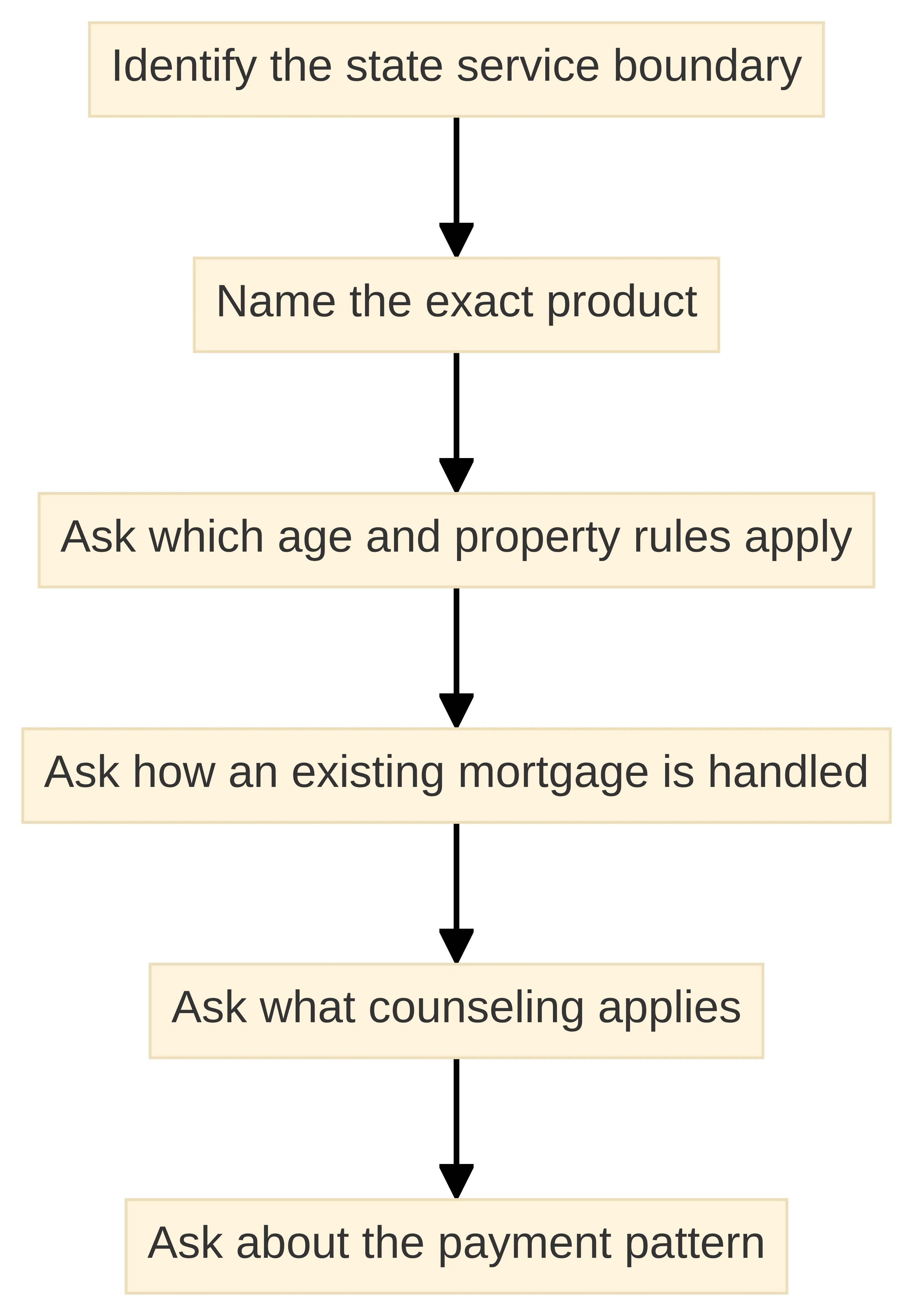
Use the list in this order: first identify whether your state is within the service boundary; next name the exact product; then ask which age and property rules apply. Do not reverse that order by treating a state name as proof that a product accepts you.
Ask the provider questions that resolve the product-and-state gap
A productive conversation starts with the exact product name. Ask these questions in sequence:
- Which product are you discussing? Is it an FHA-insured HECM, a proprietary reverse mortgage, a jumbo reverse mortgage, or a HELOC?
- What age rule applies to that product? If the answer is 55+, is that threshold part of the exact program being presented rather than a general statement about reverse mortgages?
- What does the product require from the property? Ask about principal residence, property condition, taxes, insurance, and maintenance.
- What happens to an existing mortgage? Ask how any balance would be paid at closing and how that would affect the available funds.
- What counseling applies? For an FHA-insured reverse mortgage, ask about HUD-approved reverse mortgage counseling.
- What payment pattern should you plan for? For a HELOC, ask about the draw period and repayment period, including the possibility of substantially higher monthly payments after the draw period ends.
The provider should be able to keep product rules separate. Ask for the age requirement, occupancy requirement, mortgage-payoff treatment, counseling requirement, and ongoing homeowner responsibilities as distinct answers. A general statement such as “available in your state” does not answer those questions. To evaluate the answer, ask the provider to keep each statement tied to the named product. A complete explanation should say whether the product is FHA-insured, proprietary, jumbo, or a HELOC; identify the applicable age threshold; and separate state service from property and borrower review. It should also explain how an existing mortgage, counseling, taxes, insurance, maintenance, occupancy, and repayment or payment structure fit that product. This format makes it easier to identify what has been answered and what still requires verification. Before the conversation ends, I would ask the provider to repeat the product name when answering each major question. For an HECM, that keeps the FHA-insured product, general 62+ screen, HUD-approved counseling, mortgage payoff, and ongoing property duties together. For a proprietary or jumbo discussion, it keeps the exact program and its stated minimum age visible without importing HECM terms. For a HELOC, it keeps the open-end line-of-credit description separate from questions about the draw period, repayment period, and payments that may increase substantially when repayment begins. I would record unanswered items as questions to verify, not as evidence that the product is unavailable or available. This method creates a clean handoff for a later personalized review while preserving the article’s central boundary: information about a product is not a determination of eligibility.
If the conversation shifts from an HECM to a jumbo or proprietary option, ask the provider to name that change plainly. The HECM is FHA-insured and available through an FHA-approved lender; a proprietary reverse mortgage is not FHA-insured. Keeping those descriptions attached to the product name helps you avoid applying HECM rules to a different program.
If you are in Florida and age 55 or older, I can discuss HECM and jumbo reverse mortgage questions with you. If you are in another listed state, ask about the product and state boundary together. In either case, the purpose of the conversation is to identify the exact review needed, not to treat the conversation as an approval.
Keep the comparison factual and limited
A state list, an age threshold, or a product description cannot determine your approval, available funds, or the terms of a particular reverse mortgage or HELOC. Those outcomes depend on the exact product and the applicable borrower, property, occupancy, mortgage, and financial requirements.
Keep the comparison factual in three ways:
- Name the product before discussing its age rule.
- Put ongoing property responsibilities beside any discussion of payment flexibility.
- Treat the state list as a service boundary rather than a product-eligibility map.
Current product and state rules require a product-specific conversation. The practical question is not simply whether a state allows a reverse mortgage at age 55. The practical question is which exact product may be discussed in your state and what requirements apply to your circumstances. The evidence behind this guide does not establish a current, state-by-state list of 55+ reverse mortgage products. The supplied business facts establish a service boundary and a Florida-specific 55+ advice fact, not a map of product eligibility. If the question is about a HECM, verify the general age screen and HECM requirements. If it is about a 55+ possibility, obtain the exact proprietary or jumbo program name and its terms. If it is about reusable access to equity, compare the HELOC’s draw and repayment structure without assuming that either product is inherently better.
Choose the next review based on the unanswered question
Your next review depends on the question that remains unanswered. If you are asking about an FHA-insured HECM, begin with the general 62+ borrower screen. If you are 55 and asking about a jumbo or proprietary reverse mortgage, request the exact program’s minimum age and terms. If your main question is access to a reusable credit line, compare a HELOC’s cash-flow and repayment structure with the reverse-mortgage paths.
Before moving forward, have your state, age, property type, occupancy, existing mortgage, income information, and preferred payment pattern ready for discussion. Ask the provider to identify the product, age rule, homeowner duties, counseling requirement, and mortgage-payoff treatment in plain language. A qualified professional decides individual suitability after reviewing the relevant facts; this guide does not make that decision.
I can help you frame the product-and-state questions for a personal review within my service boundary. The useful next step is to bring the unanswered question—HECM age, a specific 55+ program, or HELOC cash flow—to that conversation.
What should a 55-year-old verify before discussing a reverse mortgage?
What is the minimum age requirement for a reverse mortgage?
Typically, borrowers must be at least 62 years old for a standard reverse mortgage. However, some proprietary or jumbo reverse mortgage programs may allow applicants as young as 55.
How does state availability affect reverse mortgage eligibility?
State availability indicates where a provider can offer services, but it does not determine eligibility for a specific reverse mortgage product. Eligibility depends on age, property type, and other requirements.
What are the ongoing responsibilities of a reverse mortgage borrower?
Borrowers must continue to pay property taxes and homeowners insurance, maintain the home, and occupy it as their principal residence.
What is a Home Equity Conversion Mortgage (HECM)?
A HECM is an FHA-insured reverse mortgage that allows eligible homeowners to access a portion of their home equity through various payment options.
What should I ask a provider when considering a reverse mortgage?
Inquire about the specific product being discussed, the applicable age requirements, property conditions, existing mortgage obligations, and any required counseling.
Can I use a reverse mortgage to pay off an existing mortgage?
Yes, if you have an existing mortgage balance, it must be paid off at closing, which can be done using your own funds or proceeds from the reverse mortgage.
Have questions about this?
Talk to a Certified Reverse Mortgage Professional — directly.
When you call, you reach me — not a call center. Free 30-minute consult by phone, video, or in person. No SSN, no credit pull, no obligation.
Schedule a consult