

what is the downside to a reverse mortgage
What Is the Downside to a Reverse Mortgage? HECM Costs, Obligations, and Heir Considerations
Start with a downside triage
I focus here on the FHA-insured HECM, short for Home Equity Conversion Mortgage, rather than proprietary, jumbo, or hybrid programs. HECM borrowers are generally age 62+, with provisions for eligible non-borrowing spouses under 62. Some proprietary programs start at age 55. The other programs follow different rules and calculations.
Begin by identifying the issue that needs a clear answer first: available proceeds, ongoing property charges, the repayment event, or the family’s plan for the home. The rest of this review uses that order to help you prepare a focused conversation rather than treating every downside as the same question.
A reverse mortgage is a loan secured by the home, but the title remains in the homeowner’s name. That distinction matters because ownership continues with responsibilities. You still need to understand the loan balance, maintain the home, pay required charges, and plan for the event that makes repayment due.
See why the balance can grow
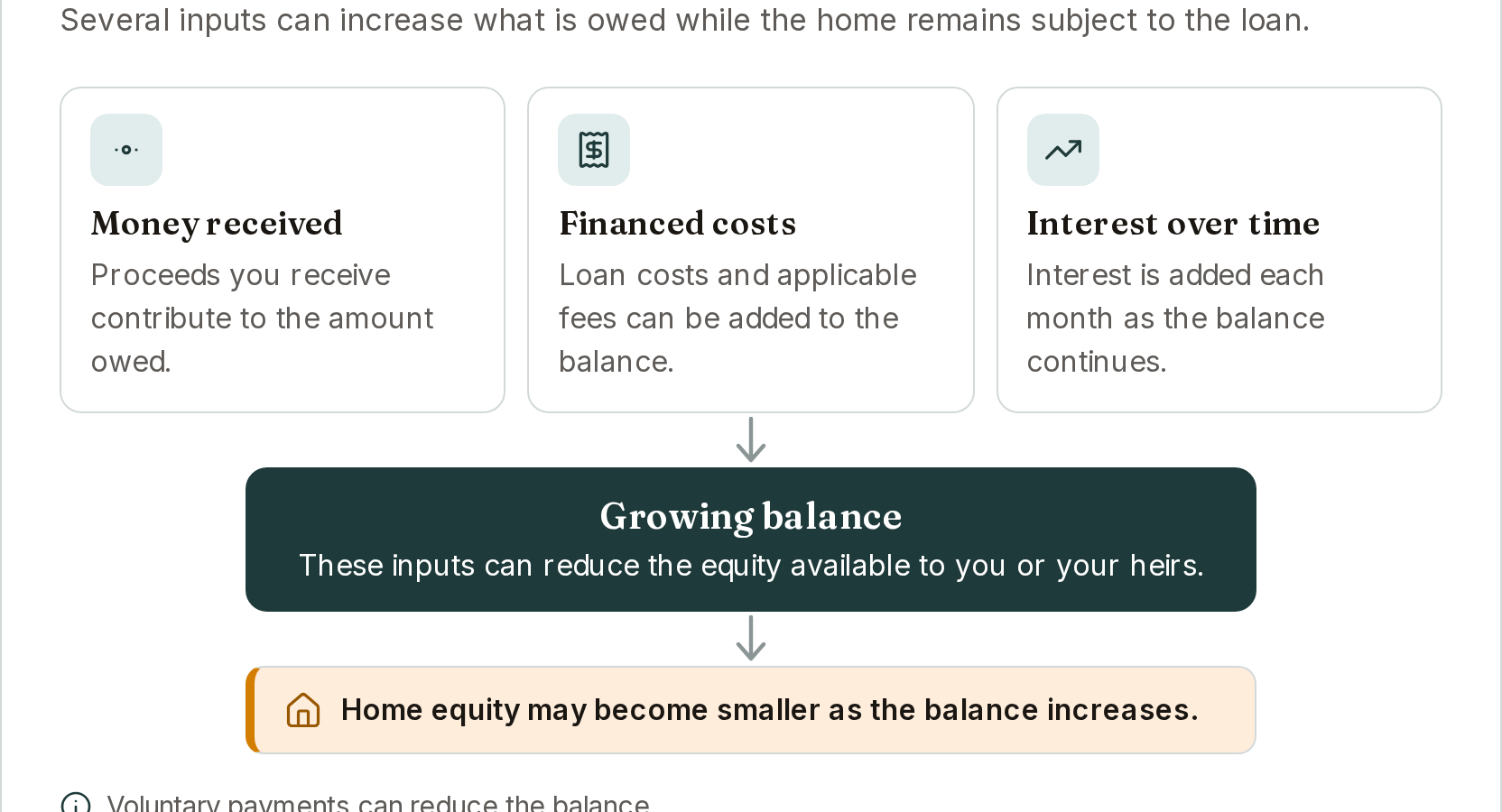
The reverse mortgage balance can grow even when you make no required monthly principal and interest payments. A reverse mortgage generally does not require monthly mortgage payments, but other loan requirements continue. Interest and fees are added to the balance each month, so what you owe grows over time and your home equity may decrease.
That balance movement is the central financial trade-off. Money you receive, financed loan costs, interest, and applicable fees can all contribute to the amount owed. The home may remain in your name, but the equity available to you or your heirs can become smaller as the balance increases. You may make voluntary payments at any time to reduce the balance, and a HECM has no prepayment penalty.
Your planned use of the home gives this downside its practical meaning. A homeowner who expects to remain in the property for a long period may evaluate a growing balance differently from a homeowner considering a move, a sale, or a change in living arrangement. The balance does not disappear because required monthly principal and interest payments are not due. Before treating available proceeds as the whole decision, write down what you want the home and its equity to accomplish over time.

Separate the headline cost from the full cost
The full HECM cost includes more than the amount shown in a single fee line. A reverse mortgage loan is typically more expensive than other home loans, and its cost depends on the loan type and lender. HECM costs can include an origination fee, closing and other third-party costs, servicing fees, and mortgage insurance premiums; financed costs may be added to the loan balance.
The annual mortgage insurance premium is equal to 0.5% of the outstanding mortgage balance. That percentage measures the annual premium against the outstanding balance; it is not a promise about your total loan cost or the amount of equity that will remain. Interest, servicing charges, property charges, and other terms also belong in the complete review.
The timing of costs also matters. Reverse mortgages are most costly at the beginning of the loan term, and their annual average cost generally decreases over time. Only a lender can provide the actual costs of a specific reverse mortgage product.
Use the lender’s itemized figures rather than a general estimate when you compare the loan with another option. Ask which costs are paid in cash, which are financed, whether a charge is one-time or ongoing, and how financed charges affect the balance. A HUD-approved counselor can explain general cost concepts, but the specific product costs must come from the lender.
Before closing, the lender must provide a Total Annual Loan Cost (TALC) disclosure for any HECM you are considering. Review that disclosure with the itemized fee sheet before signing. The disclosure does not replace the lender’s explanation of product-specific terms; it gives you another document to question if the figures or charges are not clear.
Keep the home obligations in view
The home obligations continue after a HECM begins. Your home must remain your principal residence, meaning it is where you spend the majority of the year. You must pay your property taxes and homeowners insurance on time, and you must keep the home in good condition.
These obligations are separate from required monthly principal and interest payments. These obligations continue while the home remains subject to the HECM. Your household plan needs to account for those expenses for as long as the home remains subject to the HECM.
Property charges can reach beyond the two bills most homeowners name first. Depending on the property, they can include flood insurance premiums, ground rent, condominium fees, planned unit development fees, homeowners’ association fees, and other special assessments. A set-aside for future property taxes and homeowners insurance does not automatically cover every other property charge. Ask which charges apply to the property and who will track each due date.
For loans made after April 27, 2015, a lender may evaluate your ability to pay future property taxes and homeowners insurance and may require loan proceeds to be set aside for them. A set-aside reserves proceeds for those charges, so it can affect the amount available for other purposes.
Missed obligations can have serious consequences. If you do not meet these requirements, the loan may go into default and foreclosure may result. A set-aside or another payment arrangement may address some future property charges, but it does not remove every responsibility attached to the home.
A practical review should therefore ask who will monitor tax bills, insurance renewals, repairs, and primary-residence status. Put those tasks beside the household budget before you decide whether the payment structure is workable.

Check proceeds and repairs first
If available proceeds are your first concern, begin with the existing traditional mortgage. If you still owe on a traditional mortgage, some reverse-mortgage proceeds are used to pay it off. A large balance may leave little money for other purposes or may mean you cannot get a reverse mortgage.
This is a change in the shape of your debt, not free cash added on top of the existing loan. The traditional mortgage is usually paid off at closing with HECM funds, so the amount left for other purposes depends on the available proceeds and the existing balance. Ask for that calculation in writing and distinguish the payoff amount from the remaining proceeds.
If the home’s condition is your first concern, begin with required repairs. A lender may require repairs as a condition of getting a reverse mortgage and may withhold some loan proceeds for those repairs. Repairs can therefore affect both whether the loan moves forward and how much money is available for other purposes.
Review the home’s condition before treating an estimate as usable funds. Ask which repairs are required, who will inspect or document them, whether money will be held aside, and what happens if the work costs more than expected. Do not let a repair proposal from a contractor become the sole reason to choose a reverse mortgage.
Mark the events that make repayment due
The reverse mortgage is repaid when the borrowers no longer live in the home. Repayment is therefore connected to occupancy and household plans rather than to a fixed calendar deadline.
Consider the plans that could change your use of the property. That timing belongs in plans for the property’s future. The question is not only how the loan works while you live in the home; it is also how your household would handle the loan when that period ends.
A repayment event can require a decision about the property and the outstanding balance. You may want to record who would communicate with the servicer, where important loan documents would be kept, and how a planned move or sale would be handled. Those preparations do not change the loan terms, but they can make the event easier for your household to understand when it occurs.

Set out the family's home plan
The HECM repayment event affects heirs because the home and loan balance must be addressed together. A HECM becomes due and payable after the borrower and any coborrower or eligible nonborrowing spouse have died. When repayment is due, heirs may sell the home or pay the balance in full from another source to keep it.
After heirs receive a due-and-payable notice, they may buy, sell, or turn the home over to the lender to satisfy the debt; the CFPB says they have 30 days to do so. The timing and available choices should be explained to family members well before the decision is needed. A family conversation can clarify whether keeping, selling, or transferring the home is realistic.
FHA-insured HECM loans are non-recourse. Heirs never owe more than the home’s value. If the HECM balance is greater than the home’s value, you or your heirs do not have to pay the excess. If the home is sold, the lender may accept the sale proceeds as full payment, subject to the applicable appraised-value rule; when the balance is higher, heirs may repay at least 95 percent of the home’s appraised value under that rule.
Independent HUD counseling is required, and family members are encouraged to participate. Non-recourse protection does not mean there are no decisions for the family; it means the repayment obligation has a defined protection that belongs in the family discussion.
Keeping the home still requires paying the balance in full from another source, and a loan of the heir’s own may be one way to do that. The protection limits personal repayment exposure without removing the family’s need to make a housing decision.
Property-charge defaults create a separate family and servicing issue while the borrower is living in the home. That 60-month period measures the total time allowed under the stated standard policy for repayment of those advances; it is not a general promise about every servicing arrangement or every loan event.

Compare the trade-off with other ways to use equity
The HECM trade-off becomes clearer when you place it beside other ways to borrow against home equity. Neither is ‘better.’ A home equity loan or HELOC might cost less than an HECM, but these options usually require monthly payments, and qualification depends on income and credit.
| Question | FHA-insured HECM | Home equity loan or traditional HELOC |
|---|---|---|
| Required monthly principal and interest payments | Generally not required, while property and loan obligations continue | Usually required |
| Qualification factors | HECM rules, home, borrower, and loan conditions apply | Qualification depends on income and credit, among other terms |
| Home responsibilities | Principal residence, property charges, and home maintenance continue | The home remains collateral and the product’s obligations continue |
| Later repayment | Repayment is tied to the applicable maturity event, sale, or permanent departure | Repayment follows the loan or line’s terms |
Before making a final decision, examine other borrowing and housing options, including whether waiting, changing housing plans, or using another form of credit fits your circumstances.
A traditional HELOC can move from its draw period into repayment, and monthly payments can increase substantially at that point. That timing belongs in a cash-flow comparison because the payment pattern can change even though the home remains collateral. Ask when the draw period ends and how repayment is calculated.
A HECM can reduce the need for required monthly principal and interest payments, but it can also increase the balance and reduce home equity. The comparison depends on cash flow, income, existing mortgage, age, long-term goals, and the desire to make monthly payments.
I use a personalized comparison rather than recommending the same solution for everyone. The practical next step is to compare the payment obligation, balance movement, property duties, and repayment event side by side.
Build a priority question list
Start with the concern that matters most to your next conversation. Use one of these four starting points:
- Available proceeds: What are the actual origination, closing, third-party, servicing, mortgage insurance, and other costs, and which would be financed into the balance?
- Ongoing property charges: What will you pay directly, and could a lender require a set-aside for future property taxes or homeowners insurance?
- Home condition: Which repairs are required, and could loan proceeds be withheld for them?
- Family plan: What event makes the HECM due, and what choices would heirs have for the home?
Take the questions for your first concern to the lender, HUD counselor, family member, or other qualified professional. Use the remaining categories as follow-up questions.
Make the first conversation concrete by asking for the terms that apply to the issue you selected:
- For available proceeds, ask how an existing traditional mortgage would affect the amount left for other purposes and how the balance could change with the selected payout option.
- For property responsibilities, ask which property charges apply, whether future taxes or homeowners insurance could require a set-aside, and what maintenance is expected.
- For the home’s later disposition, ask how non-recourse protection applies if the balance is higher than the home’s value and how heirs can sell, refinance or purchase the home.
- For qualified review, ask what independent HUD counseling will cover about financial implications, taxes, estate matters, assistance-program eligibility, and alternatives. A written comparison can help the homeowner, family members, and professionals identify which unanswered question belongs to the lender, HUD counselor, or another qualified adviser.
Recognize pressure and sales warning signs
Pressure can interfere with a careful comparison. Do not take out a reverse mortgage merely because a contractor says it is the way to pay for repairs or improvements. A repair need deserves its own review of cost, timing, available funds, and other financing choices.
Talk to a few lenders before deciding; a lender who says you are the only person you should talk to is a warning sign. You can pause and seek independent HUD counseling or another qualified review when a conversation discourages questions, limits your choices, or pushes you toward a quick signature.
Coercion by a family member or caregiver, or pressure to sign a power of attorney giving someone sole access to the loan money, can be a scam warning sign. Loan proceeds should not be controlled by another person simply because that person is arranging the conversation or offering to help.
Treat secrecy, pressure to exclude family members, or requests for sole control as reasons to stop and obtain independent help. A trusted family member can participate with your permission, but participation should support your understanding rather than replace it.
Match the issue to qualified help
Ask a qualified professional when a question turns on your circumstances rather than on general loan terms. A financial, tax, legal, housing-counseling, or mortgage professional can address how a benefit, tax matter, estate document, or housing plan relates to your situation. Independent HECM counseling covers the loan’s financial implications, possible effects on taxes, estate, and eligibility for assistance, and other home equity conversion options. A lender, rather than a housing counselor, provides the actual costs of a specific product.
A possible default requires prompt attention. If your reverse-mortgage loan defaults because of unpaid property charges, contact the lender or servicer immediately and consider help from a HUD-approved housing counseling agency or an attorney. Keep records of notices, tax payments, insurance payments, repair communications, and every conversation with the servicer.
A repayment issue after a move, sale, or death also calls for direct contact with the servicer and qualified help. Do not ignore a due-and-payable notice, assume the home will transfer without action, or sign a repayment document before you understand the available choices.
Prepare priority questions for a follow-up
Begin with the question that could change the next conversation: how much may remain after costs, what property responsibilities continue, when repayment could become due, or how the family would address the home. Put that question first, then keep the other topics as follow-up items.
I can provide general education about those questions and trade-offs; a qualified professional can address how financial, tax, legal, housing-counseling, or mortgage information applies to your circumstances.
What should you clarify before asking for a personal follow-up?
What should I do if I cannot pay the property taxes or homeowners insurance on a HECM?
Contact the lender or servicer immediately and keep proof of every payment and notice. You may also seek help from a HUD-approved housing counseling agency or an attorney. Unpaid property charges can place the loan in default, so do not wait for the issue to resolve on its own.
What should I confirm about HECM costs before deciding?
Ask for the actual itemized costs from the lender, including origination, closing and third-party costs, servicing fees, and mortgage insurance premiums. Confirm which charges will be paid in cash and which will be added to the balance. A HUD-approved counselor can explain general cost concepts, but only the lender can provide the specific product costs.
What should I do before permanently moving from a home with a HECM?
Contact the servicer before the move and ask how the planned change in occupancy affects the loan. A HECM becomes due when the last borrower permanently leaves the home, sells it, or passes away, subject to applicable protections for an eligible non-borrowing spouse. Ask what documents and decisions will be required rather than assuming a temporary absence or a move will have the same result.
What should heirs know when a HECM becomes due?
Heirs may sell the home, refinance or purchase it to keep it, or use another source of funds to repay the loan. FHA-insured HECM loans are non-recourse, so heirs never owe more than the home’s value. Independent HUD counseling is required, and family members are encouraged to participate; these options should be discussed well before a decision is needed.
Have questions about this?
Talk to a Certified Reverse Mortgage Professional — directly.
When you call, you reach me — not a call center. Free 30-minute consult by phone, video, or in person. No SSN, no credit pull, no obligation.
Schedule a consult