

Jumbo Reverse Mortgages
Master Guide to Proprietary Reverse Mortgages: How Jumbo Reverse Mortgages Work

Master Guide to Proprietary Reverse Mortgages: How Jumbo Reverse Mortgages Work
For years, when homeowners heard the words reverse mortgage, they were usually hearing about one particular program: the FHA-insured Home Equity Conversion Mortgage, or HECM.
But HECMs aren’t the only reverse mortgages available.
Homeowners with higher-value properties—or circumstances that don’t fit neatly within the HECM program—may also have access to proprietary reverse mortgages, frequently called jumbo reverse mortgages.
These privately offered programs have expanded the reverse mortgage marketplace, creating additional ways for eligible homeowners to access a portion of their home equity without required monthly principal and interest mortgage payments.
But proprietary reverse mortgages are not simply “bigger HECMs.”
They can have different age requirements, property guidelines, loan amounts, payout choices, interest rates, costs, financial assessment requirements and borrower protections.
Understanding those differences is essential before deciding which option makes sense.
Quick Answer: What Is a Proprietary Reverse Mortgage?
Private lenders offer proprietary reverse mortgages without Federal Housing Administration (FHA) insurance. Many people call these loans jumbo reverse mortgages because they often serve homeowners with higher-value properties.
The Consumer Financial Protection Bureau distinguishes proprietary reverse mortgages from FHA-insured HECMs and notes that these programs typically serve borrowers with higher home values
Like other reverse mortgages, proprietary programs can allow eligible homeowners to convert a portion of their home equity into available funds without required monthly principal and interest mortgage payments, subject to the terms of the loan.
Unlike a HECM, however, private lenders or investors design proprietary reverse mortgage programs. The features and requirements can therefore vary considerably from one proprietary program to another.
Why Did Lenders Create Proprietary and Jumbo Reverse Mortgages?
One of the biggest differences between a HECM and a proprietary reverse mortgage is how much of a home’s value the program considers when determining available proceeds.
For FHA case numbers assigned in 2026, HUD established the nationwide HECM maximum claim amount at $1,249,125.
That doesn’t mean someone with a $2 million or $3 million home can’t obtain a HECM.
They potentially can.
It means that additional property value above the HECM maximum claim amount does not increase the value used in the HECM principal-limit calculation.
That distinction becomes increasingly important as home values rise.
Imagine a homeowner with a $3 million property and significant equity. Depending on the homeowner’s age, existing mortgage balance, goals and available programs, a proprietary reverse mortgage may be able to recognize more of that property’s value when determining available proceeds.
This is one of the primary reasons the jumbo reverse mortgage market exists.
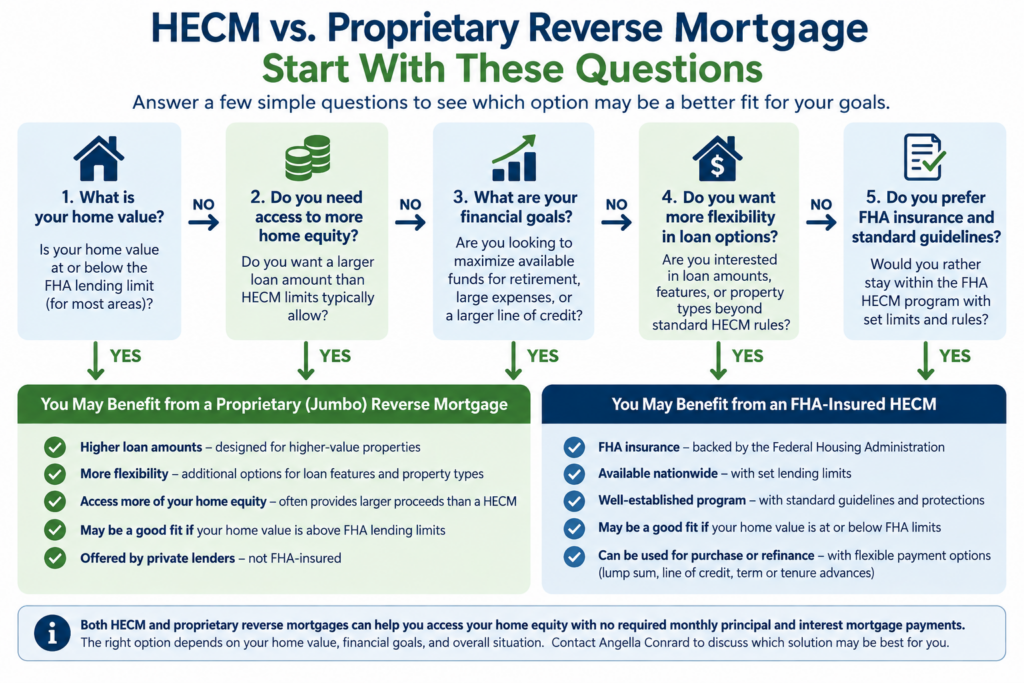
Proprietary Reverse Mortgage vs. HECM: What’s the Difference?
Both are reverse mortgages, but they aren’t interchangeable.
HECM Reverse Mortgage
The FHA insures HECMs, and federal HECM requirements govern the program.
Important HECM features include:
- Minimum borrower age of 62
- FHA insurance
- A nationwide 2026 maximum claim amount of $1,249,125
- HUD-approved reverse mortgage counseling
- Financial assessment
- FHA mortgage insurance premiums
- Federally established non-recourse protections
- Several ways to receive proceeds, depending on loan structure, including a line of credit, lump sum, term or tenure advances, and certain combinations
The Consumer Financial Protection Bureau provides additional information about HECM eligibility and how reverse mortgages work.
Proprietary or Jumbo Reverse Mortgage
Private lenders offer proprietary reverse mortgages without FHA insurance.
Depending on the particular program and state, proprietary options may offer:
- Access to more equity from higher-value homes
- Minimum ages below 62 with some programs
- Higher potential loan amounts
- No FHA mortgage insurance premium
- Different property eligibility guidelines
- Lump-sum proceeds
- Line-of-credit options with some programs
- Different financial assessment and credit requirements
- Different counseling requirements
- Program-specific non-recourse provisions and protections
The key phrase here is depending on the program.
There is no single set of terms that applies to every proprietary reverse mortgage.
Can You Get a Proprietary Reverse Mortgage Before Age 62?
Possibly.
The FHA HECM program requires borrowers to be at least 62 years old, as explained in the CFPB’s reverse mortgage eligibility guidance.
Some proprietary reverse mortgage programs may allow eligible borrowers at younger ages, depending on the program and state.
That can make proprietary reverse mortgages worth investigating for homeowners who are not yet 62 but have substantial home equity and want to evaluate alternatives to traditional mortgage financing.
However, a particular younger minimum age should never be treated as universal across proprietary reverse mortgages. Age eligibility can vary by lender, product and state.
We will explore this subject in greater detail in our upcoming guide:
Can You Get a Reverse Mortgage at Age 55? Proprietary Reverse Mortgage Options Explained
How Much Can You Borrow With a Jumbo Reverse Mortgage?
There isn’t one universal answer.
With a proprietary reverse mortgage, available proceeds can depend on factors such as:
- Age of the borrower or youngest borrower
- Appraised property value
- Current interest rates
- Existing mortgage and lien balances
- Property type
- State
- Specific proprietary program
- Underwriting and financial assessment requirements
Some proprietary programs are specifically designed to recognize property values substantially above the HECM maximum claim amount.
However, a $3 million home does not mean the homeowner receives $3 million—or even a predetermined percentage of $3 million.
The particular program’s guidelines determine the actual proceeds available.
That’s why owners of high-value homes should generally compare actual HECM and proprietary illustrations rather than assuming the jumbo program automatically provides the better result.
What Happens to an Existing Mortgage?
You do not necessarily need to own your home free and clear to obtain a reverse mortgage.
With a HECM, an existing mortgage balance that must be satisfied can generally be paid using available reverse mortgage proceeds, provided sufficient proceeds are available.
Proprietary programs establish their own requirements, but paying off an existing mortgage is also a common use of proprietary reverse mortgage proceeds.
For some homeowners, eliminating an existing required monthly principal and interest mortgage payment is one of the primary reasons they investigate a reverse mortgage.
Property taxes, homeowners insurance and other applicable property obligations still remain the homeowner’s responsibility.
Does a Proprietary Reverse Mortgage Require Monthly Mortgage Payments?
Proprietary reverse mortgages are generally structured without required monthly principal and interest mortgage payments, subject to the specific loan terms.
That doesn’t mean the home becomes free to own.
Borrowers generally must continue meeting obligations required by the particular loan, which can include:
- Property taxes
- Homeowners insurance
- Applicable flood insurance
- HOA or condominium assessments
- Property maintenance
- Occupancy requirements
Interest and applicable charges accrue to the reverse mortgage balance instead of requiring a monthly principal and interest mortgage payment.
This distinction is important:
“No required monthly principal and interest mortgage payment” does not mean “no homeowner expenses.”
The CFPB’s reverse mortgage borrower-responsibilities guidance explains these continuing obligations for HECM borrowers.
Does a Proprietary Reverse Mortgage Have Mortgage Insurance?
Proprietary reverse mortgages are not FHA-insured, so they don’t carry the FHA mortgage insurance premiums associated with a HECM.
That can be attractive to some homeowners, particularly those comparing the upfront costs of different reverse mortgage options.
But the absence of FHA mortgage insurance should not automatically be interpreted as meaning the proprietary loan is less expensive.
Interest rates, origination charges, third-party expenses and other costs can differ by program.
HECMs, for comparison, have upfront and ongoing costs that can include origination and closing costs, FHA mortgage insurance and interest added to the outstanding balance.
The better comparison is the complete cost and benefit of each option, not one fee viewed in isolation.
Can You Get a Proprietary Reverse Mortgage Line of Credit?
Some proprietary programs offer a line-of-credit option, while others may emphasize lump-sum proceeds.
This is an area where comparing the details matters enormously.
The FHA HECM line of credit has a specific growth feature. Unused borrowing capacity can increase according to the terms of the HECM. HECMs also provide several ways of accessing available proceeds, depending on the loan structure.
A proprietary line of credit should not automatically be assumed to work the same way.
Depending on the product, a proprietary line may have different draw provisions, growth features, availability periods, minimum draws or other requirements.
We will devote an entire guide to this subject:
Jumbo Reverse Mortgage Line of Credit: How Does It Work?
What Types of Properties May Qualify?
Property eligibility is another reason homeowners sometimes investigate proprietary reverse mortgages.
Depending on the particular program, eligible properties may include certain:
- Single-family residences
- Condominiums
- Planned unit developments
- Townhomes
- Two- to four-unit properties
- Higher-value or unique properties
One potential advantage is that some proprietary programs may have different condominium requirements from FHA’s HECM program.
That does not mean every condo qualifies for a proprietary reverse mortgage.
The property still needs to satisfy the lender’s specific appraisal, project, insurance and eligibility requirements.
We’ll explore this separately in:
Can You Get a Jumbo Reverse Mortgage on a Condo? What Owners Need to Know
Can a Trust Own the Home?
Potentially, but trust eligibility is highly program-specific.
An acceptable trust may potentially hold title to the property if the trust documents, borrower interests and other requirements satisfy the particular lender’s guidelines.
This is an area where the actual trust documents should be reviewed rather than relying on a general rule.
The same principle applies to more complex ownership structures and estate-planning arrangements.
Are Proprietary Reverse Mortgages Non-Recourse?
This is one of the most important questions to ask.
HECMs have federally established non-recourse protections. The CFPB explains HECM ownership and repayment protections, including protections that limit repayment through the property when the loan balance exceeds the home’s value.
Many proprietary reverse mortgages also include non-recourse provisions, but those protections come from the specific proprietary program and loan documents rather than FHA insurance.
Therefore, borrowers should verify exactly what the particular loan provides rather than assuming its protections are identical to a HECM.
We will cover this in detail in:
Are Jumbo Reverse Mortgages Non-Recourse? What Happens if the Home Value Falls?
That article will also address what heirs need to know.
What Happens to the Home When the Borrower Dies?
A reverse mortgage does not mean the lender automatically owns the house.
With a HECM, title remains with the homeowner. The loan generally becomes due and payable after certain events, including when the last borrower dies, sells the home or permanently leaves it, subject to HECM rules and eligible non-borrowing spouse provisions.
With a proprietary reverse mortgage, the particular loan documents and applicable law govern repayment procedures, timelines and protections.
The amount of equity ultimately remaining for heirs depends on factors including:
- Amount borrowed
- Interest rate
- Length of time the loan remains outstanding
- Additional advances taken
- Fees and charges
- Future property value
A reverse mortgage can reduce the equity eventually available to heirs.
For many families, however, the larger question is how the homeowners want their home equity used during their lifetime.
That is why I encourage borrowers who want their adult children involved to include them in the conversation.
Can You Buy a Home With a Proprietary Reverse Mortgage?
Some proprietary programs may allow eligible borrowers to purchase a new home, depending on the product and its requirements
For comparison, the federally insured HECM for Purchase allows eligible borrowers to use a HECM in connection with the purchase of a principal residence.
A proprietary purchase option can create an interesting alternative for older homeowners who want to sell their existing property and purchase a higher-value home while preserving a portion of their other assets.
For example, someone might want to:
- Move closer to children or grandchildren
- Right-size into a home better suited for aging
- Relocate to another state
- Purchase a single-level home
- Move into a higher-cost retirement community
- Preserve more investment assets rather than purchasing the next home entirely with cash
We’ll cover this strategy separately in:
Jumbo Reverse Mortgage for Purchase: How to Buy a Higher-Value Home Without a Required Monthly Mortgage Payment
Who Might Consider a Proprietary Reverse Mortgage?
A proprietary reverse mortgage may be worth evaluating when a homeowner:
- Owns a higher-value property
- Has substantial home equity
- Wants to see whether more equity may be accessible than through a HECM calculation
- Has an existing mortgage payment affecting retirement cash flow
- Wants to remain in the home
- Is below age 62 and an eligible proprietary program is available
- Owns a property that may not fit HECM requirements but may qualify under a proprietary program
- Wants to evaluate a proprietary line of credit
- Is purchasing a higher-value retirement home
- Wants to coordinate home equity with a broader retirement strategy
None of those circumstances automatically means a proprietary reverse mortgage is the right choice.
They mean it may deserve a comparison.
When Might a HECM Be the Better Option?
Higher home value doesn’t automatically mean proprietary is better.
A HECM may still deserve serious consideration when the homeowner values features such as:
- FHA insurance
- Federally established borrower protections
- The HECM line-of-credit growth feature
- Term or tenure advances
- Standardized federal program requirements
- HECM-specific non-recourse protections
Someone with a $2 million home, for example, should not automatically assume a jumbo reverse mortgage is the best solution.
The useful comparison is:
What does each available program provide for this homeowner’s actual circumstances and goals?
For a broader discussion, read How Home Equity Fits Into a Retirement Income Plan.
Homeowners comparing traditional home-equity borrowing with reverse mortgages may also want to read HELOC vs. Reverse Mortgage: Which Is Better for Retirees?.
Proprietary Reverse Mortgages and Retirement Planning
For homeowners with substantial wealth concentrated in their homes, home equity can be more than simply an asset that sits unused until the property is sold.
It can potentially become another financial resource.
Depending on the homeowner and program, reverse mortgage proceeds might be considered for purposes such as:
- Paying off an existing mortgage
- Establishing additional liquidity
- Funding home improvements
- Supporting aging in place
- Paying for large planned expenses
- Creating access to funds for future needs
- Coordinating withdrawals from investment accounts
- Purchasing another home
This doesn’t mean home equity should always be spent.
It means it deserves to be included in the retirement conversation.
That is particularly relevant for financial advisors working with clients who may have substantial home equity and want to consider how housing wealth fits alongside other retirement assets.
We’ll explore that subject in:
How Financial Advisors Can Use Proprietary Reverse Mortgages in Retirement Planning
Questions to Ask Before Choosing a Proprietary Reverse Mortgage
Because proprietary programs vary, don’t evaluate one based solely on the words “jumbo reverse mortgage.”
Ask:
- What is the minimum borrower age?
- What property values does the program recognize?
- How much is available?
- Is the interest rate fixed or adjustable?
- Is there a line-of-credit option?
- If so, how does that line work?
- Does unused borrowing capacity grow?
- Are there limitations on future draws?
- What are the upfront costs?
- What costs accrue over time?
- What financial assessment or underwriting is required?
- Is counseling required?
- What are the non-recourse provisions?
- What events cause the loan to become due and payable?
- What options will heirs have?
- How does this compare with a HECM?
- Would selling, downsizing, a HELOC or another strategy better accomplish the homeowner’s goal?
Those questions turn the conversation from “Can I get this loan?” into the much more useful question:
“Does this loan accomplish what I want my home equity to do?”
Key Takeaways
A proprietary reverse mortgage, often called a jumbo reverse mortgage, is a privately offered reverse mortgage that is not insured by FHA.
These products are commonly designed for homeowners with higher-value properties.
They can be particularly useful to investigate because some proprietary programs may recognize home values beyond the HECM maximum claim amount.
They may also offer features not available under the HECM program or serve borrowers whose age or property circumstances don’t fit HECM requirements.
But proprietary programs are not standardized.
Age requirements, available proceeds, interest rates, property eligibility, underwriting, lines of credit, counseling requirements, non-recourse provisions and other features can differ from one program to another.
That’s why the most useful approach is usually to compare the actual options side by side.
Final Thought
A high-value home can represent decades of accumulated wealth.
For some retirees, leaving that equity untouched may be exactly what they want.
For others, accessing a portion of it may provide greater flexibility, eliminate an existing required principal and interest mortgage payment, help fund aging-in-place goals, create additional liquidity or allow other retirement assets to remain available for other purposes.
A proprietary reverse mortgage is another tool for considering how that equity might be used.
The important question isn’t whether a jumbo reverse mortgage is universally better than a HECM.
It isn’t.
The question is which option—if any—best supports the homeowner’s goals, property, financial situation and plans for retirement.
Frequently Asked Questions About Proprietary Reverse Mortgages
What is another name for a proprietary reverse mortgage?
People frequently call proprietary reverse mortgages jumbo reverse mortgages, particularly when these programs serve higher-value homes.
Is a proprietary reverse mortgage FHA-insured?
No. Private lenders offer proprietary reverse mortgages without FHA insurance.
What is the HECM lending limit in 2026?
The 2026 HECM maximum claim amount is $1,249,125 for FHA case numbers assigned on or after January 1, 2026.
Can I get a proprietary reverse mortgage at age 55?
Some proprietary programs may be available to borrowers younger than 62, including age 55 with certain programs in eligible states. Minimum ages are program- and state-specific and should be verified for the particular loan being considered.
Do jumbo reverse mortgages require monthly mortgage payments?
They are generally structured without required monthly principal and interest mortgage payments, subject to the terms of the specific program. Borrowers must continue satisfying applicable property and loan obligations.
Do proprietary reverse mortgages have FHA mortgage insurance?
No. Because proprietary reverse mortgages are not FHA-insured, they do not carry FHA’s HECM mortgage insurance premiums.
Can a proprietary reverse mortgage have a line of credit?
Some can. Line-of-credit availability and features vary by proprietary program. A proprietary credit line should not be assumed to have the same features as a HECM line of credit.
Can I use a jumbo reverse mortgage if I still have a mortgage?
Potentially. Borrowers generally must satisfy any liens required by the particular program at or before closing, and available reverse mortgage proceeds may be used when program requirements permit.
Can a proprietary reverse mortgage be used on a condo?
Potentially. Some proprietary programs have different condominium eligibility requirements from the FHA HECM program. The specific condominium and program still need to qualify.
Is a jumbo reverse mortgage better than a HECM?
Neither is universally better. Home value, borrower age, available proceeds, desired payout method, costs, property type, protections and long-term goals should all be compared.
Have Questions About a Proprietary Reverse Mortgage?
If you own a higher-value home and are wondering whether a HECM or proprietary reverse mortgage could provide the better fit, I can help you compare the available options.
The goal isn’t simply to access the most equity possible.
It’s to understand which home-equity strategy best supports the retirement you want.
Have questions about this?
Talk to a Certified Reverse Mortgage Professional — directly.
When you call, you reach me — not a call center. Free 30-minute consult by phone, video, or in person. No SSN, no credit pull, no obligation.
Schedule a consult