

Home Equity & HELOC
HELOC vs. Reverse Mortgage: Which Is Better for Retirees?

For homeowners approaching or already in retirement, home equity can represent one of their largest financial resources. When additional funds are needed, two options often come into the conversation: a home equity line of credit (HELOC) and a reverse mortgage.
Both allow homeowners to access a portion of their home equity without selling the home. But the way these loans work—and the effect they can have on retirement cash flow—can be very different.
A traditional HELOC may be an excellent choice for a homeowner who comfortably qualifies, wants relatively short-term access to equity, and is comfortable making monthly payments.
If you’re still deciding whether a traditional HELOC makes sense during retirement, start with my guide to HELOCs for retirees.
A reverse mortgage may be worth considering for an eligible homeowner whose priorities include reducing required monthly mortgage payments, establishing longer-term access to home equity, or creating greater financial flexibility during retirement.
So when comparing a HELOC vs. reverse mortgage, the question shouldn’t simply be:
“Which loan has the lowest interest rate?”
A better question is:
“Which loan structure better supports what I want my home equity to accomplish during retirement?”
Quick Answer: HELOC vs. Reverse Mortgage
A HELOC generally works more like traditional borrowing. You receive a revolving line of credit secured by your home, make required monthly payments, and usually have a variable interest rate. You can generally borrow during a defined draw period, after which the loan enters repayment. The CFPB notes that HELOC payments are often significantly higher once repayment begins. (Consumer Financial Protection Bureau)
A reverse mortgage works differently. For eligible homeowners, it allows access to a portion of home equity without required monthly principal and interest mortgage payments. With a HECM, the most common type of reverse mortgage, homeowners must be at least 62 and continue meeting loan obligations such as paying property taxes and homeowners insurance and maintaining the home. (Consumer Financial Protection Bureau)
Neither option is automatically better.
The better fit depends on the homeowner’s age, income, credit, existing mortgage, available equity, cash-flow needs, how long the funds may be needed, and long-term plans for the home.
How Does a Traditional HELOC Work?
A HELOC is a revolving line of credit secured by your home.
A lender establishes a maximum credit limit based on factors that typically include your home’s value, available equity, credit, income, debts, and the lender’s underwriting requirements.
During the draw period, you can generally borrow, repay, and borrow again up to the available credit limit.
HELOCs usually have variable interest rates, which means both the interest rate and required payment may change over time. (Consumer Financial Protection Bureau)
Eventually, the draw period ends.
You then enter the repayment period, when you can no longer take additional advances and must repay the outstanding balance according to the loan terms.
That structure can work very well when the HELOC is being used for a relatively short-term financial need and the monthly payments comfortably fit the household budget.
But retirement can make those same features more important to evaluate.
How Does a Reverse Mortgage Work?
A reverse mortgage is also a loan secured by the home, but its repayment structure is fundamentally different.
The most common reverse mortgage is the Home Equity Conversion Mortgage (HECM), which is insured by the Federal Housing Administration (FHA) and available to eligible homeowners age 62 and older. Proprietary reverse mortgages are also available from private lenders and may have different eligibility requirements and features. (Consumer Financial Protection Bureau)
With a reverse mortgage, eligible homeowners can convert a portion of their home equity into available funds without required monthly principal and interest mortgage payments.
Depending on the program, funds may be available through options such as a lump sum, line of credit, monthly advances, or combinations of these options.
Interest and applicable loan charges accrue to the outstanding loan balance rather than being paid through required monthly principal and interest payments.
The loan generally becomes due when the last borrower permanently leaves the home, sells the property, refinances the loan, or passes away, subject to the terms of the program.
The homeowner continues to own the home and remains responsible for meeting the loan requirements.
HELOC vs. Reverse Mortgage: What’s the Biggest Difference?
For many retirees, the most significant difference is required monthly cash flow.
With a traditional HELOC, the borrower must make payments according to the loan terms.
With a reverse mortgage, there are generally no required monthly principal and interest mortgage payments as long as the loan remains in good standing.
That does not mean a reverse mortgage has no costs.
Interest and applicable charges accrue to the loan balance over time, so the amount owed generally increases rather than decreases.
The homeowner must also continue paying property taxes and homeowners insurance, maintain the property, and meet the other requirements of the loan. (Consumer Financial Protection Bureau)
For a retiree, therefore, the comparison isn’t simply between two interest rates.
It is also a comparison between two very different cash-flow structures.
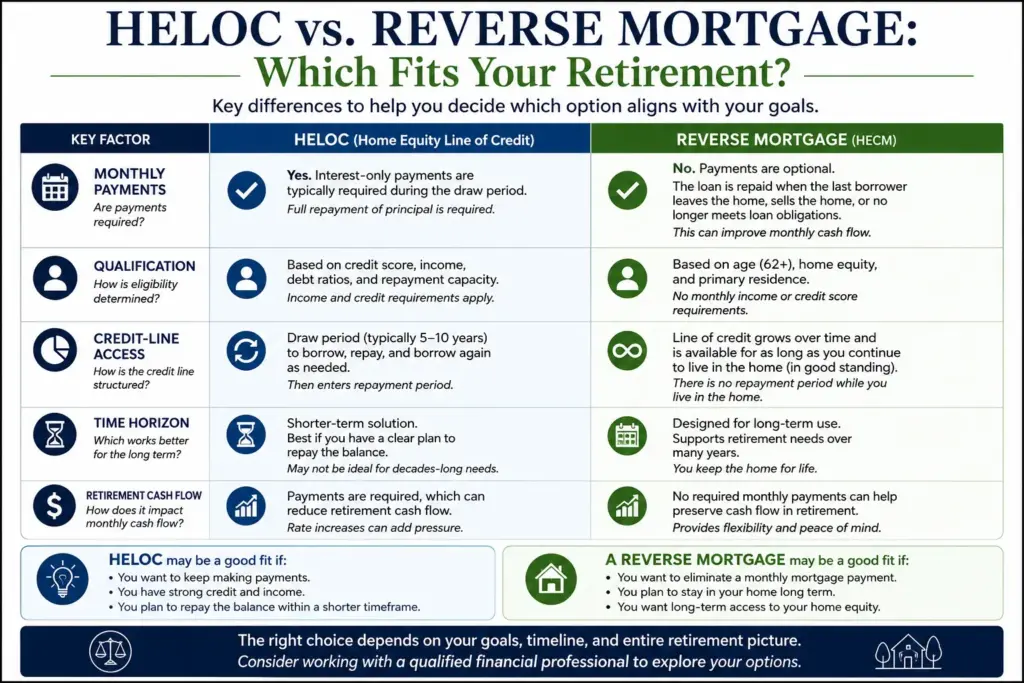
HELOC vs. Reverse Mortgage Comparison
Monthly Mortgage Payments
HELOC: Required monthly payments are part of the loan. Payments may change based on the balance and interest rate.
Reverse Mortgage: No required monthly principal and interest mortgage payments while loan requirements are met. Interest and applicable charges accrue to the loan balance.
Qualification
HELOC: Traditional underwriting generally evaluates income, credit, debts, and the borrower’s ability to make the required payments.
Reverse Mortgage: Qualification is different. HECM borrowers undergo a financial assessment that evaluates their ability and willingness to meet ongoing property obligations, including property taxes and homeowners insurance.
A reverse mortgage does not mean “no qualification.” It means the qualification process is structured differently because the loan itself does not require monthly principal and interest mortgage payments.
Interest Rates
HELOC: HELOCs commonly have variable rates, although some lenders offer the ability to convert portions of the balance to fixed-rate structures. (Consumer Financial Protection Bureau)
Reverse Mortgage: Depending on the reverse mortgage and how funds are accessed, fixed- or adjustable-rate options may be available.
Interest rates matter with both products, but the rate shouldn’t be evaluated independently of how the loan will be used and how long the balance may remain outstanding.
Upfront Costs
HELOC: Traditional HELOCs often have relatively low upfront costs, although lender fees vary.
Reverse Mortgage: Reverse mortgages generally have higher upfront costs. A HECM includes FHA mortgage insurance and may include origination and standard third-party closing costs.
For someone who needs a relatively small amount of money for a short period and can comfortably make the payments, the lower upfront cost of a HELOC can be a meaningful advantage.
Existing First Mortgage
A HELOC commonly operates as a second mortgage behind an existing first mortgage. (Consumer Financial Protection Bureau)
This can be attractive to homeowners who have a low-rate first mortgage they don’t want to refinance.
With a traditional first-position reverse mortgage, existing required mortgage liens generally must be satisfied at closing. Available reverse mortgage proceeds can be used toward paying off the existing mortgage, provided sufficient proceeds are available.
However, today’s retirement mortgage marketplace also includes certain proprietary or hybrid products that may be structured in second position, so homeowners should not assume that every retirement mortgage requires replacing a favorable first mortgage.
What Happens to the Credit Line Over Time?
This is an especially important distinction.
Traditional HELOC
A traditional HELOC generally has a defined draw period.
When that period ends, access to additional borrowing stops and repayment begins.
In addition, an unused HELOC should not necessarily be considered the same as money sitting in a savings account. Under certain circumstances, a lender may restrict future advances—for example, following a significant decline in the property’s value or qualifying changes in the borrower’s financial condition. (Consumer Financial Protection Bureau)
HECM Line of Credit
An adjustable-rate HECM can offer a line-of-credit option with a very different structure.
Unused borrowing capacity in a HECM line of credit can grow over time, increasing the amount available for future borrowing, subject to the terms of the loan. (Consumer Financial Protection Bureau)
The growth in available credit is not investment earnings and does not mean the home’s value itself is growing.
Instead, it is a feature of the HECM loan that increases available borrowing capacity.
This can make the HECM line of credit particularly interesting for retirees who are thinking about home equity as a long-term financial resource rather than simply a short-term source of cash.
What About the Risk of Losing Your Home?
This question deserves a straightforward answer because both loans are secured by the home.
With a HELOC, the borrower is required to make payments according to the loan agreement. The CFPB warns that homeowners who fall behind or cannot repay a HELOC according to its terms could lose their home. (Consumer Financial Protection Bureau)
A reverse mortgage removes the requirement for monthly principal and interest mortgage payments, but it does not remove the homeowner’s responsibilities.
The borrower must continue to meet loan obligations, including paying applicable property taxes and homeowners insurance, maintaining the home, and using the property as required by the program. Failure to meet those obligations can cause a reverse mortgage to become due and payable. (Consumer Financial Protection Bureau)
That’s an important distinction.
A reverse mortgage does not eliminate foreclosure risk. It changes what obligations must be met to keep the loan in good standing.
Are Today’s Reverse Mortgages Different From Earlier Reverse Mortgages?
Some homeowners remain hesitant about reverse mortgages because of stories they’ve heard from earlier generations of the product.
That history shouldn’t simply be dismissed.
But consumers should also understand that today’s HECM is a federally insured and regulated mortgage program with specific consumer protections and requirements. HECMs are insured by FHA, and prospective HECM borrowers must complete counseling with a HUD-approved reverse mortgage counseling agency before obtaining the loan. (HUD)
Counseling is designed to help homeowners understand eligibility, financial implications, responsibilities, costs, and available alternatives.
Proprietary reverse mortgage programs are not FHA-insured, and their requirements and protections can differ from HECMs. Counseling is generally required by proprietary reverse mortgage programs as an industry consumer-protection measure, but the specific requirements depend on the program.
That is why it’s important to distinguish between HECM reverse mortgages and proprietary reverse mortgages rather than treating every reverse mortgage as identical.
What Is Non-Recourse Protection?
Another important HECM feature is non-recourse protection.
A HECM loan balance can grow and may eventually exceed the home’s value.
Non-recourse protection generally means the borrower or estate will not be personally responsible for a deficiency beyond the applicable value of the home when the property is sold to satisfy the debt. HUD describes the HECM as a non-recourse loan. (HUD)
This protection is particularly important when thinking about a loan that may remain outstanding for many years.
What Happens to the Home and the Heirs?
With either a HELOC or a reverse mortgage, borrowing against home equity affects the equity ultimately available to the homeowner or heirs.
With a HELOC, the outstanding loan balance must eventually be repaid.
With a reverse mortgage, the loan balance generally increases over time as funds are advanced and interest and applicable charges accrue.
When the reverse mortgage becomes due, heirs generally have options that may include selling the property and using the proceeds to repay the loan or keeping the home by satisfying the loan according to program requirements.
A reverse mortgage therefore may reduce the amount of home equity ultimately available to heirs.
That isn’t automatically good or bad.
For some families, preserving the maximum possible home equity for heirs is a high priority.
For others, using a portion of home equity during retirement may help preserve investment assets, support aging in place, pay for care, improve cash flow, or provide greater financial flexibility.
It is an estate-planning consideration that deserves to be discussed—not assumed.
When Might a HELOC Be Better Than a Reverse Mortgage?
A traditional HELOC may be a strong choice when:
- The homeowner comfortably qualifies based on income and credit.
- Required monthly payments easily fit the retirement budget.
- The need for funds is short-term.
- The homeowner has a clear repayment strategy.
- Lower upfront costs are particularly important.
- The homeowner wants to preserve an existing low-rate first mortgage.
- The borrower doesn’t meet the age or other eligibility requirements for a reverse mortgage.
- The homeowner expects to sell the property relatively soon.
In situations like these, paying the higher upfront costs associated with a reverse mortgage may not make financial sense.
When Might a Reverse Mortgage Be Worth Considering?
A reverse mortgage may deserve closer consideration when:
- Reducing required monthly mortgage payments is an important retirement objective.
- The homeowner expects to remain in the home for many years.
- Long-term access to home equity is more important than short-term borrowing.
- Traditional HELOC qualification is difficult because of retirement income or debt ratios.
- The homeowner wants to establish a home-equity resource for future retirement needs.
- The homeowner is concerned about a HELOC draw period eventually ending.
- Aging in place is an important long-term goal.
- Home equity may be used strategically alongside retirement investments.
For some retirees, eliminating a required mortgage payment can materially change monthly cash flow.
For others, keeping a HELOC and paying it down may be the better financial decision.
The answer depends on the entire retirement picture.
Can a Reverse Mortgage Help During a Market Downturn?
Home equity can sometimes serve a broader role in retirement planning.
Imagine a retiree who needs $40,000 during a significant stock-market decline.
One option may be to sell investments while their values are temporarily depressed.
Another potential option—if established in advance—may be to access available home equity and allow invested assets additional time to recover.
This concept is sometimes referred to as using home equity as a buffer asset.
This approach can be part of a broader strategy for coordinating home equity with investments and other sources of retirement income.
It does not eliminate investment risk, and borrowing has costs. But it illustrates why comparing a HELOC vs. reverse mortgage can involve more than simply asking which loan has today’s lowest interest rate.
The larger question is how the home-equity strategy interacts with the rest of the retirement plan.
Don’t Compare a HELOC and Reverse Mortgage on Interest Rate Alone
Interest rate matters.
But choosing a retirement home-equity strategy based only on the advertised interest rate can miss much of the financial picture.
Consider:
How much money do you actually need?
How long do you expect to need it?
Can you comfortably make the required monthly payment?
What happens if interest rates rise?
How long will the credit line remain available?
Do you plan to stay in the home long-term?
How important is preserving home equity for heirs?
Would required mortgage payments affect withdrawals from retirement accounts?
Could access to home equity help you avoid selling investments during unfavorable markets?
Those questions can reveal differences that an interest-rate comparison alone won’t show.
Key Takeaways: HELOC vs. Reverse Mortgage
- A HELOC and a reverse mortgage both allow homeowners to borrow against home equity, but they operate very differently.
- A traditional HELOC requires monthly payments and commonly carries a variable interest rate.
- HELOCs generally have a defined draw period followed by repayment.
- An eligible reverse mortgage does not require monthly principal and interest mortgage payments, but borrowers must continue meeting property and loan obligations.
- Reverse mortgage balances generally increase over time because interest and applicable charges accrue to the loan balance.
- Traditional HELOCs often have lower upfront costs than reverse mortgages.
- An adjustable-rate HECM line of credit includes a growth feature for unused borrowing capacity.
- HECMs include FHA insurance, mandatory HUD-approved counseling, and non-recourse protection.
- A reverse mortgage may reduce the amount of home equity ultimately available to heirs.
- Neither loan is universally better. The right choice depends on the homeowner’s retirement goals, finances, time horizon, and plans for the property.
Frequently Asked Questions About HELOCs vs. Reverse Mortgages
Is a HELOC cheaper than a reverse mortgage?
A traditional HELOC often has lower upfront costs than a HECM reverse mortgage. However, cost should be evaluated over the expected life and use of the loan. A short-term borrowing need may favor a HELOC, while a homeowner seeking a long-term retirement strategy may place greater value on other features.
Do you make monthly payments on a reverse mortgage?
There are generally no required monthly principal and interest mortgage payments on a reverse mortgage while the loan remains in good standing. Interest and applicable charges accrue to the loan balance. Borrowers remain responsible for property taxes, homeowners insurance, property maintenance, and other loan requirements.
Can I keep my current mortgage and get a reverse mortgage?
With a traditional first-position reverse mortgage, existing required mortgage liens generally must be satisfied at closing, often using available reverse mortgage proceeds. Certain proprietary or hybrid retirement mortgage products may permit second-position structures, depending on program requirements.
Is a reverse mortgage line of credit the same as a HELOC?
No. Although both provide access to home equity through a line of credit, the loan structures are different. A traditional HELOC generally requires monthly payments, has a defined draw period, and may be subject to restrictions on future advances. An adjustable-rate HECM line of credit does not require monthly principal and interest payments and includes a growth feature for unused borrowing capacity. (Consumer Financial Protection Bureau)
Can a reverse mortgage loan balance become larger than the home’s value?
Yes. A reverse mortgage balance can grow beyond the home’s value. HECMs are non-recourse loans, which generally protects borrowers or their estates from personal liability for a deficiency when the home is sold to satisfy the loan, subject to program requirements. (HUD)
Can you lose your home with a reverse mortgage?
A reverse mortgage does not require monthly principal and interest mortgage payments, but borrowers must continue meeting loan obligations. Failure to pay required property taxes or homeowners insurance, maintain the home, or meet applicable occupancy requirements can cause the loan to become due and payable. (Consumer Financial Protection Bureau)
Which is better for retirees: a HELOC or reverse mortgage?
Neither is universally better. A HELOC can be an excellent choice for someone who comfortably qualifies, can make the payments, wants lower upfront costs, and has a shorter-term borrowing need. A reverse mortgage may be more appropriate for an eligible homeowner prioritizing retirement cash flow, long-term access to equity, or reducing required monthly mortgage payments.
Final Thoughts: Choosing Between a HELOC and Reverse Mortgage
For many homeowners, a HELOC feels familiar.
A reverse mortgage may not.
That familiarity can sometimes cause people to choose the product they already understand before comparing how each option would actually function during retirement.
The goal isn’t to convince every retiree to choose a reverse mortgage.
Some retirees should choose a HELOC.
Others may discover that a reverse mortgage or another retirement mortgage strategy better aligns with their cash flow, longevity, and financial goals.
The important thing is to understand the differences before making the decision.
If you’re considering accessing home equity during retirement, I can help you compare a traditional HELOC, retirement-focused HELOC, HECM reverse mortgage, proprietary reverse mortgage, and other available retirement mortgage strategies so you can make an informed decision based on your goals—not simply on which option feels most familiar.
Have questions about this?
Talk to a Certified Reverse Mortgage Professional — directly.
When you call, you reach me — not a call center. Free 30-minute consult by phone, video, or in person. No SSN, no credit pull, no obligation.
Schedule a consult