

reverse morgages
How a Reverse Mortgage Works: Follow the Home Equity Decision From Borrowing to Repayment

Begin with the question a reverse mortgage must answer
A reverse mortgage answers a specific retirement-finance question: can you use part of your home equity without selling the home, while postponing repayment until a later event? A reverse mortgage lets an older homeowner use home equity without selling the home, with repayment deferred until a future time.
That answer describes a loan structure, not a personal recommendation. The useful way to examine it is to follow the home equity decision from beginning to end: identify the product, see how money enters the loan balance, keep ownership and homeowner duties in view, and mark the event that starts repayment.
The details matter because a reverse mortgage changes more than the timing of payments. Interest and fees affect the balance, ongoing property charges remain your responsibility, and the eventual repayment event affects the home and the people who may live there or inherit it.
A reverse mortgage investigation works best when you ask four questions in order:
- What exact product is being discussed?
- What funds could be available, and how would the balance change?
- Which responsibilities would remain with you?
- What alternatives and family arrangements belong in the comparison?
This approach gives you a practical record of the decision without turning general information into an eligibility result, loan estimate, or prediction about your home equity.
Name the product before assessing the decision
A Home Equity Conversion Mortgage (HECM)—commonly known as a reverse mortgage—is an FHA-insured loan that allows eligible homeowners to access a portion of their home equity through a cash lump sum, line of credit, monthly payments, or a combination of these options.
The Home Equity Conversion Mortgage, or HECM, is the reverse mortgage insured by the Federal Housing Administration and is available through an FHA-approved lender. HECM borrowers are generally age 62+, with provisions for eligible non-borrowing spouses under 62. Some proprietary programs start at age 55.
The phrase “reverse mortgage” can also describe products outside the FHA-insured HECM program. Proprietary and jumbo programs are separate products that qualify and calculate differently. A HECM rule, limit, cost, or eligibility point should not be carried over to those programs without a separate review.
Product identity changes the questions you ask. For a traditional FHA HECM, ask how FHA insurance, counseling, property requirements, and the financial assessment apply. For a proprietary or jumbo program, ask for that program’s own eligibility standards, payment options, costs, and repayment terms.
Before comparing a reverse mortgage with a HELOC, cash-out refinance, or another way to use home equity, write the full product name at the top of your notes. A comparison is only useful when each side is described under its own rules.
Separate ownership from the loan’s security
A reverse mortgage uses the home as security for the loan, but title remains in the homeowner’s name. The lender places a lien, like with other mortgages; the lender does not take ownership of the home simply because the loan is secured by it.
That distinction separates two ideas that are often blended together. Ownership describes who holds title. Security describes the property interest that protects the loan if repayment becomes due. You remain the homeowner while the reverse mortgage is outstanding, subject to the loan documents and the ongoing responsibilities attached to the property.
Home ownership also connects the loan to how you use the property. The home generally must remain your principal residence, meaning you live there for the majority of the year. A move away from the home can affect when the loan must be repaid, especially when a spouse or partner is not a co-borrower.
The practical question is not whether you keep title in the abstract. Ask how your household’s living arrangements, absences, and plans for the property fit the repayment terms of the specific program.
Follow the money from borrowing to balance growth
Reverse mortgage proceeds can be arranged as a cash lump sum, a line of credit, monthly draws, or a combination of these options, subject to the specific program and transaction terms. A defined payment format helps connect the loan to the purpose you have identified rather than treating available equity as an unlimited account.
A reverse mortgage does not turn proceeds into income. The funds are loan proceeds secured by the home. Ask how much is available at closing, how access to a line of credit works under the program, and whether the selected payment structure matches the timing of the expense you have in mind.
A reverse mortgage generally has no required monthly principal and interest payments, while interest and fees are added to the loan balance each month, so the balance grows. The more interest, fees, and borrowed funds that accumulate, the more of the home’s equity is represented by the loan balance.
Balance growth is not a forecast of what will happen in your case. It is a feature to track. Your comparison file should show which charges may be added, when they may be added, and how different payment choices could affect the balance over the period you are considering.
Keep homeowner responsibilities beside the funds
A reverse mortgage leaves ongoing homeowner responsibilities in place. Borrowers remain responsible for property taxes and homeowners insurance, must keep the home as their principal residence, and must maintain the property.
Those duties belong beside every discussion of proceeds. A payment option does not replace the need to budget for property charges, repairs, and ordinary upkeep. If you are considering a reverse mortgage, list the annual taxes and insurance, recurring maintenance needs, and larger repairs you expect to address.
Property charges can affect the transaction. Applicants may need funds or a set-aside for ongoing taxes, insurance, maintenance, and repairs. For a HECM, the financial assessment evaluates the borrower’s ability and willingness to meet financial obligations and may determine whether proceeds must be set aside for property charges.
A set-aside changes how much money is available for other uses, so ask about it as a separate line in any comparison. Do not treat the gross amount associated with the home as the amount available for every purpose.
Test the existing mortgage and property record
An existing mortgage is a payoff question, not an automatic reason that a reverse mortgage is unavailable. With a traditional FHA HECM, the existing mortgage is usually paid off at closing. Personal funds or reverse mortgage proceeds may be used to pay it off when the reverse mortgage closes, subject to the program’s requirements.
Gather your current mortgage statement, payoff information, interest rate, and any other liens before comparing options. The key figure is not only the home’s value. The existing balance and the funds needed to resolve it affect what remains for the purpose you are evaluating.
The property record also matters. The home generally must be your principal residence, and you must own it outright or have a mortgage balance that can be paid off at closing. Federal debt and ongoing property charges can affect the transaction; applicants may need to pay debt or set aside funds for taxes, insurance, maintenance, and repairs.
A home that does not meet required property standards may need repairs before a reverse mortgage can proceed. Put the following in your comparison file:
- Current mortgage and lien statements
- Property tax and homeowners insurance records
- Known repairs and maintenance needs
- Federal debt that may require resolution
- A clear description of who owns the property and who lives there
Connect the proceeds to a defined retirement use
Reverse mortgage proceeds may be used for purposes such as property taxes, insurance, home repairs, medical costs, and living expenses. Naming the intended use gives you a basis for comparing the payment format, timing, and ongoing responsibilities.
Write the use in concrete terms rather than starting with a general goal such as “access equity.” For example, your notes might identify a repair project, recurring property charges, medical costs, or a defined living expense. The point is to connect the borrowing decision to a known need and to identify how long the funds may need to last.
A defined use creates a short set of follow-up questions:
- Is the expense one-time or recurring?
- Would a lump sum, line of credit, monthly draws, or a combination match its timing?
- Which property charges would remain your responsibility after the funds are received?
- How could interest and fees affect the balance if the funds remain outstanding?
These questions do not determine whether a reverse mortgage fits. They make the comparison specific enough for a later review.
Put costs and equity on the same page
Reverse mortgage costs and home equity belong in the same discussion. A CFPB report states that reverse mortgages generally have higher costs than home equity loans and HELOCs, while home equity loans and HELOCs require monthly payments. The report also describes reverse mortgages, home equity loans, and HELOCs as different ways to access home equity, with different benefits, costs, and risks.
The practical comparison is therefore broader than “payment” or “no payment.” Ask what charges apply at the start, what charges may be added over time, what payments you would make, and how each option could affect the balance secured by your home.
A reverse mortgage balance grows as interest and fees are added, so the equity represented by the loan may increase over time. FHA HECM mortgage insurance is intended to reduce the risk of loss if the loan balance exceeds the property’s value when the mortgage becomes due and payable.
That insurance feature does not preserve a fixed amount of equity for you or your heirs. It also does not remove the need to understand costs, property responsibilities, and repayment terms. Place these items in separate rows in your notes:
- Initial and ongoing costs
- Borrowed funds and payment timing
- Balance growth
- Remaining home equity under the assumptions being reviewed
- The event that makes repayment due
Compare the alternative payment obligation
A reverse mortgage and a traditional HELOC use home equity in different ways, so compare the payment obligation alongside qualification and cost.
| Question | Reverse mortgage | Traditional HELOC |
|---|---|---|
| What happens to monthly mortgage payments? | Borrowers have no required monthly principal and interest payments. | Required monthly payments apply. |
| How does the balance work? | Interest and fees are added to the balance each month, so it grows. | The balance reflects the amount borrowed under the line and its repayment terms. |
| What does the CFPB report say about qualification? | The report states that reverse mortgages generally are easier to qualify for than home equity loans or HELOCs. | The report states that home equity loans and HELOCs require adequate income and credit scores. |
| What does the CFPB report say about cost? | The report states that reverse mortgages generally have higher costs. | The report states that home equity loans and HELOCs generally have lower costs. |
| What happens after the draw period? | Repayment follows the reverse mortgage’s maturity terms. | When a traditional HELOC’s draw period ends, monthly payments can increase substantially as the loan enters repayment. |
Neither is “better.” The right comparison depends on your cash flow, income, existing mortgage, age, long-term goals, and desire to make monthly payments. The CFPB comparison describes general patterns, not a result for your household.
Ask for the assumptions behind any comparison. A lower stated cost may come with a required payment, while reduced monthly payment obligations may accompany balance growth and a different repayment event. Keep those consequences visible instead of comparing a single number.
Mark the event that starts repayment
A reverse mortgage generally becomes due when the last borrower permanently leaves the home, sells the property, or passes away. The loan is generally repaid when the borrower no longer lives in the home.
Repayment is therefore connected to an event rather than a fixed deadline stated simply as a loan term. Ask which household events could affect the loan, how notice works, and what options are available when repayment becomes due. The answer belongs in your family and housing plans before you select a payment structure.
A non-borrowing spouse or partner needs separate attention. If a non-borrowing spouse or partner moves elsewhere for most of the year, the loan generally must be repaid, although HUD exceptions may apply to an eligible non-borrowing spouse.
For qualifying HECM case numbers assigned on or after August 4, 2014, an eligible non-borrowing spouse may be able to remain in the home after the borrower dies if HUD’s initial and ongoing requirements are met. If another person lives in the home, identify that person’s role in the loan and ask how the program addresses it.
Prepare the family conversation before it is needed
An FHA-insured HECM family discussion should cover four protections and responsibilities together. FHA-insured HECM loans are non-recourse, so heirs never owe more than the home’s value. Independent HUD counseling is required, and family members are encouraged to participate. Non-borrowing family members living in the home should discuss together what they will do after the borrower dies.
These points describe the framework; they do not decide how a particular estate, title arrangement, or household situation will be handled. Invite the people affected by the home’s future into the information-gathering conversation while there is time to ask questions.
Heirs’ practical options for an FHA-insured HECM can include:
- Selling the home and using the sale process to address the loan balance
- Refinancing to keep the home
- Purchasing the home
Those options should be explained well before the decision is needed. The family conversation can record who may want to live in the home, whether keeping it is a shared goal, and which questions require a separate review of the loan and property documents.
Use counseling and assessment as information checkpoints
HUD-approved counseling is a required information checkpoint before applying for a reverse mortgage. Counseling addresses available home equity conversion mortgage types, suitability for the borrower, and alternatives to a HECM.
That discussion gives you a place to examine the product apart from a sales conversation. Bring your questions about the home, existing mortgage, payment format, property charges, family members, and repayment event. Independent counseling is not a promise that a particular option will fit; it is part of the required education for the transaction.
A HECM financial assessment evaluates the borrower’s ability and willingness to meet financial obligations and may determine whether proceeds must be set aside for property charges. Federal debt, taxes, insurance, maintenance, repairs, and the existing mortgage can therefore belong in the review.
Treat the assessment as a record of financial conditions that affect the transaction. Gather documents that explain your income, obligations, property charges, mortgage balance, and repair needs. The resulting information can clarify which questions remain open without serving as an approval prediction.
Build a personal comparison file
A personal comparison file gives you one place to organize facts before contacting a reverse mortgage professional. Include these sections:
- Household and property — who owns the home, who lives there, how it is used, and whether it is the principal residence.
- Mortgage and liens — current balance, payoff information, other liens, and the way an existing mortgage could be addressed at closing.
- Property charges — taxes, homeowners insurance, maintenance, repairs, and any possible set-aside.
- Federal debt and obligations — balances or records that may need to be resolved or explained.
- Purpose and timing — the expense you are considering, whether it is recurring, and when funds would be needed.
- Family plans — non-borrowing occupants, possible heirs, and the household’s plan for the home when repayment becomes due.
A comparison file should also contain questions rather than only documents:
- Which exact product is being compared: FHA-insured HECM, proprietary, jumbo, HELOC, or another option?
- What payment formats are available, and when would funds be accessible?
- Which costs are paid at closing, and which may be added to the balance?
- How would the balance change under the proposed assumptions?
- Which property responsibilities remain with you?
- What happens if you move, sell, enter a healthcare facility, or die?
- What options would heirs have, and when would those options be explained?
- Which facts require independent HUD-approved counseling or a separate professional review?
Use the file to make the next conversation more precise. Do not use it as a substitute for the product documents or the required counseling process.
Know what this explanation cannot decide
A general explanation cannot establish whether you qualify for a particular reverse mortgage. It cannot determine the amount available, the rate, the fees, the required set-aside, the condition of your property, or the outcome of a HECM financial assessment.
It also cannot determine how a reverse mortgage would affect your taxes, public benefits, estate arrangements, or a non-borrowing spouse in your specific household. Those questions depend on facts and rules that must be reviewed for the relevant product and situation.
The boundary is practical: use this explanation to identify the facts and questions that belong in a personal review, not to reach an eligibility or suitability conclusion. If your household includes a non-borrowing spouse, another occupant, federal debt, an existing mortgage, or plans to move, place that fact at the top of your question list because it can change the discussion.
Choose the next question, not a product verdict
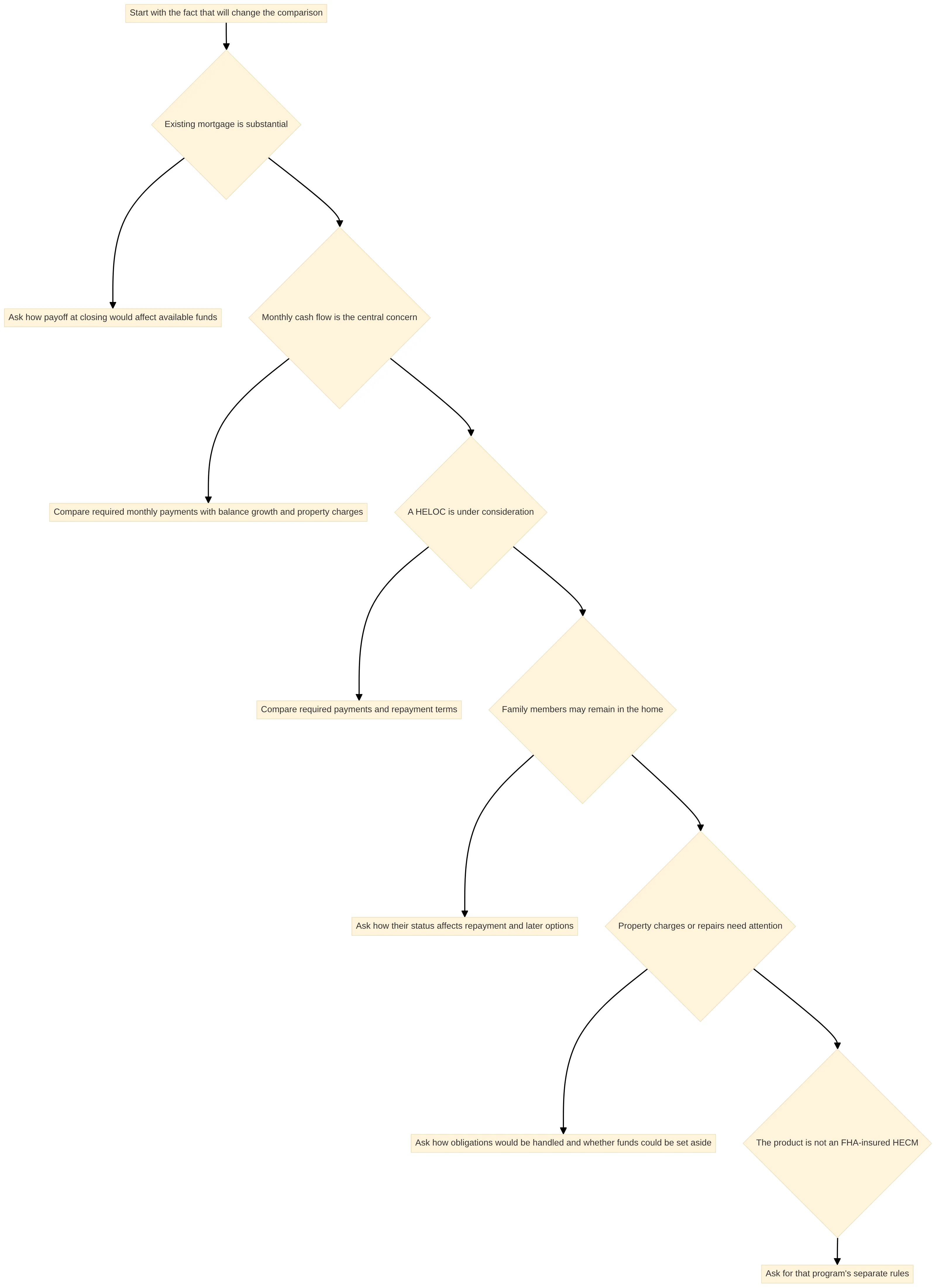
A reverse mortgage decision becomes more useful when the next question is narrower than “Should I get one?” Start with the fact that will change the comparison:
- If an existing mortgage is substantial, ask how payoff at closing would affect available funds.
- If monthly cash flow is the central concern, compare the absence of required monthly principal and interest payments with balance growth and ongoing property charges.
- If a HELOC is under consideration, compare its required payments and repayment-period terms with the reverse mortgage structure.
- If family members may remain in the home, ask how their status affects repayment and what options they would have later.
- If property charges or repairs need attention, ask how those obligations would be handled and whether funds could be set aside.
- If the product is not an FHA-insured HECM, ask for that program’s separate rules rather than applying HECM assumptions.
Each branch ends with a question you can document. That is more useful than assigning a universal answer to every homeowner.
Neither is “better.” The right outcome depends on cash flow, income, existing mortgage, age, long-term goals, and the desire to make monthly payments. We provide clear, unbiased education so families can understand reverse mortgage options and prepare better questions.
A personalized comparison should show the assumptions, payment obligation, balance effect, homeowner responsibilities, and repayment event for each option under review. Keep those categories together when you move from general education to a personal discussion.
Invite a personal follow-up
A reverse mortgage merits further investigation when you can name the product, the purpose, the payment format, the ongoing property responsibilities, and the repayment questions that matter to your household. Bring your comparison file so the discussion starts with facts rather than assumptions.
We offer reverse mortgage services and provide clear, unbiased education to help families understand their options. A qualified professional must decide whether any option fits your circumstances.
Have questions about this?
Talk to a Certified Reverse Mortgage Professional — directly.
When you call, you reach me — not a call center. Free 30-minute consult by phone, video, or in person. No SSN, no credit pull, no obligation.
Schedule a consult