

reverse mortgage pros and cons
Reverse Mortgage Pros and Cons: A Decision Guide for Older Homeowners

Start with the conditions behind the decision
A reverse mortgage decision starts with the retirement need you want home equity to address, not with the loan label itself. You may be looking for a way to create more room in your monthly budget, fund a planned move, keep more cash available, or coordinate housing and family goals. The useful question is whether the product’s payment structure and long-term conditions match that purpose.
A reverse mortgage can let you access part of your home’s equity without selling it, but it has different benefits, costs, and risks from a home equity loan or home equity line of credit, commonly called a HELOC. The trade-off is not simply access to money versus no access. You are also considering how the balance can grow, which homeowner duties continue, how an existing mortgage is handled, and what event makes repayment due.
Your circumstances give the decision its shape. Before you compare a reverse mortgage with another option, write down these five facts:
- The retirement expense, housing change, or cash-flow need you want to address.
- Whether your home is your principal residence and whether you plan to remain there.
- The balance and payment obligation on any existing mortgage.
- The property taxes, insurance, maintenance, repairs, and other housing costs you continue to handle.
- How your household wants to approach the home and loan balance later.
This list is not an approval test or a prediction of what you will qualify for. It keeps the conversation tied to your actual household rather than to a general promise. A HUD-approved counseling discussion can also cover your goals, future housing needs, family considerations, reasons for considering the loan, and alternatives.
Name the FHA-insured HECM before weighing its trade-offs
A Home Equity Conversion Mortgage (HECM)—commonly known as a reverse mortgage—is an FHA-insured loan that allows eligible homeowners to access a portion of their home equity through a cash lump sum, line of credit, monthly payments, or a combination of these options. Most reverse mortgages today are Home Equity Conversion Mortgages, or HECMs, and HECMs are federally insured by the Federal Housing Administration.
The word “reverse” describes the direction of the payment relationship. With a traditional mortgage, you generally make principal-and-interest payments that reduce the balance over time. With an HECM, interest and fees are added to the loan balance over time. There are no required monthly principal-and-interest payments, but the balance can grow.
An HECM does not transfer ownership of your home to the lender. You keep title, and the home serves as security for the loan. You still need to use the property as your principal residence, pay property taxes and homeowners insurance, and keep the home in good condition.
The HECM label also does not answer every personal question. Property value, the existing mortgage, property condition, ongoing charges, household plans, and the selected payment structure all affect the discussion. Before obtaining a reverse mortgage, you must receive counseling from a HUD-approved reverse-mortgage counselor. Treat that counseling as part of understanding the product, not as a substitute for examining your own facts.
Identify the retirement cash-flow change being considered
Retirement cash flow is the first practical benefit to test. A reverse mortgage can turn part of your home equity into proceeds while you remain in the home, so the decision may relate to a recurring budget need, a planned expense, a reserve, or a housing goal. The available formats include a cash lump sum, a line of credit, monthly payments, or a combination. The format matters because each one changes when and how proceeds become available.
A payment option is not the same as income, and proceeds do not establish that a particular expense will be covered. Start by writing the purpose in a single sentence: “I am examining this option because ____.” Then separate the amount or timing you are considering from the broader question of whether using home equity fits your retirement plan. This keeps a possible cash-flow benefit beside the balance growth and repayment conditions that come with the loan.
That sentence can also separate the purpose from the payment design. A recurring housing cost raises a different question from a one-time expense: you can ask whether access is needed once, periodically, or only as a reserve. A line of credit and monthly payments are not interchangeable descriptions; they identify different ways proceeds may be made available. Record not only the amount you are considering, but also the timing of access and the reason for it. This makes it easier to notice when the proposed structure does not match the stated purpose. It also keeps a planned move in view: a payment format that appears useful while you remain in the home must be considered alongside the repayment event tied to a sale or move. These are questions for product-specific review, not promises about availability or qualification.
Your cash-flow review can use these questions:
- Is the need recurring, occasional, or tied to a planned housing change?
- Would a lump sum, line of credit, monthly payments, or a combination match the timing of that need?
- What housing costs would remain your responsibility after closing?
- What existing mortgage balance or other property charge would need attention at closing?
- If your plans change, how would a move or a sale affect the loan?
You can also separate the purpose into three parts: the amount you are considering, when you would need access to proceeds, and how long you expect to remain in the home. Those details help distinguish a short-term cash need from a longer housing plan. They do not produce a personal recommendation.
A reverse mortgage may be worth further investigation when payment flexibility addresses a defined purpose and you can continue your property responsibilities. It may deserve a different comparison when the purpose, timing, or housing plan remains unsettled.
Put balance growth beside payment flexibility
Loan-balance growth is the principal cost of receiving payment flexibility without required monthly principal-and-interest payments. Interest and fees are added to the reverse-mortgage balance over time, so the balance can grow rather than being reduced by traditional monthly principal-and-interest payments. The amount and pace of growth depend on the loan terms, the balance, the proceeds received, and the interest and fees that apply.
That growth affects the equity remaining in the home. If you receive more proceeds or keep the loan outstanding for longer, more of the home’s value may be committed to the loan balance. This is a consequence to place beside the immediate cash-flow purpose, not a forecast of your future equity. A useful review asks what flexibility you gain now and what claim the growing balance may represent later.
Use a two-column record before discussing a specific estimate:
| Payment flexibility to examine | Balance and equity questions to examine |
|---|---|
| Which payment format matches the timing of your purpose? | How can interest and fees affect the balance over time? |
| Which proceeds would be available under the selected structure? | How could the balance affect the equity left in the home? |
| What payment obligation would not be required each month? | What event would make repayment due? |
| Which housing costs would remain yours? | How would your household discuss the home later? |
Add a third note beneath the record for assumptions that could change the discussion, such as the time you expect to remain in the property, the amount of equity already committed to another mortgage, or a possible move. The record does not calculate a result. It keeps a benefit and its corresponding trade-off in the same view.
The CFPB describes reverse mortgages as having different benefits, costs, and risks from home equity loans and HELOCs.
One useful refinement is to read the record across three moments. At the first moment, note the payment flexibility or access to proceeds being examined. While the loan remains outstanding, note that interest and fees are added to the balance and that the balance can grow. At the later repayment event, note which household plans and property decisions will have to be considered. Looking across those moments prevents the immediate payment feature from standing alone. It also distinguishes a question about current cash flow from a question about the equity that may remain later. The record is most useful when each benefit has a corresponding condition written beside it, rather than when the features are reviewed as separate lists.
Separate the lack of required principal-and-interest payments from homeowner duties
A reverse mortgage has no required monthly principal-and-interest payments, but it does not remove your ongoing homeowner responsibilities. The homeowner keeps title to the home; the home serves as security for the loan. A reverse-mortgage borrower must continue paying property taxes and homeowners insurance.
Property charges can also include items such as flood insurance premiums, ground rent, condominium fees, planned-unit-development fees, homeowners’ association fees, or special assessments, depending on the property. This distinction matters: the absence of required monthly principal-and-interest payments does not mean that housing costs disappear. Property taxes, insurance, maintenance, repairs, and other applicable charges remain part of the household budget.
A practical homeowner-duty check includes:
- A list of property taxes and insurance premiums, with their payment timing.
- Any association fees, special assessments, flood insurance, ground rent, or similar charges tied to the property.
- A realistic maintenance and repair record for the home.
- The person or account responsible for each payment if more than one household member is involved.
- A plan for keeping the home as your principal residence while the loan remains in place.
Eligibility may depend on having funds, or setting aside loan proceeds, for ongoing property charges, maintenance, and repairs. The property must also meet required standards. This is a direct fit question: the absence of required principal-and-interest payments helps only if you can continue meeting your other housing obligations.
Check the property and mortgage conditions that affect the fit
Property value and condition affect the reverse-mortgage discussion. The value of the property affects the equity available, and an FHA-insured HECM is subject to an FHA loan limit. Some homes may need repairs to meet required property standards, and the available equity can differ from one property to another. These facts make a general description useful for orientation but insufficient for a personal estimate.
Review the property as it exists today. Consider its current use, condition, ownership record, association obligations, insurance, taxes, and any repairs that may need attention. If you plan to move, rent the home, or change how you occupy it, raise that plan before relying on a reverse-mortgage structure that is tied to principal-residence requirements.
An existing mortgage is another condition to examine. With a traditional FHA HECM, the existing mortgage is usually paid off at closing. More generally, any existing mortgage must be payable at closing with your funds or reverse-mortgage proceeds. A reverse mortgage does not make an existing balance disappear; the balance must be addressed as part of closing.
Prepare these records for a discussion:
- The current mortgage statement and payoff information.
- Any home equity loan, line of credit, lien, or other recorded obligation.
- Recent property-tax and homeowners-insurance information.
- A list of repairs, association charges, and property assessments.
- Your expected housing plans for the period you may remain in the home.
This record helps separate a property question from a payment question. It also gives a qualified professional the facts needed to explain which conditions apply, what may require further review, and which alternative paths deserve comparison.
An existing balance therefore affects more than the eligibility discussion. If reverse-mortgage proceeds are used to pay it at closing, those proceeds are not also available for the retirement purpose being examined. If your own funds are used, those funds belong in the household’s cash-reserve discussion. The useful question is not simply whether a mortgage exists, but how its payoff would change the payment obligation, available proceeds, and remaining reserves. Ask for the payoff amount and how closing would account for it. Keep this separate from later balance growth: paying off an existing mortgage at closing addresses that prior debt, while the reverse-mortgage balance follows its own terms.
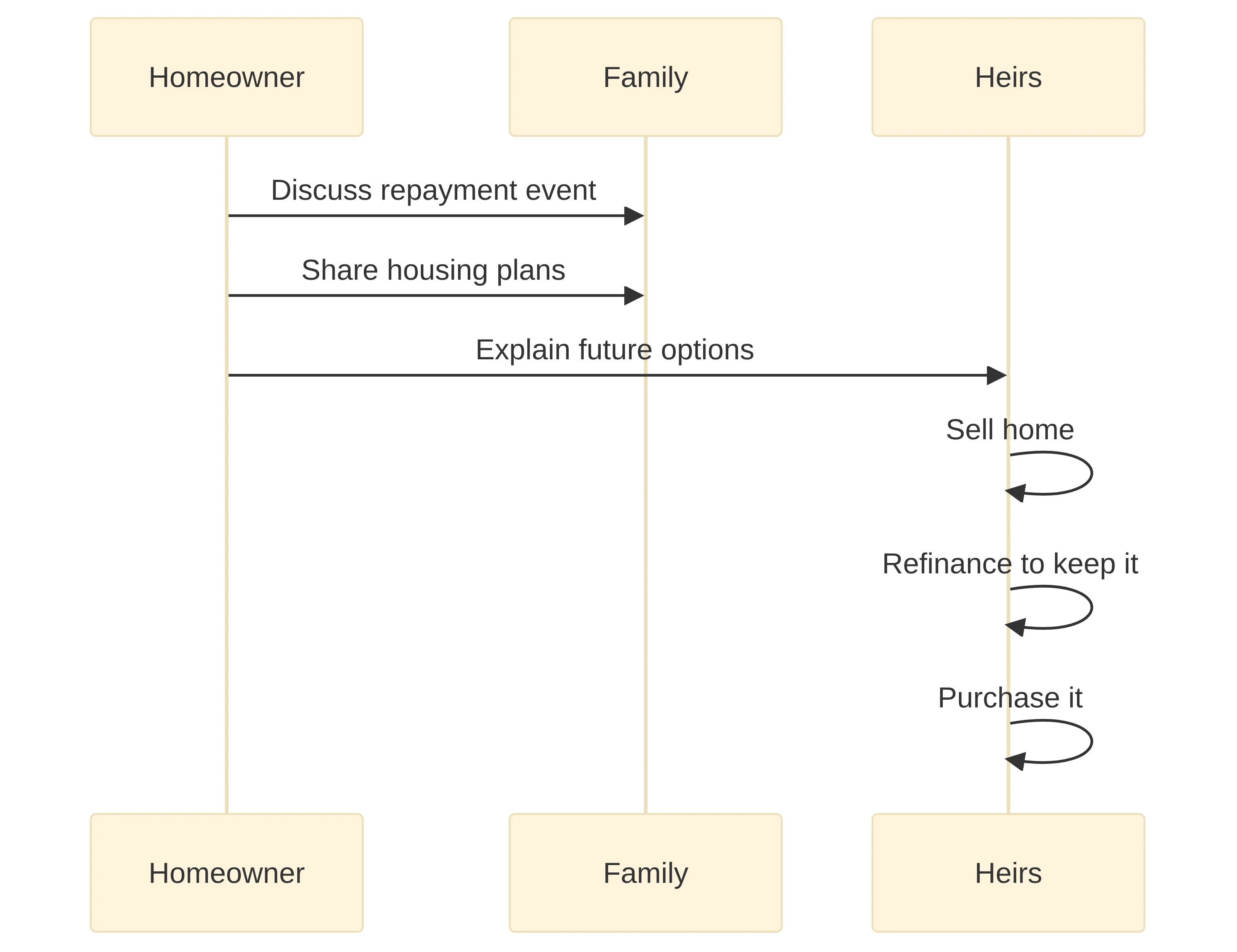
Bring the future repayment event into the household discussion
Repayment is tied to a future event rather than to a routine monthly principal-and-interest schedule.
Discuss that event before deciding whether to investigate further. Ask who needs to understand the loan, how a future move would be handled, what your household expects regarding the home, and which records should be kept. The goal is not to predict a future sale or assign a future outcome. The goal is to make the repayment condition visible while you are evaluating the product.
Independent HUD-approved counseling is required, and family members are encouraged to participate when you want their involvement. Family participation can bring future housing needs, dependent needs, and alternatives into the same conversation as the loan balance and property duties.
These options should be explained well before the decision is needed. Questions for the family conversation include:
- What would each person need to know if you moved or sold the home?
- Who should receive copies of the closing documents and servicing information?
- Which ongoing property responsibilities need a clear owner?
- What does the household want to understand about the home and the balance later?
- Which alternative should be reviewed before a decision is made?
Do not treat family agreement as a substitute for your informed decision. Treat family participation as a way to surface housing plans, responsibilities, and questions while there is time to address them.
Compare the payment obligation with a home equity loan or HELOC
A home equity loan or HELOC uses home equity too, but its payment obligation differs from a reverse mortgage.
| Question | Reverse mortgage | Home equity loan or HELOC |
|---|---|---|
| How is home equity accessed? | Through a reverse-mortgage structure that may provide a lump sum, line of credit, monthly payments, or a combination. | Through a loan or line of credit secured by the home. |
| Is a required monthly principal-and-interest payment described in the comparison? | No required monthly mortgage payments. | Monthly payments are required. |
| What cost direction does the CFPB report describe? | Generally higher costs. | Generally lower costs. |
| What changes if a traditional HELOC’s draw period ends? | This question does not describe the reverse-mortgage structure. | Monthly payments can increase substantially when the loan enters repayment. |
| What must you compare? | Balance growth, property duties, repayment event, and payment format. | Payment amount, repayment timing, costs, and ability to meet the monthly obligation. |
Neither is ‘better.’ The right comparison depends on your cash flow, income, existing mortgage, age, long-term goals, and desire to make monthly payments. A reverse mortgage may address a need for payment flexibility, while a home equity loan or HELOC may fit a household prepared for required monthly payments and the related cost structure. Those are comparison points, not a universal ranking.
A traditional HELOC also requires attention to the transition from its draw period into repayment. Monthly payments can increase substantially at that point, so ask for the payment schedule beyond the initial draw period rather than comparing only the opening terms. I prepare personalized comparisons instead of recommending the same solution for everyone. The cited CFPB report is the basis for the general comparison above; it should not be read as a current quote for a particular loan. Actual costs, payment amounts, protections, and repayment terms depend on the specific FHA-insured HECM, home equity loan, or HELOC being examined. For a useful side-by-side review, ask which costs apply at closing, which amounts are added to the balance, when required payments begin, how the payment changes after a traditional HELOC draw period, and what event makes the balance due. Keep the product name beside each answer. This prevents a general statement about reverse mortgages from being silently applied to a HELOC, and it prevents an HECM description from being applied to a different reverse-mortgage program. The comparison is strongest when it records both the feature and the condition attached to it.
Keep proprietary reverse mortgages separate from HECMs
A proprietary reverse mortgage is a separate product from an FHA-insured HECM. The HUD handbook states that proprietary reverse mortgages are not federally insured. The handbook also says that, when these products are available, counselors should provide a comparison of their costs and benefits with those of HECMs.
That distinction matters because you cannot carry an HECM feature, limit, eligibility assumption, or cost description into a proprietary program without checking the separate terms. An HECM is subject to an FHA loan limit, while property value and the available lending program affect the discussion. Keep the product name attached to every question: ask whether a statement applies to an FHA-insured HECM or to a proprietary reverse mortgage.
Use a separate comparison record for each product. For an FHA-insured HECM, examine FHA insurance, the applicable FHA loan limit, payment format, balance growth, property duties, and repayment conditions. For a proprietary reverse mortgage, ask whether it is federally insured, how its costs and benefits compare with an HECM, which property values and borrower circumstances it addresses, and which terms govern repayment.
If you’re interested in Jumbo, Proprietary, or Hybrid Retirement Mortgage options, contact Angella for a personalized comparison and estimate based on your unique goals and situation. These programs are not interchangeable with an HECM, so the product name should remain visible throughout the discussion.
Use five fit questions to choose what to investigate next
Five fit questions can turn a broad reverse-mortgage search into a focused next conversation. Answer each question with your own facts, then mark the items that need professional review.
- What retirement purpose would the proceeds address? Describe the expense, reserve, housing change, or cash-flow need and identify whether the timing calls for a lump sum, line of credit, monthly payments, or a combination.
- Can you continue the homeowner duties? Review property taxes, homeowners insurance, maintenance, repairs, principal-residence use, and other charges tied to the home.
- How would the balance and equity trade-off fit your plans? Account for interest and fees being added to the balance and for the effect a growing balance may have on the equity remaining in the home.
- What property and mortgage facts require review? Gather the current mortgage balance, payoff information, property condition, value information, insurance, taxes, and any liens or assessments.
- Which alternative deserves a side-by-side comparison? Compare a reverse mortgage with a home equity loan, HELOC, or separate proprietary program using payment obligation, costs, protections, product rules, and long-term housing plans.
The questions do not tell you to proceed or to set the option aside. They tell you what kind of review is needed. If the first question has no defined answer, clarify the retirement purpose before comparing loan structures. If the second question exposes a property-duty issue, address that condition before treating payment flexibility as a benefit. If the third or fifth question raises a trade-off, keep both products in view rather than ranking one in the abstract.
I provide clear, unbiased education to help families understand reverse mortgage options. I will tell you if a reverse mortgage is not the right solution for your situation, and I have access to the full reverse mortgage market to choose the program that fits your situation. Those are reasons to bring a complete question list, not reasons to skip the product and household review.
You can sort the answers into three review paths. A defined purpose with a payment structure that matches its timing points toward a focused product comparison. A defined purpose paired with unresolved property duties, an existing mortgage, or an uncertain plan to remain in the home points toward closer review of those conditions before the payment feature is assessed. An undefined purpose means the first task is to clarify what the home equity would address, rather than comparing products by label. This sorting method does not decide suitability. It identifies which unanswered question could change the discussion most.
Mark each answer as documented, needs explanation, or not yet known. A missing answer is not evidence that the product works or fails for the household. It is a signal to keep that issue visible when discussing eligibility, costs, payment choices, property obligations, and the repayment event. That approach also helps an adult child or professional advisor support a homeowner without substituting a general article for a personal review.
Use HUD-approved counseling as an information checkpoint
HUD-approved counseling is a required checkpoint before obtaining a reverse mortgage. The counseling discussion can address your financial needs and goals, future housing needs, family or dependent needs, the reasons you are considering the loan, and the alternatives you have considered.
Bring your five fit questions and the records you have gathered. Ask the counselor to explain the product being discussed, the payment choices, the balance-growth mechanics, the homeowner duties, the repayment event, and the alternatives that apply to your circumstances. Ask which assumptions require a separate review. A detailed discussion gives you a structured place to examine the decision before signing loan documents.
Your counseling notes should distinguish facts from questions that remain open:
- Household purpose: what you want the proceeds to address and when.
- Product: FHA-insured HECM, proprietary reverse mortgage, or another option.
- Property: principal-residence use, value, condition, taxes, insurance, repairs, and assessments.
- Existing debt: current mortgage balance, payoff requirements, liens, and other secured obligations.
- Payment structure: lump sum, line of credit, monthly payments, or a combination.
- Future event: what a sale, move, or death would mean for repayment and housing plans.
- Alternative comparison: required payments, costs, protections, and conditions for each option.
The record is a practical aid for organizing questions and notes. It does not establish eligibility, calculate a loan amount, or decide suitability. For an HECM, the FHA loan limit and the property’s value remain part of the product-specific review.
Before the conversation ends, ask the professional to identify the assumptions behind any explanation or estimate. Ask which product rules are being used, how the existing mortgage would be handled, which payment format is being discussed, and which ongoing property charges remain the homeowner’s responsibility. Ask what changes if the homeowner sells the property, moves out, or otherwise reaches the repayment event, and ask how the household’s alternatives compare under their own payment obligations. If a proprietary reverse mortgage or HELOC is mentioned, write its name beside every answer so its terms are not blended with HECM rules. These questions turn counseling notes into a record of what was explained, what still needs documentation, and what the household wants to compare next.
A conditions-first review of the loan decision
I use a conditions-first review. The sequence starts by identifying the product being considered, then places payment flexibility beside the balance growth that interest and fees can create. It next examines the existing mortgage and property requirements, including the principal-residence requirement. It ends with the event that makes the loan due: when the last borrower permanently leaves the home, sells the property, or passes away. This keeps the trade-offs connected to the conditions that can affect the decision without ranking the options.
Neither is “better.” A home equity loan or HELOC has a different payment obligation, including required monthly payments. A qualified professional must determine individual suitability, eligibility, and the terms that apply to your circumstances. I provide clear, unbiased education about reverse mortgage options, and I will tell you if a reverse mortgage is not the right solution for your situation.
What should I ask before exploring a reverse mortgage?
What are the main benefits of a reverse mortgage?
A reverse mortgage allows older homeowners to access a portion of their home equity without selling their home, providing potential cash flow for retirement needs. It offers flexibility in payment options, such as a lump sum, line of credit, or monthly payments, and does not require monthly principal-and-interest payments.
What ongoing responsibilities do homeowners have with a reverse mortgage?
Homeowners with a reverse mortgage must continue to pay property taxes, homeowners insurance, and maintain the home in good condition. These responsibilities remain even though there are no required monthly principal-and-interest payments.
What should I discuss with my family regarding a reverse mortgage?
It’s important to discuss how a reverse mortgage may impact future housing needs, the responsibilities of maintaining the home, and what will happen to the home and loan balance if a move or sale occurs. Family members should be involved in understanding the loan and its implications.
Have questions about this?
Talk to a Certified Reverse Mortgage Professional — directly.
When you call, you reach me — not a call center. Free 30-minute consult by phone, video, or in person. No SSN, no credit pull, no obligation.
Schedule a consult