

how long does it take to get a reverse mortgage
How Long Does It Take to Get a Reverse Mortgage?

Start with a planning range, not a promised finish date
One process guide estimates 30–45 days for well-prepared borrowers, but that is a general range, not an individualized timeline. The next milestone depends on finishing the step in front of you and resolving questions about your documents, property, mortgage, or financial assessment.
The practical answer is this: plan around a sequence of readiness gates. You learn how the loan works, complete HUD-approved counseling, prepare the application record, document the property, move through underwriting, sign the closing documents, and then wait through the required rescission period before funds are released. A missing item at any point can leave the next gate unopened.
Your planning question should therefore be more specific than “How many days will this take?” Ask which stage is complete, which item is still outstanding, and what event allows the next stage to begin. That wording gives you a useful status update without treating a general range as an individualized forecast.
The closing stage has a required boundary that cannot be skipped. After you sign with a notary or closing agent, a mandatory three-business-day right of rescission follows; funds are released after that period ends. The signing typically takes about an hour, but signing is not the same as funding.
If you are planning around a home repair, an upcoming move, a recurring bill, or another retirement-finance date, record the date you need information rather than assuming that date will be the funding date. Ask what must be complete before the file can meet that planning need. That distinction helps you make room for document requests and required waiting periods.
Identify the HECM timeline being discussed
This guide follows the timeline for an FHA-insured HECM.
A reverse mortgage provides loan proceeds secured by home equity, with repayment deferred until a future time. If you have an existing mortgage balance, it must be paid off when you close, using your funds or reverse-mortgage proceeds. That payoff requirement can affect the application record and the amount of usable proceeds, so it belongs in the timeline conversation from the beginning.
For 2026, the FHA HECM lending limit is $1,249,125. FHA reviews the limit every year.
The product label matters because a proprietary reverse mortgage is not insured by the Federal Housing Administration, unlike an FHA-insured HECM. Proprietary, jumbo, and hybrid retirement mortgage programs are separate products and should not be assigned HECM timing, eligibility rules, or calculations.
The process questions in this article apply to an FHA-insured HECM unless a professional tells you that a different product is being considered. If you are comparing products, ask which program the timeline describes before you compare any date, document list, or estimate.
Overview
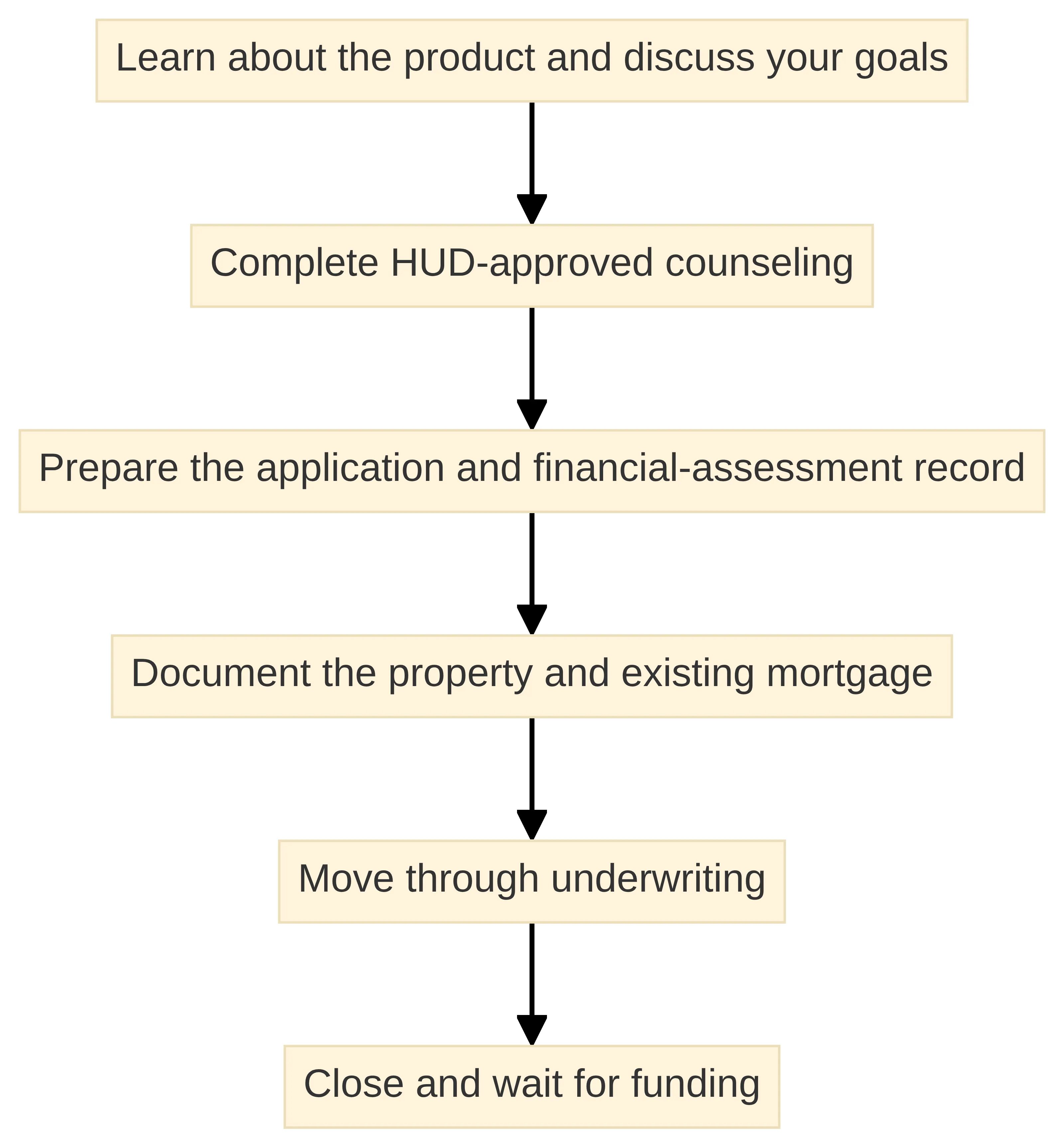
The process overview follows this order:
- Learn about the product and discuss your goals. You identify the purpose of the inquiry, the payment format being considered, and the questions that need answers.
- Complete HUD-approved counseling. Counseling is a required step for a reverse-mortgage borrower.
- Prepare the application and financial-assessment record. The file brings together your information and the details needed to evaluate ongoing property obligations.
-
- Move through underwriting. An underwriter performs the credit analysis and makes the underwriting decision.
- Close and wait for funding. You sign final documents with a notary or closing agent, complete the three-business-day right of rescission, and receive funds after that period ends according to the selected payment option.
The readiness gates do not all take the same amount of time. Counseling availability, the completeness of your documents, property questions, and underwriting follow-up can affect when the next stage opens. A process guide describes 10 sequential HECM stages from initial consultation through funding and estimates 30–45 days for well-prepared borrowers; that estimate does not replace a file-specific timeline.
A useful status record has three columns: completed, outstanding, and next event. Updating those columns after each conversation helps you see whether the process is waiting on you, the property, the lender, a counselor, or a required waiting period.
The sequence also explains why a calendar estimate can change without the overall process changing. Counseling remains counseling, an appraisal remains an appraisal, and underwriting remains a separate review. The open question is usually which gate has been reached and what condition must be met before the next one begins.
A calendar view can make the sequence easier to plan because not every interval is measured in the same way. HUD counseling has no stated duration here, so the useful timing question is when an appointment is available and when its required record will be ready. Those are planning markers, not promises for an individual file.
It does not eliminate time spent collecting documents, responding to questions, completing property work, or waiting for a third party.
Because that planning window starts at application while the separate 30–45-day guide estimate is described from initial consultation through funding, neither range should be treated as a personal forecast. Ask which starting point a timeline uses, which stage is complete, and whether the next interval is waiting on you, the property, the lender, or a required waiting period.
Some dates are expected durations, while others depend on readiness or availability. If a date moves, ask which category changed. A moved counseling appointment points to scheduling availability; a later appraisal report may involve property access or review; and a later underwriting decision may mean the file is not yet complete for that review. Identifying the category helps you ask about the cause of a change rather than treating every delay as the same kind of wait.
Begin with learning and an initial conversation
The initial conversation should begin with learning, not with a promised result. You can use this conversation to describe what you want the home equity to accomplish, identify the product under discussion, and create a list of questions for the remaining stages.
Useful opening questions include:
- Which product are we discussing: an FHA-insured HECM or another retirement-lending program?
- What stage would begin after this conversation?
- Which documents should I begin gathering?
- Is an existing mortgage balance part of the closing calculation?
- What property or occupancy details could affect the next milestone?
- Who will tell me when the file is ready to advance?
The initial conversation does not establish approval, a funding date, or the amount you may receive. It establishes the questions that must be answered. You remain the homeowner with a reverse mortgage, and title remains in your name; the loan is secured by the home.
A clear first conversation also separates the loan question from the household decision. You may be considering retirement expenses, home repairs, medical costs, or another use for equity, but the timeline still turns on the product, your property, your documents, and the required process steps. Write down the purpose you want to evaluate and the information you need before you decide whether to continue.
Complete HUD-approved counseling before the application advances
HUD-approved counseling is a required step for a reverse-mortgage borrower.
Counseling availability can affect the sequence. A process guide says that scheduling counseling can create a 1–2 week delay, so ask about this step early rather than treating it as an item to arrange after every other task. The exact appointment timing depends on counselor availability and your ability to complete the required discussion.
Use counseling as a checkpoint for questions such as:
- What responsibilities continue after closing?
- How does an existing mortgage balance fit into the closing?
- What property documents may be needed?
- What happens when you no longer live in the home?
- Which part of the proposed timeline is a required waiting period, and which part depends on file preparation?
Counseling does not turn a general timeline into a personal approval decision. Keep the counseling certificate and any follow-up questions with your other process records, then ask the professional handling the application what item is needed next.
Prepare the application and financial-assessment record
The application stage turns the initial discussion into a documented file. The financial-assessment record must address whether ongoing property charges can be paid.
The application record addresses property taxes, homeowners or hazard insurance, flood insurance when applicable, and HOA, planned-unit-development, or condominium fees. Those records help establish the property obligations that belong in the file. Ask for a written list of the documents requested for your circumstances rather than relying on a general checklist.
A practical preparation list includes:
- Your current mortgage statement, if a balance remains.
- Property-tax information and insurance declarations.
- Flood-insurance information when it applies to the property.
- HOA, planned-unit-development, or condominium fee information when applicable.
- Documents requested for the financial assessment.
- A written list of any federal debt, title, ownership, or property questions that need an answer.
The useful action is not to guess which documents apply. Ask which item is missing, who must provide it, and whether the file can advance while that item is being obtained.
An existing mortgage balance deserves early attention because it must be paid off at closing with your funds or reverse-mortgage proceeds. Ask how the payoff statement will be obtained, how long it remains valid, and whether any other lien or title question needs resolution before closing. These questions identify dependencies without assuming that every property has the same record.
A complete application record does not guarantee approval. It gives the next professional enough information to review the file and identify what remains.
To keep the record usable, separate documents into three groups: items already accepted, items sent but awaiting review, and items still requested. Add the date each item was sent and the person or organization responsible for the next response. This simple record can show whether a delay is caused by collection, review, correction, or a required waiting period.
Let the property record determine the next dependency
Association and insurance records can also become dependencies. A condominium or HOA property may therefore need association information before the file can be fully reviewed.
Ask these questions as soon as the property type is known:
- Has the appraisal been ordered, completed, or returned?
- Is the appraiser waiting for access or property information?
- Does the report identify a property-standard item?
- Is an HOA or condominium letter needed, and who is responsible for requesting it?
- Are the insurance, tax, and association records complete?
- Does any title or lien question remain open?
These questions do not establish that a particular document is required in every file. They identify the property dependencies that can affect your next milestone.
The appraisal’s value conclusion can affect the amount available under the loan, so timing and amount are connected at this stage. Do not treat an early estimate as a final result. Ask whether the estimate is based on an appraisal, what property information is still pending, and whether the product being discussed is an FHA-insured HECM or a different program.
Move from a complete file to underwriting review
Underwriting review begins after the application and property information are ready for analysis. HUD guidance describes the sequence this way: the lender assigns an appraiser to determine property value, and an underwriter then performs the mortgage credit analysis before making the underwriting decision.
The underwriting gate is therefore different from the appraisal gate. An appraisal can answer property-value and property-standard questions, while underwriting reviews the broader file. If the underwriter requests clarification or another document, the file may return to preparation before a decision is made.
A useful underwriting status request has four parts:
- Is the file complete for underwriting review?
- Has the appraisal been received and accepted for the next review?
- Is the underwriter waiting for a document, explanation, payoff figure, or property response?
- What event marks the move from review to the next stage?
A process guide treats the HECM path as a series of sequential stages, while HUD guidance identifies the underwriter’s decision as a distinct stage. Your file status and the items still outstanding matter more than a broad calendar estimate.
An underwriting decision is not the same as a personal financial recommendation. The review addresses the requirements of the loan file; it does not decide whether using home equity fits your retirement goals. Keep those questions separate so that a process update does not become a conclusion about what you should do.
Separate signing from the final funding wait
Closing is a distinct stage after the file reaches the documents-ready point. At closing, you sign the final loan documents with a notary or closing agent; the signing typically takes about an hour. The signing completes an important milestone, but it does not mean funds are released immediately.
The final funding wait includes a mandatory three-business-day right of rescission. During that period, you may cancel the loan without penalty, and funds are released after the period ends. This waiting period is a required boundary rather than a task that can be shortened by sending another document.
Ask two separate questions: “When will signing occur?” and “When will the selected payment option be funded after rescission?” Keeping those dates separate prevents a signed document from being mistaken for the end of the process.
The selected payment option also belongs in the funding conversation. Reverse-mortgage proceeds may be structured as a cash lump sum, line of credit, monthly payments, or a combination of these options. Ask how your selected format affects the funding event and which amount, if any, is used to pay an existing mortgage balance at closing.
Check the items most likely to affect the next milestone
The delay review looks for an open dependency rather than a vague promise to wait. HUD guidance also requires records for property taxes, insurance, applicable flood insurance, and HOA, planned-unit-development, or condominium fees.
Use this checklist with the person handling your file:
- Counseling: Has HUD-approved counseling been completed, and has the required record been received?
- Mortgage payoff: Is the existing mortgage statement or payoff information current?
- Taxes: Are the requested property-tax records available?
- Insurance: Are the homeowners or hazard insurance documents complete, with flood insurance information when applicable?
- Association records: Are the HOA or condominium documents that apply to the property complete?
- Title: Has the file identified any title or lien question that needs an answer?
- Property condition: Did the appraisal identify a repair or FHA property-standard issue?
- Underwriting: Is the file waiting for a decision, clarification, or additional document?
Missing tax returns, unresolved title liens, and HOA approval letters should be handled as file-specific questions, not assumed universal requirements. Ask whether each item has been requested for your application, whether it is outstanding, and who is responsible for obtaining it. That wording gives you a concrete action without treating every property or borrower record as identical.
If a document has been submitted, ask whether it was accepted for the next stage. If it has not been requested, avoid collecting unrelated paperwork simply because another file required it. Your goal is a complete record for your circumstances, not a larger folder.
The process guide’s 30–45-day estimate applies to well-prepared borrowers as a general range, not as an assurance for every application. A useful update should name the active stage, the outstanding item, the person responsible, and the event that will follow. If the answer contains only a calendar date without a milestone, ask what must happen before that date becomes realistic.
When several items are open, ask which one controls the next milestone. A document that is merely pending review is different from a document that must be corrected, and both are different from a required waiting period. Naming that difference helps you decide what question to ask next.
Keep process timing separate from homeowner responsibilities
Homeowner responsibilities continue during and after the reverse-mortgage process. With a reverse mortgage, title remains in your name. You remain responsible for property taxes and homeowners insurance, using the home as your principal residence, and keeping the home in good condition.
Those responsibilities are not simply items on a closing checklist. They remain part of the loan arrangement and should be included in your household planning.
The process timeline answers when the file may move from one stage to another. It does not answer whether the ongoing homeowner responsibilities fit your budget or plans. Keep these questions in separate columns:
- Process: What document, review, appraisal, decision, or waiting period remains?
- Household planning: How will you handle taxes, insurance, maintenance, repairs, and principal-residence use?
- Loan structure: How will the existing mortgage be paid off, and how will proceeds be delivered?
This separation keeps a short process update from hiding a long-term obligation. It also gives you better questions for counseling and for any later conversation about personal suitability.
Repayment is tied to the point when you no longer live in the home, rather than to the date of the initial inquiry or the date of counseling. Ask how the repayment event is defined for the product under discussion and how your household wants to address that future question. The process timeline and the later repayment event are related, but they are not the same milestone.
Ask which stage is complete and what comes next
The clearest timeline conversation is a stage-and-dependency conversation. Ask for answers to these questions:
- Which stage is complete today?
- Which stage is active now?
- What exact item is still outstanding?
- Who is responsible for providing or reviewing that item?
- Has the appraisal been ordered, completed, or accepted for underwriting?
- Has underwriting started, and is the underwriter requesting anything else?
- What event allows the file to move forward?
- Which date is a required waiting period, and which date is only an estimate?
- After signing, when does the three-business-day rescission period end?
- When should I ask for the next status update?
Keep the answers in a simple timeline record. Write the date of each completed stage, the open item, the person responsible, and the next event. Include the distinction between signing and funding because the required rescission period follows closing.
A good record does not need to predict the entire process on the first day. It needs to show what has happened, what remains, and what will change the status. That approach matches the way the process guide describes sequential stages and the way HUD guidance separates appraisal from underwriting.
General process education can describe the steps, but it cannot establish your eligibility, approval, loan terms, or personal funding date. Keep those individual questions separate from the general timeline and ask for the specific review needed to address them.
Key Highlights
The key points are:
- The HECM process is a sequence of stages: learning, counseling, application preparation, property review, underwriting, closing, rescission, and funding.
- HUD-approved counseling is required before the reverse-mortgage process can advance through its later stages.
- An existing mortgage balance must be paid off at closing with your funds or reverse-mortgage proceeds.
- The appraisal addresses property value and FHA property standards, while underwriting performs the credit analysis and makes the underwriting decision.
- Incomplete documentation can delay the next milestone, so ask which item is missing and who must provide it.
- Property-tax, insurance, flood-insurance when applicable, and HOA, planned-unit-development, or condominium records may form part of the property documentation.
- Signing and funding are separate events because a mandatory three-business-day right of rescission follows closing.
- Title remains in your name, and ongoing responsibilities include property taxes, homeowners insurance, principal-residence use, and keeping the home in good condition.
The next useful action is to ask for your present stage, outstanding item, responsible party, and next milestone in writing. That four-part update gives you a clearer planning range than a general promise that the process will finish by a particular date.
Map your individual questions through an educational follow-up
The reverse-mortgage timeline becomes easier to plan when you track the next gate instead of treating the process as one countdown. Bring your questions about counseling, documents, property records, mortgage payoff, underwriting, signing, and funding to an educational conversation.
A qualified professional must determine individual suitability, eligibility, approval, terms, and timing after reviewing your circumstances. Use the conversation to identify your current stage and the questions that remain, not to assume that a general range establishes your personal outcome.
What should I ask before discussing my reverse-mortgage timeline?
What are the main stages in the reverse mortgage process?
The main stages in the reverse mortgage process include learning about the product, completing HUD-approved counseling, preparing the application and financial assessment, documenting the property, moving through underwriting, closing, and waiting for funding.
What factors can cause delays in the reverse mortgage process?
Delays in the reverse mortgage process can occur due to incomplete documentation, scheduling issues for HUD-approved counseling, unresolved property questions, or the need for additional information from the borrower or third parties.
What responsibilities do homeowners have during the reverse mortgage process?
Homeowners are responsible for maintaining their property, paying property taxes and homeowners insurance, and ensuring the home remains their principal residence throughout the reverse mortgage process.
How does the appraisal affect the reverse mortgage process?
The appraisal determines the property’s value, which affects the available loan amount, and verifies that the property meets FHA minimum standards. If the property does not meet these standards, repairs may be required before the loan can be obtained.
What happens after closing on a reverse mortgage?
After closing, there is a mandatory three-business-day right of rescission during which the borrower can cancel the loan without penalty. Funds are released after this waiting period ends.
What should I ask a reverse mortgage professional to clarify the process?
You should ask about the current stage of your application, any outstanding documentation, who is responsible for providing it, and what the next steps are in the process.
Have questions about this?
Talk to a Certified Reverse Mortgage Professional — directly.
When you call, you reach me — not a call center. Free 30-minute consult by phone, video, or in person. No SSN, no credit pull, no obligation.
Schedule a consult