

Home Equity & HELOC
How to Access Home Equity Without Refinancing Your Low-Rate Mortgage

You love your 3% mortgage rate. But what if you need access to the equity you’ve built in your home?
If you’re wondering how to access home equity without refinancing, you’re not alone. Many homeowners have built substantial equity while holding mortgage rates far below today’s market rates. Refinancing the entire mortgage to get cash could mean replacing a low interest rate with a significantly higher one.
The good news? You may be able to access your home equity without giving up your existing mortgage rate. Options include traditional home equity lines of credit (HELOCs), home equity loans, home equity investments (HEIs), HELOC For Seniors®, and certain second-position hybrid retirement and reverse mortgages.
Each works differently, and understanding those differences can help you protect the mortgage terms you already have while putting your equity to work.
The Rate Lock Dilemma: Why Homeowners Are Hesitant to Refinance
For many homeowners, their existing mortgage is one of their most valuable financial advantages.
Imagine you purchased or refinanced your home when mortgage rates were around 3%. You’ve been making payments, building equity, and watching your property’s value change over time.
Now you want to access $100,000 for home improvements, unexpected expenses, debt consolidation, or retirement planning.
A traditional cash-out refinance may give you that money, but it generally requires replacing your entire existing mortgage.
That means the new interest rate applies not just to the additional $100,000, but to the refinanced balance of your original mortgage as well.
This is what’s known as the mortgage rate lock-in effect.
Recent home equity research highlights just how significant this issue has become. According to First American, approximately $13.2 trillion in U.S. homeowner equity was considered accessible in the second quarter of 2026, with roughly $11.6 trillion associated with mortgages carrying rates below prevailing market levels.
The challenge isn’t necessarily a lack of equity. It’s finding a sensible way to access it without unnecessarily disrupting an attractive existing mortgage.
Can You Access Home Equity Without Refinancing?
Yes. You may be able to access home equity without refinancing your first mortgage by using a traditional HELOC, home equity loan, home equity investment, HELOC For Seniors®, or an eligible second-position hybrid retirement or reverse mortgage.
These arrangements may allow your original mortgage to remain in place, preserving its interest rate and payment terms.
However, they are not interchangeable.
Some require monthly payments. Others allow repayment to be deferred. Some charge interest, while others exchange cash today for a share of your home’s future value or appreciation.
Let’s look at five options.
Option 1: Traditional Home Equity Line of Credit (HELOC)
A home equity line of credit, commonly called a HELOC, is a revolving line of credit secured by your home.
Rather than receiving all the money at once, you can generally draw funds as needed during an initial draw period, up to your approved limit.
A HELOC is often structured as a second mortgage, meaning your existing first mortgage can remain in place.
Why homeowners consider a HELOC
- Keep an existing low-rate first mortgage.
- Access funds as needed rather than borrowing everything at once.
- Generally pay interest only on amounts borrowed during an interest-only draw period, where offered.
- Use the credit line for planned or unexpected expenses, subject to lender terms.
What to consider
Most traditional HELOCs have variable interest rates, so payments can change. Many also have an initial draw period followed by a repayment period, when required payments may increase substantially.
A lender may also freeze or reduce a HELOC under certain circumstances, subject to applicable rules.
For retirees living on a fixed income, those payment changes deserve careful attention.
Related reading: HELOC for Retirees: Is a Home Equity Line of Credit a Good Idea in Retirement?
Option 2: Home Equity Loan
A traditional home equity loan generally provides a lump sum of cash, often at a fixed interest rate, with scheduled monthly principal and interest payments.
Like a HELOC, it may be placed behind your existing mortgage.
This can be attractive when you know exactly how much money you need and prefer a predictable payment schedule.
For example, if you’re planning a major home renovation with a defined budget, a fixed-rate home equity loan may be worth comparing.
However, the additional monthly payment becomes another obligation in your household budget. Qualification generally depends on credit, income, equity, and lender underwriting requirements.
Option 3: Home Equity Investment (HEI)
A Home Equity Investment (HEI) is another way to access home equity without refinancing your existing mortgage.
Unlike a traditional home equity loan, an HEI is generally structured as a contractual home equity agreement rather than a conventional interest-bearing loan.
You receive a lump sum of cash today in exchange for an agreed share of your home’s future value or appreciation.
There are typically no required monthly payments to the HEI provider. Instead, the agreement is settled later, according to its terms.
Your existing mortgage remains in place, and you continue making any required mortgage payments.
How does a home equity investment work?
Here’s the basic concept:
- You apply for a home equity investment based on your property and the provider’s eligibility requirements.
- The provider evaluates your home and presents an offer explaining the amount available, fees, valuation terms, and future settlement formula.
- If you accept, you receive a lump sum, less applicable costs.
- You continue owning and living in your home, subject to the agreement, while maintaining your existing mortgage and property obligations.
- You settle the agreement when you sell, reach the end of its term, buy out the agreement, or experience another contractually defined repayment event.
The settlement amount depends on the particular contract. Some arrangements share appreciation, while others use a percentage of future home value, valuation adjustments, or contractual caps.
An HEI may have no monthly payments or stated interest rate, but that does not mean it is free money. The amount eventually owed can be substantially greater than the cash originally received.
The HEI program I now offer
I’m pleased to offer a home equity investment program alongside my reverse and retirement mortgage solutions.
The program currently includes these features:
| Program feature | Details |
|---|---|
| Agreement term | Up to 30 years |
| Investment amount | $30,000–$600,000, up to 25% of home value |
| Credit eligibility | Scores as low as 500 considered |
| Minimum age | No minimum age requirement |
| Monthly HEI payments | None |
| Existing first mortgage | Can remain in place |
| Eligible property types | Single-family homes, condos, townhomes, and eligible 2–4 unit properties |
| Program states | Arizona, California, Colorado, Florida, Hawaii, Michigan, Oregon, Pennsylvania, and Washington |
Eligibility, investment amounts, property ownership requirements, and final terms are subject to the provider’s review. Not every homeowner will qualify.
For someone with substantial equity who wants to keep an attractive first mortgage rate, this adds another option worth evaluating.
What happens when the HEI comes due?
This is one of the most important questions to ask.
Unlike many reverse mortgages, an HEI has a contractual end date. Depending on the agreement, settlement may also be required when you sell, refinance, or experience certain triggering events.
You may be able to settle the agreement earlier using savings, sale proceeds, or financing.
But it’s important to have a realistic plan for how you’ll pay the settlement amount when the time comes.
You should also understand how the provider calculates its share if your home appreciates, stays flat, or declines in value.
A longer term can provide flexibility, but it does not eliminate the eventual repayment obligation.
Option 4: HELOC For Seniors® — A Home Equity Line of Credit Designed for Retirement
What if you could keep your low-rate first mortgage and access additional home equity through a line of credit designed specifically for homeowners age 62 and older?
HELOC For Seniors® offers that possibility, combining features of a traditional home equity line of credit with a repayment structure designed for retirement.
Unlike many traditional HELOCs, which eventually require principal-and-interest payments during a repayment period, HELOC For Seniors® offers interest-only monthly payments for the life of the loan, provided the loan remains in good standing.
The loan becomes due upon a maturity event, such as selling or refinancing the home, rather than automatically requiring full repayment at the end of the 10-year draw period.
Key benefits of HELOC For Seniors®
- Keep your low-rate mortgage. The program can be placed in second position, allowing your existing first mortgage to remain in place.
- Access $50,000 to $400,000. The amount available depends on your property, equity, credit, and other eligibility requirements.
- Interest-only monthly payments. There is no scheduled conversion to principal-and-interest payments during the life of the loan.
- Fixed rate on each draw. Each advance receives its own fixed interest rate, based on Prime plus a margin established when the line is opened. Future draws may have different rates.
- 10-year draw period. You can make additional draws during the draw period, subject to program limits and available credit.
- Flexible repayment. You can pay down the balance and redraw available funds during the draw period, subject to program terms.
- No prepayment penalty. You can repay the loan early without a prepayment penalty.
How is it different from a traditional HELOC?
Traditional HELOCs often begin with a draw period followed by a repayment period. When that happens, monthly payments can increase significantly because the borrower must begin repaying principal along with interest.
HELOC For Seniors® is structured differently.
Its interest-only payment requirement continues for the life of the loan, with the outstanding balance becoming due upon a contractual maturity event.
That can make budgeting more predictable for retirees who want to manage monthly cash flow.
However, interest-only does not mean payment-free. Monthly interest payments are required, and your payment amount can change if your outstanding balance changes. You must also continue paying your existing first mortgage, property taxes, homeowners insurance, and other required property expenses.
Is HELOC For Seniors® right for you?
This program may be worth considering if you’re 62 or older, have substantial equity in your home, want to preserve an attractive first-mortgage rate, and are comfortable making monthly interest-only payments.
It’s particularly worth comparing with a home equity investment or second-position reverse mortgage because each offers a different combination of cash flow, costs, and repayment obligations.
One important feature to understand: at least 80% of the approved credit line must be drawn at closing. This makes the program different from a traditional HELOC that may allow you to open a line and leave most of it unused.
The right choice depends on how much equity you need today, whether you anticipate needing more later, and how each option fits your retirement budget.
Option 5: Second-Position Hybrid Retirement and Reverse Mortgages
Many homeowners assume that getting a reverse mortgage means they must pay off their existing first mortgage.
That’s generally true with a traditional FHA-insured Home Equity Conversion Mortgage (HECM), which typically requires existing mortgage liens to be paid off at closing.
However, some hybrid retirement mortgage and proprietary reverse mortgage programs are specifically designed to sit in second position behind an existing first mortgage.
I offer both types of programs, giving eligible homeowners another way to access equity while preserving an attractive first-mortgage rate.
This can be particularly valuable for homeowners approaching or already enjoying retirement who don’t want to refinance a low-rate mortgage.
How do second-position hybrid retirement and reverse mortgages work?
With an eligible second-position program, your existing first mortgage stays in place.
The new mortgage is secured by your home in second position, and its repayment structure depends on the program.
Some programs are designed to reduce required monthly payments on the new financing. Others may offer flexible or partial payment features that help homeowners manage cash flow and loan balance growth.
Depending on the program, homeowners may be able to:
- Keep their existing low-rate first mortgage, including its interest rate and payment terms.
- Access additional home equity without refinancing the first mortgage.
- Avoid required monthly principal and interest payments on the second-position reverse mortgage, where the program provides that feature.
- Explore hybrid retirement mortgage structures with payment options tailored to their goals.
- Preserve more flexibility in their retirement cash flow.
What homeowners should understand
Keeping your first mortgage means you must continue making its required payments.
You also remain responsible for property taxes, homeowners insurance, maintenance, and other obligations associated with the property and financing.
Not all hybrid retirement mortgages have the same payment requirements, and not all reverse mortgages can be placed in second position. Eligibility, minimum age, available proceeds, loan terms, and repayment provisions depend on the specific product.
For eligible homeowners, these programs deserve consideration alongside HEIs and traditional home equity financing.
Compare Your Options: Five Ways to Access Home Equity Without Refinancing
These options can preserve your existing first mortgage, but their costs and repayment structures are different.
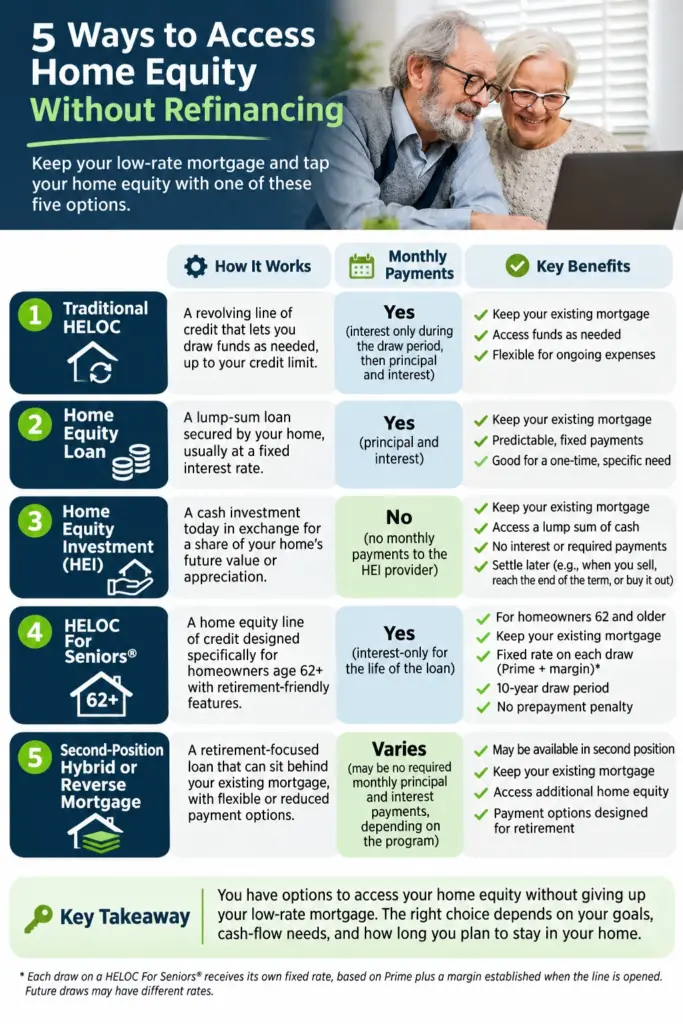
There isn’t one answer that’s right for every homeowner.
The better question is: Which option gives you the funds you need while supporting your longer-term financial plans?
Example: Keeping a 3% Mortgage While Accessing $100,000
Let’s consider a hypothetical homeowner:
- Home value: $800,000
- Existing mortgage balance: $250,000
- First-mortgage interest rate: 3%
- Equity: $550,000
- Additional funds desired: $100,000
A cash-out refinance would generally replace the existing $250,000 mortgage with a new, larger loan, subject to closing costs and underwriting.
But what if the homeowner wants to preserve that 3% rate?
A traditional HELOC or home equity loan might provide the additional funds while keeping the original mortgage intact. The homeowner would take on an additional payment obligation.
An HEI might provide a lump sum without a scheduled monthly payment to the HEI provider, but the homeowner would exchange part of the home’s future value or appreciation and eventually need to settle the agreement.
For a homeowner age 62 or older, HELOC For Seniors® might offer another alternative, with interest-only monthly payments and a fixed rate on each draw. The required initial advance and other product terms would need to be considered.
An eligible second-position hybrid retirement or reverse mortgage might also preserve the first mortgage while providing access to equity under a payment structure designed for the homeowner’s retirement goals.
The right comparison would include not just the initial $100,000, but also:
- How much cash the homeowner actually receives after fees.
- Required monthly payments.
- The total projected cost over time.
- What happens if the home’s value increases or decreases.
- When repayment becomes due.
- Whether the homeowner plans to remain in the property, downsize, or leave it to heirs.
This is an illustrative scenario, not a loan or investment offer. Actual eligibility and available proceeds depend on the program and property.
Five Questions to Ask Before Using Your Home Equity
1. Do I want to keep my current mortgage rate?
If your existing mortgage has a particularly attractive interest rate, preserving it may be a major priority.
2. Can my monthly budget support another payment?
A traditional HELOC or home equity loan generally adds a required payment. HELOC For Seniors® requires monthly interest-only payments. An HEI has no scheduled monthly payment to the investor, while certain second-position hybrid or reverse mortgages may offer reduced or no required monthly principal and interest payments on the new loan.
Each has different costs and obligations.
3. How long do I plan to stay in my home?
Your expected time in the property matters. A shorter ownership horizon can produce a very different comparison than a plan to remain for 20 years or longer.
4. What will this option cost over time?
Look beyond the amount received today.
For an HEI, request settlement illustrations showing rising, flat, and declining home values. For loans, review interest rates, fees, projected balances, and repayment terms.
5. How will this decision affect my future flexibility?
Consider your retirement cash flow, emergency reserves, potential long-term care needs, and plans for the property.
Using home equity should be part of a thoughtful financial plan, not simply a way to solve today’s cash shortage.
Frequently Asked Questions
Can I take equity out of my house without refinancing?
Yes. Depending on eligibility, you may be able to use a traditional HELOC, home equity loan, HEI, HELOC For Seniors®, or certain second-position hybrid retirement and reverse mortgage programs without replacing your existing first mortgage.
Can I keep my 3% mortgage and get cash from my home?
Potentially. Several home equity solutions can leave your first mortgage in place. You will still be responsible for its required payments and other obligations.
Can seniors get a HELOC without refinancing their first mortgage?
Yes. HELOC For Seniors® is available in second lien position for eligible homeowners age 62 and older. It allows borrowers to preserve an existing first mortgage while accessing additional equity through a line of credit with required interest-only monthly payments.
What is the difference between a traditional HELOC and HELOC For Seniors®?
Traditional HELOCs often have variable interest rates and a repayment period that requires principal-and-interest payments. HELOC For Seniors® offers interest-only monthly payments for the life of the loan and locks a fixed rate on each draw. Future draws may carry different rates.
Can a reverse mortgage be in second position?
Yes. Although traditional HECM reverse mortgages generally require existing mortgage liens to be paid off at closing, certain proprietary reverse mortgage programs can be structured in second position. Some hybrid retirement mortgages also offer second-position financing. Eligibility and terms vary.
Is a home equity investment the same as a reverse mortgage?
No. An HEI generally exchanges cash today for a contractual share of future home value or appreciation and has a settlement deadline. A reverse mortgage is a loan that accrues interest and becomes due under specified loan conditions.
Does a home equity investment charge interest?
HEIs generally do not charge conventional loan interest. Instead, their costs arise from the contractual settlement formula and applicable fees. Depending on home value changes and contract terms, the effective cost can be significant.
Can retirees qualify for a home equity investment?
Potentially. The HEI program I offer has no minimum age requirement, although applicants must meet its other eligibility criteria. Retirees should compare HEIs with reverse mortgages, hybrid retirement mortgages, HELOC For Seniors®, and other home equity solutions before deciding.
Your Home Equity Should Work With Your Retirement Plan
Having a low-rate mortgage doesn’t mean your home equity has to remain untouched.
Today’s homeowners have more ways to access equity than a traditional cash-out refinance alone.
The key is understanding what you’re exchanging for the funds you receive—whether that’s monthly payments, accruing interest, or a share of your home’s future value.
As a Certified Reverse Mortgage Professional with over 20 years of experience, I help homeowners explore reverse mortgages, hybrid retirement mortgages, second-position home equity solutions, HELOC For Seniors®, and now home equity investments.
My approach is to review the available options side by side, explain the tradeoffs, and help you make an informed decision.
Want to explore your options without giving up your low mortgage rate?
Call or text 949-439-7030, or schedule a conversation.
You worked hard to build your home equity. Let’s make sure you understand your choices before putting it to work.
Home equity investments are offered through a third-party provider and are not reverse mortgages. Program availability, eligibility, terms, fees, and settlement obligations vary. HELOC For Seniors® is a home equity line of credit, not a reverse mortgage, and requires monthly interest-only payments. Reverse and hybrid retirement mortgages are loans and must be repaid according to their terms. Homeowners remain responsible for applicable property taxes, insurance, maintenance, and existing mortgage obligations. Information is educational and does not constitute a commitment to lend or an HEI offer.
Have questions about this?
Talk to a Certified Reverse Mortgage Professional — directly.
When you call, you reach me — not a call center. Free 30-minute consult by phone, video, or in person. No SSN, no credit pull, no obligation.
Schedule a consult