

Home Equity & HELOC
Using a HELOC for Home Improvements in Retirement: Is It the Right Choice?
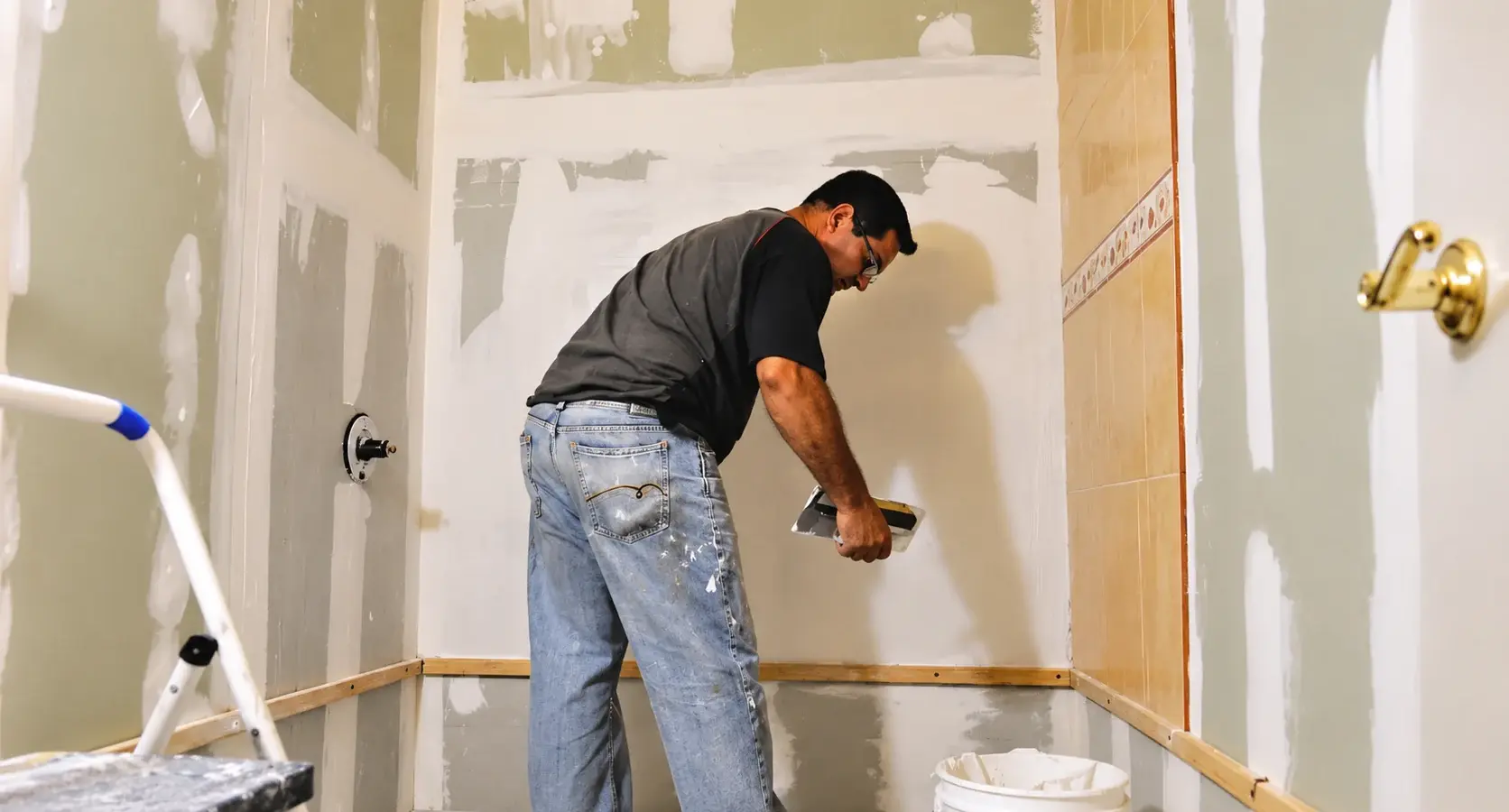
Thinking about renovating your home in retirement? Learn how a HELOC works for home improvements, how it compares with retirement mortgage options, and what to consider before borrowing against your home equity.
Your home has been part of your life for years, perhaps decades. It’s where you’ve celebrated holidays, welcomed family, and created countless memories.
Now you’re thinking about making a few changes.
Maybe the kitchen needs updating. Perhaps it’s time to replace an aging roof, remodel a bathroom, or make your home more comfortable and accessible for the years ahead.
The question isn’t necessarily whether the improvements are worthwhile.
It’s how to pay for them without disrupting the retirement you’ve worked so hard to enjoy.
Using a HELOC for home improvements in retirement can be an attractive option. It may allow you to access your home’s equity, complete renovations in stages, and preserve an existing low-rate first mortgage.
But traditional HELOCs also come with payment requirements, variable interest rates, and potential changes to your monthly obligations.
And for homeowners approaching or already enjoying retirement, those details matter.
Let’s explore the possibilities.
Why Home Improvements Take on New Meaning in Retirement
During our working years, home improvements often focus on raising property values, creating more space, or updating outdated features.
In retirement, those priorities may change.
A beautiful kitchen is still wonderful, but an accessible kitchen may be even more valuable.
A remodeled bathroom might not just look better. It could make daily activities easier and safer.
And a home that once worked perfectly for a busy family may need adjustments to support a different lifestyle.
The National Institute on Aging’s guidance on aging in place encourages older adults to consider home safety, accessibility, and future needs before problems arise.
That doesn’t mean every homeowner needs major renovations.
Sometimes the most valuable improvements are surprisingly simple.
Home improvements worth considering
Bathroom upgrades
- Walk-in or curbless showers
- Professionally installed grab bars
- Nonslip flooring
- Improved lighting
- Accessible fixtures and storage
Kitchen improvements
- Pull-out shelving
- Easier-to-reach cabinets
- Better task lighting
- Lever-style faucets
- Improved walking space
Accessibility improvements
- Wider doorways
- Entry ramps or step-free access
- Stair lifts where appropriate
- Improved handrails
- Safer walkways
Major maintenance projects
- Roof replacement
- Heating and cooling systems
- Plumbing or electrical upgrades
- Window replacements
- Exterior repairs
Some projects improve everyday comfort. Others address safety or protect the property’s condition.
The important thing is to identify which improvements genuinely support your lifestyle and long-term plans.
How Does a HELOC for Home Improvements Work?
A home equity line of credit, commonly called a HELOC, allows eligible homeowners to borrow against available home equity.
Unlike a home equity loan that generally provides one lump sum, a traditional HELOC typically operates as a revolving credit line.
You can borrow funds as needed during a specified draw period, subject to your available credit and the loan agreement.
That flexibility can make a HELOC particularly useful for renovations.
For example, suppose you’re remodeling your kitchen and updating two bathrooms.
Rather than borrowing the entire estimated cost immediately, you may be able to access funds as contractors complete different phases of the work.
You generally pay interest on the outstanding amount borrowed, not the unused portion of the credit line.
However, HELOCs usually have variable interest rates, and required payments may change over time.
The Consumer Financial Protection Bureau’s explanation of HELOCs provides additional information about borrowing periods, repayment obligations, and potential risks.
Example: Financing a $75,000 Home Renovation
Imagine a retired couple planning several improvements:
| Home improvement | Estimated cost |
|---|---|
| Bathroom remodel | $25,000 |
| Kitchen updates | $20,000 |
| New flooring | $12,000 |
| Accessibility improvements | $8,000 |
| Contingency reserve | $10,000 |
| Total estimated budget | $75,000 |
A HELOC for home improvements can be particularly useful when renovation expenses occur in stages, but homeowners should understand how interest rates and required payments may change.These are hypothetical planning figures, not estimates for any particular home or market.
The homeowners have substantial equity and an existing first mortgage with a favorable interest rate.
They don’t want to refinance that first mortgage.
A HELOC may allow them to keep their existing loan while borrowing additional funds for the improvements.
What might the payments look like?
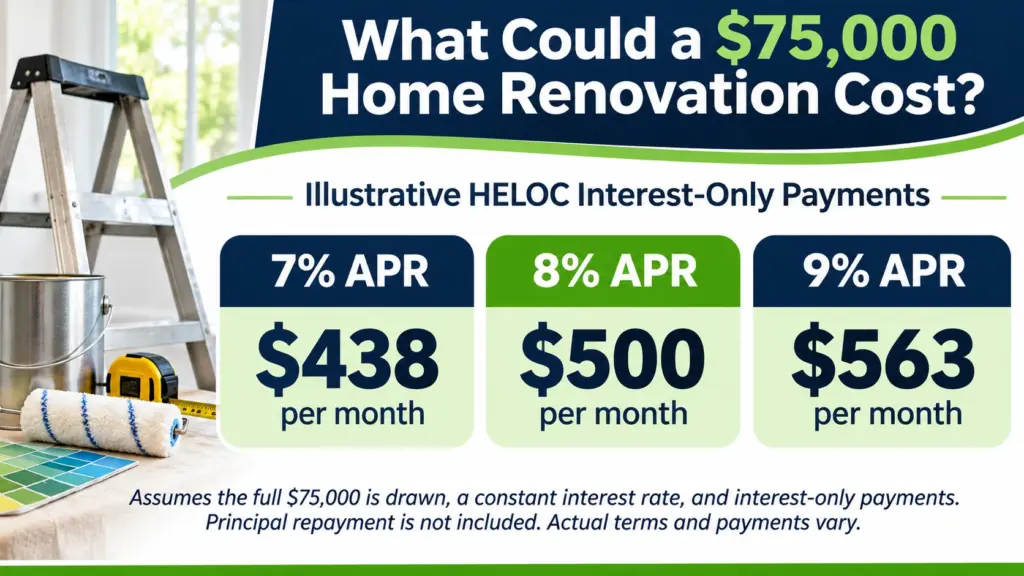
For illustration, assume they borrow the full $75,000 at an 8.5% annual interest rate.
If the loan permits interest-only payments during the draw period, the approximate monthly interest payment would be:
$531.25 per month.
That payment does not reduce the principal balance.
If the rate increases to 10%, the interest-only payment would rise to approximately $625 per month.
And when the HELOC enters its repayment period, the required payment could increase further as principal repayment begins.
For comparison, amortizing $75,000 over 15 years at an assumed 8.5% rate would require approximately $739 per month in principal and interest.
These calculations exclude fees and assume the entire amount is outstanding, the stated rate remains constant, and the loan follows the illustrated repayment terms.
The example demonstrates why homeowners should evaluate more than the initial payment.
The real question is whether the financing remains comfortable throughout retirement—not just during the first year.
HELOC for Home Improvements: Understanding Payment Shock
Traditional HELOCs often have two distinct phases.
The draw period
During the draw period, borrowers can generally access funds up to their available credit limit.
Some HELOCs permit interest-only payments, while others require principal and interest.
The repayment period
When the draw period ends, additional borrowing generally stops.
The outstanding balance must then be repaid according to the loan agreement.
Depending on the terms, this can create a substantial increase in the required monthly payment.
That increase is commonly called payment shock.
For someone still working, an increase may be inconvenient.
For a retiree living on a relatively fixed cash flow, it can become a much larger financial concern.
I’ve covered this issue in greater detail in HELOC Payment Shock in Retirement: What Happens When the Draw Period Ends?.
Before using a HELOC for renovations, ask your lender what your payment could be both during and after the draw period.
Before choosing a HELOC for home improvements, consider whether your retirement budget could comfortably accommodate higher monthly payments in the future.
Can a Bank Freeze Your HELOC During a Renovation?
Yes, under certain circumstances.
This is another consideration homeowners sometimes overlook.
Imagine beginning a major remodeling project, making your first few contractor payments, and expecting to draw additional funds as construction progresses.
Then the lender reduces or freezes your remaining credit availability.
Traditional HELOC agreements may permit this in certain circumstances, including a significant decline in property value or a material change in the borrower’s financial condition.
That can be especially challenging when a renovation is already underway.
The possibility doesn’t mean homeowners should avoid HELOCs.
It means they should have a realistic contingency plan rather than assuming the full unused credit line will always remain accessible.
For more information, see my article Can a Bank Freeze or Reduce Your HELOC? What Retirees Need to Know.
What About a HELOC Designed Specifically for Seniors?
Not every home equity line of credit follows the same structure.
Certain retirement-focused HELOC products have been developed with older homeowners in mind.
One example is HELOC For Seniors®, a specialized home equity line of credit available to eligible homeowners age 62 and older.
Unlike a traditional HELOC that may eventually transition into principal-and-interest payments, this product is structured with required interest-only monthly payments over its loan term, subject to the loan agreement.
Its published features include:
- Fixed interest rates for individual advances
- A revolving credit line during the eligible draw period
- A 10-year draw period
- The ability to repay eligible principal and redraw funds
- An initial advance requirement of at least 80% of the approved line
That last feature deserves special attention.
Why the initial advance matters for renovations
Suppose you qualify for a $100,000 credit line but only need $25,000 to begin your bathroom remodel.
If your loan requires an 80% initial advance, you would need to borrow at least $80,000 at closing.
That means interest begins accruing on a much larger amount than your immediate project requires.
For homeowners undertaking a substantial renovation with large upfront expenses, that structure may make sense.
For someone planning small improvements over several years, it may be less attractive.
The best financing option should match the timing of your expenses—not just the total amount of available credit.
HELOC For Seniors is not a reverse mortgage, and required monthly interest payments remain an important consideration.
Program features, eligibility, and availability are subject to current lender terms.
When evaluating a HELOC for home improvements, the amount you must borrow initially can be just as important as the interest rate and repayment terms.
Could a Reverse Mortgage Be Used for Home Improvements?
Absolutely.
For eligible homeowners, a reverse mortgage may provide another way to access home equity for renovations.
A Home Equity Conversion Mortgage (HECM) is available to qualifying homeowners age 62 and older.
Certain proprietary reverse mortgage programs may be available beginning at age 55, depending on the program and state.
One important difference from a traditional HELOC is that an eligible reverse mortgage generally doesn’t require scheduled monthly principal and interest payments while borrowers meet the loan obligations.
Interest and applicable charges accrue and increase the outstanding balance when not paid.
Borrowers remain responsible for property taxes, homeowners insurance, maintenance, and other applicable obligations.
Why homeowners consider this approach
Suppose your home needs $75,000 in improvements.
You may have sufficient equity to complete the work, but you don’t want another required monthly payment reducing your retirement cash flow.
A reverse mortgage could be worth evaluating.
Depending on the program, available proceeds may be taken as a lump sum, a line of credit, or another permitted disbursement arrangement.
A HECM credit line, for example, may allow borrowers to access funds over time, subject to the program’s requirements.
Certain proprietary reverse mortgage products also offer credit-line features, although growth, draw periods, and repayment provisions vary.
Importantly, a first-position reverse mortgage generally requires existing mortgage liens to be paid off at closing.
Some second-position proprietary reverse mortgage programs may allow an existing first mortgage to remain in place, but payments on that first mortgage must continue.
A reverse mortgage isn’t automatically the best choice for renovations. The costs, interest accumulation, remaining equity, and expected time in the home must all be considered.
For a broader discussion, read HELOC vs. Cash-Out Refinance in Retirement: Which Option Makes More Sense?.
Comparing Home Improvement Financing Options in Retirement
Here is a simplified comparison of four approaches.
| Feature | Traditional HELOC | HELOC For Seniors | Reverse mortgage LOC | Home equity loan |
|---|---|---|---|---|
| Funds available | As needed during draw period | Subject to initial draw and draw-period rules | Subject to available proceeds and program terms | Generally one lump sum |
| Required monthly principal and interest | Usually some form of payment required | Interest-only payments required | Generally none on reverse loan | Generally required |
| Rate structure | Commonly variable | Fixed rate for each draw | Depends on program | Commonly fixed |
| Existing first mortgage | Usually remains | May remain | Generally paid off for first-position loans; some second-position exceptions | Usually remains |
| Ability to borrow again | Generally during draw period | Yes, subject to terms | Depends on program | No |
| Main consideration | Variable payments and repayment transition | Large initial draw requirement | Accumulating loan balance and costs | Payments on full amount borrowed |
No single option is appropriate for everyone.
A traditional HELOC may fit a homeowner who has strong cash flow and plans to repay borrowed funds relatively quickly.
A retirement-focused HELOC may appeal to someone who wants revolving access and a different payment structure.
A reverse mortgage may deserve consideration when avoiding an additional required monthly mortgage payment is a priority.
A home equity loan may be suitable when the project has a known cost and the homeowner prefers predictable payments.
The right answer depends on your circumstances.
Five Questions Before Using a HELOC for Home Improvements
1. Will these improvements help you remain in your home longer?
If aging in place is your goal, prioritize changes that improve safety, accessibility, and comfort.
Not every renovation needs to increase resale value to provide meaningful benefits.
The California Department of Aging’s home modification resources offer practical information about improving safety and accessibility.
2. How much will the project really cost?
Obtain written estimates and include a reasonable contingency allowance.
Unexpected electrical work, plumbing issues, permits, or structural repairs can change a renovation budget.
Avoid financing decisions based solely on the contractor’s initial estimate.
3. When will you need the money?
A project completed in stages may benefit from flexible borrowing.
A major renovation requiring substantial upfront payments may call for a different financing structure.
Compare initial advance requirements and future draw restrictions.
4. How will the payments affect your retirement?
Consider the effect on Social Security, pension payments, retirement-account withdrawals, and other financial resources.
A loan that fits comfortably into today’s budget may feel different five or ten years from now.
5. How long do you expect to remain in the home?
If you anticipate moving within a few years, substantial loan costs or extensive remodeling may not make financial sense.
On the other hand, improvements that allow you to remain safely and comfortably at home for many years may have benefits beyond their potential resale value.
Don’t Overlook These Renovation Planning Details
Before beginning a project, consider several practical safeguards.
Check contractor licensing and insurance. Verify the contractor’s credentials with the appropriate state licensing authority.
Get detailed written contracts. Confirm the scope of work, materials, payment schedule, and change-order procedures.
Understand permits and inspections. Some accessibility and structural improvements require permits.
Avoid paying for the entire project upfront. Structure payments around documented milestones and applicable state laws.
Keep emergency reserves available. Don’t commit every dollar of accessible savings or borrowing capacity to the renovation.
Review your financing before signing construction contracts. Make sure you understand when funds will be available and what happens if costs increase.
Home improvements should help you feel more secure in retirement—not create unnecessary financial stress.
Frequently Asked Questions
Can retirees qualify for a HELOC?
Yes. Retirement itself doesn’t disqualify someone from obtaining a HELOC. Lenders generally evaluate credit, income, debt obligations, property value, and available equity. Qualifying retirement income and assets may be considered according to the lender’s underwriting requirements.
Can I use a HELOC to remodel my bathroom or kitchen?
Generally, yes. HELOC proceeds can commonly be used for home improvements, including kitchen and bathroom renovations, subject to loan terms.
Is a HELOC a good idea for aging-in-place improvements?
It can be, particularly when the borrower can comfortably manage required payments. However, the draw period, variable interest rates, and future repayment obligations should be carefully evaluated.
What happens if my renovation costs more than expected?
You may be able to borrow additional funds if you have sufficient available credit and the lender permits further advances. However, never assume unused credit will remain available under all circumstances.
Can I keep my low-rate mortgage and get a HELOC?
Often, yes. A HELOC is commonly structured as a second lien, allowing the existing first mortgage to remain in place. Eligibility and lien requirements vary.
Is a HELOC For Seniors the same as a reverse mortgage?
No. A retirement-focused HELOC generally requires monthly payments, while an eligible reverse mortgage generally does not require scheduled monthly principal and interest payments while loan obligations are met.
Can I use a reverse mortgage to pay for home improvements?
Yes, eligible reverse mortgage proceeds can generally be used for home improvements and accessibility modifications, subject to the loan’s terms and disbursement restrictions.
Are home improvements financed with a HELOC tax-deductible?
Interest on home equity borrowing may qualify for a deduction under applicable federal tax rules when the proceeds are used to buy, build, or substantially improve the home securing the loan and other requirements are met. Tax laws and individual circumstances vary, so consult a qualified tax professional.
Should I use savings or home equity to renovate?
That depends on your available savings, emergency reserves, borrowing costs, tax considerations, and long-term retirement goals. Sometimes a combination of savings and financing provides a better balance than relying entirely on either one.
Make Your Home Work for the Retirement You Want
Home improvements aren’t always about creating a more beautiful house.
Sometimes they’re about creating a home that continues to fit your life.
A safer bathroom. A more accessible kitchen. A new roof that provides peace of mind. Or simply the ability to enjoy your surroundings without worrying about deferred maintenance.
These improvements can make a meaningful difference in how comfortably and confidently you live during retirement.
The financing should support those goals.
Whether you’re considering a traditional HELOC, HELOC For Seniors, a reverse mortgage, or another home equity solution, the important thing is understanding how the loan fits your current and future financial needs.
With more than 20 years of experience helping homeowners explore retirement mortgage solutions, I believe home equity decisions should always begin with your goals—not the loan product.
Your home has supported you for years. Let’s explore how it can continue supporting the retirement you envision.
Angella Conrard
Retirement Mortgage Professional
Considering home improvements? Contact me for a personalized conversation about your home equity options and how they may fit into your retirement plans.
This article is for educational purposes only and is not a loan offer or commitment. Financing terms, rates, fees, eligibility, product availability, and underwriting requirements vary. Home equity borrowing is secured by your property and carries foreclosure risk if loan obligations are not met. Reverse mortgage borrowers must continue meeting applicable property tax, insurance, occupancy, and maintenance requirements.
Have questions about this?
Talk to a Certified Reverse Mortgage Professional — directly.
When you call, you reach me — not a call center. Free 30-minute consult by phone, video, or in person. No SSN, no credit pull, no obligation.
Schedule a consult