

Home Equity & HELOC
HELOC vs. Cash-Out Refinance in Retirement: Which Option Makes More Sense?

HELOC vs. Cash-Out Refinance in Retirement: Which Option Makes More Sense?
When comparing a HELOC vs. a cash-out refinance in retirement, homeowners need to understand how each option affects their home equity, monthly payments, and long-term financial flexibility.
Two common choices are a home equity line of credit (HELOC) and a cash-out refinance.
Both allow homeowners to borrow against home equity, but they work very differently. A HELOC generally leaves your existing first mortgage in place and adds a separate line of credit. A cash-out refinance replaces your current mortgage with a new, larger mortgage and provides the difference in cash. Consumer Financial Protection Bureau
For retirees, that difference can have a significant effect on monthly cash flow, borrowing costs, and long-term financial flexibility.
Quick Answer: A HELOC may appeal to retirees who want to keep their existing first mortgage and access equity as needed. A cash-out refinance replaces the current mortgage with a larger new loan and typically provides cash at closing. The right choice depends on your existing mortgage, income, credit, equity, borrowing needs, and retirement goals.
What Is a HELOC?
A home equity line of credit, or HELOC, is a revolving line of credit secured by your home.
During the draw period, you can generally borrow up to your available credit limit, repay money, and borrow again as permitted by the loan terms. Most HELOCs have variable interest rates, so both the rate and required payment can change over time. Consumer Financial Protection Bureau
If you already have a first mortgage, the HELOC generally becomes a second mortgage rather than replacing your existing loan. Consumer Financial Protection Bureau
That feature can be particularly important for retirees who obtained their first mortgage when interest rates were lower.
AARP also points to HELOCs as one potential way older homeowners can fund repairs and renovations that support aging in place or maintain access to funds for unexpected expenses. AARP
If you’d like a more detailed explanation, read my guide to HELOCs for retirees.
What Is a Cash-Out Refinance?
A cash-out refinance replaces your existing mortgage with a new mortgage for more than you currently owe.
The new mortgage pays off your old loan, and you receive a portion of the additional borrowed amount as cash, after applicable costs and adjustments.
Freddie Mac explains that the new mortgage comes with a new interest rate and loan term, and the homeowner remains responsible for the costs associated with refinancing. My Home
That distinction matters.
You aren’t simply borrowing additional money against your equity. You’re refinancing the mortgage balance you already owe plus the additional equity you want to access.
Why Your Existing Mortgage Rate Matters
This may be the most overlooked part of the HELOC vs cash-out refinance comparison.
Imagine a retired homeowner has:
Home value: $800,000
Current mortgage balance: $200,000
Existing mortgage rate: 3.5%
Additional cash needed: $75,000
With a HELOC, the homeowner may be able to leave the $200,000 first mortgage intact and establish a separate credit line for the additional funds, subject to qualification.
With a cash-out refinance, the homeowner would replace the existing mortgage with a new, larger mortgage.
That means the homeowner isn’t simply obtaining a new interest rate on the additional $75,000. The existing $200,000 balance also moves into the new mortgage at the new loan’s terms.
The CFPB specifically advises homeowners considering a cash-out refinance to compare the new interest rate with the rate on their current mortgage. Consumer Financial Protection Bureau
For someone who already has a favorable fixed mortgage rate, that comparison can dramatically change the economics of accessing home equity.
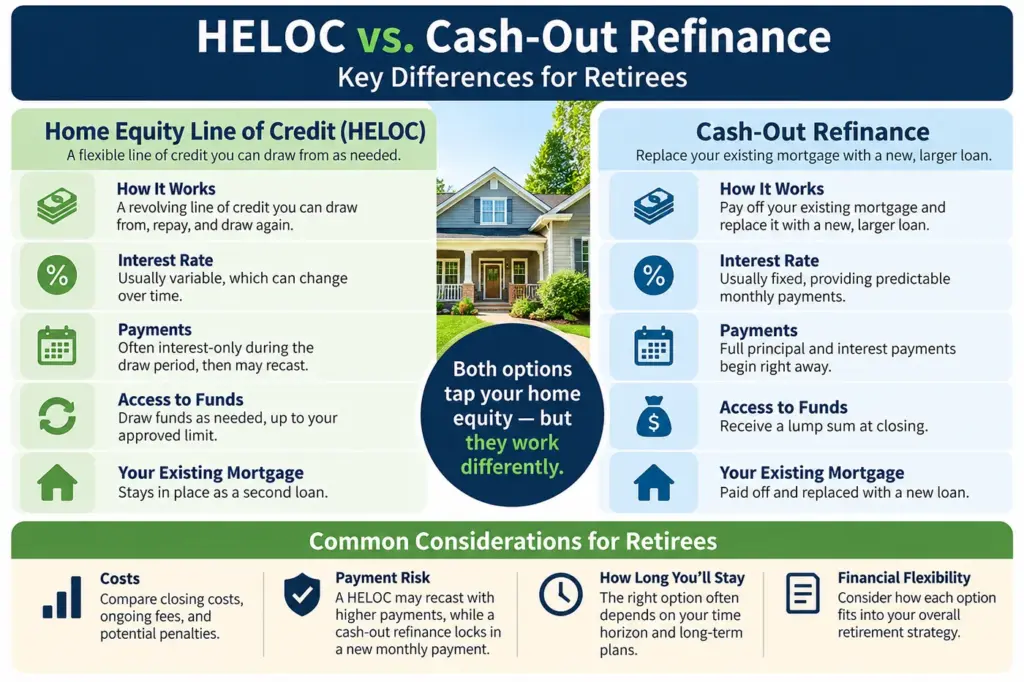
HELOC vs. Cash-Out Refinance: Key Differences
| Feature | HELOC | Cash-Out Refinance |
|---|---|---|
| Existing first mortgage | Usually stays in place | Replaced |
| Access to money | Draw as needed during draw period | Cash at closing |
| Interest rate | Usually variable | Often fixed, depending on loan |
| Monthly payment | HELOC payment plus existing mortgage, if applicable | One new mortgage payment |
| Interest charges | Generally based on amount actually borrowed | Based on new mortgage balance |
| Future access | May allow additional draws during draw period | No revolving credit line |
| Closing costs | Vary by lender and program | New refinance closing costs apply |
| Long-term structure | Draw period followed by repayment | New mortgage repayment schedule |
Neither structure is automatically better. The important question is how each one affects the homeowner’s complete financial picture.
A HELOC Can Preserve a Low-Rate First Mortgage
One of the primary reasons a retiree might consider a HELOC is the ability to preserve an existing first mortgage.
The CFPB has specifically noted that home-equity borrowing can allow homeowners to tap equity without replacing a low-rate first mortgage with a higher-rate cash-out refinance. Consumer Financial Protection Bureau
That doesn’t mean the HELOC itself will have a low interest rate.
HELOCs typically have variable rates. As rates change, the borrowing cost and monthly payment can change as well. Consumer Financial Protection Bureau
The homeowner therefore needs to compare two different risks:
Cash-out refinance: What happens if I replace my existing mortgage and its interest rate?
HELOC: What happens if the variable rate on the money I borrow increases?
That is a much more useful comparison than simply asking which product advertises the lowest rate today.
A Cash-Out Refinance Can Simplify the Mortgage Structure
A cash-out refinance has a different advantage: it can consolidate the existing mortgage and additional borrowing into one new mortgage.
Rather than maintaining a first mortgage and a HELOC with separate payments and terms, the homeowner makes the payment required under the new mortgage.
For someone who needs a substantial lump sum and finds the new rate and payment attractive, that simplicity may have value.
However, refinancing also creates a new loan term and involves closing costs.
Freddie Mac identifies potential refinancing costs such as origination charges, appraisal fees, title services, recording costs, credit report fees, and underwriting fees. My Home
Those costs should become part of the comparison—not just the monthly payment.
How Does a HELOC vs. Cash-Out Refinance Affect Retirement Cash Flow?
A HELOC can provide flexibility because homeowners generally pay interest based on the amount they actually borrow rather than the entire available credit line.
That can make a HELOC useful when expenses occur gradually.
For example, a homeowner planning several years of home improvements may prefer drawing funds as projects occur rather than borrowing the entire amount at once.
AARP notes that HELOCs can provide older homeowners with flexible access to equity for purposes such as home renovations, aging-in-place improvements and unexpected expenses. AARP
But retirees also need to understand what happens later.
The Draw Period Eventually Ends
A HELOC typically begins with a draw period during which the homeowner can access the available line.
When that period ends, borrowing stops and the HELOC enters its repayment phase.
The CFPB warns that monthly payments can rise significantly during the repayment period. Consumer Financial Protection Bureau
That transition deserves special attention for retirees living on a relatively fixed monthly budget.
I explain this risk in detail in What Happens When Your HELOC Draw Period Ends?.
Can a Bank Reduce or Freeze a HELOC?
Another difference involves future access to the money.
Having a $100,000 HELOC doesn’t necessarily mean that $100,000 will remain available under every circumstance throughout the draw period.
The CFPB explains that lenders may restrict additional borrowing in certain circumstances, including a significant decline in the home’s value or changes in the borrower’s financial circumstances that create concerns about repayment. Consumer Financial Protection Bureau
This matters when someone views a HELOC as an emergency reserve for retirement.
The credit line can provide valuable flexibility, but homeowners shouldn’t automatically treat unused HELOC borrowing capacity as guaranteed cash sitting in a bank account.
Which Option Has Higher Closing Costs?
Costs vary considerably by lender, loan amount, property, and program.
A HELOC may include application, appraisal, title, origination, annual, inactivity, cancellation, or other fees depending on the lender and product. Consumer Financial Protection Bureau
A cash-out refinance involves replacing the entire mortgage, so homeowners should evaluate the costs associated with originating that new loan.
The most useful comparison is therefore not:
“Which loan has closing costs?”
Both may have costs.
Instead ask:
“What will it cost me to access the amount of equity I actually need?”
HELOC vs. Cash-Out Refinance Qualification in Retirement
Owning substantial home equity doesn’t automatically mean a homeowner will qualify for either a HELOC or cash-out refinance.
Traditional mortgage lenders generally evaluate a borrower’s ability to repay the loan. Depending on the product and lender, underwriting may consider income, debts, credit history, property value, available equity, and other financial factors.
This distinction can become especially important after retirement.
A homeowner might own a $1 million home with significant equity but have relatively modest monthly retirement income.
The equity exists.
The question is whether the borrower meets the underwriting requirements for the new monthly debt.
That is one reason retirees should evaluate home-equity strategies based on both equity and cash flow.
HELOC vs. Cash-Out Refinance for Home Improvements
Home renovations provide a good example of how the purpose of the money can influence the decision.
If you need $100,000 immediately for one major project, receiving a lump sum through a cash-out refinance may fit the project’s funding schedule.
If you’re completing improvements gradually over several years, a HELOC may allow you to draw money as needed rather than borrowing the full amount on day one.
For older homeowners, those improvements may also have a retirement purpose.
AARP specifically identifies aging-in-place projects—such as accessibility and safety improvements—as one potential use for home equity. AARP
The financing decision should therefore consider not only how much the project costs, but also when you’ll need the money and how the resulting payments fit your retirement budget.
What About Using Home Equity to Pay Off Other Debt?
Some homeowners consider using mortgage debt to pay off credit cards, auto loans, or other obligations.
That can lower the interest rate on certain debts, but it also changes the nature of the debt.
Your home becomes collateral.
CFPB research has found that cash-out refinance borrowers frequently use proceeds to pay down credit-card and auto debt. The agency also cautions that converting unsecured debt into mortgage debt can increase the risk to the home if the borrower later struggles with payments. Consumer Financial Protection Bureau
Debt consolidation therefore deserves a broader analysis than simply comparing interest rates.
How Long Do You Plan to Stay in the Home?
Time horizon also matters.
If you expect to remain in the home for many years, the long-term cost and payment structure may matter more than the amount of cash you can access immediately.
If you’re considering moving, downsizing, or relocating within a few years, paying substantial costs to establish new financing may make less sense.
Kiplinger recommends that retirees evaluate home-equity borrowing within the context of their broader retirement budget and repayment ability rather than treating the home as an isolated financial asset. Kiplinger
This is particularly important when your plans include aging in place.
The financing you choose today should ideally support—not undermine—your ability to remain comfortably in the home later.
When Might a HELOC vs. Cash-Out Refinance Favor a HELOC?
A HELOC may deserve consideration when:
- You have a favorable existing first mortgage you don’t want to replace.
- You want to access equity gradually rather than all at once.
- You want a revolving source of funds during the draw period.
- You can comfortably manage the required monthly payments.
- You understand that the interest rate may change.
- You have a plan for the eventual repayment period.
The combination of flexibility and preserving an existing mortgage can make a HELOC attractive in the right circumstances.
But the variable rate, changing payments, repayment period, and possibility of future restrictions on the line all deserve consideration.
When Might a HELOC vs. Cash-Out Refinance Favor a Cash-Out Refinance?
A cash-out refinance may deserve consideration when:
- You need a larger lump sum.
- The new mortgage rate and terms make sense compared with your existing loan.
- You prefer one mortgage rather than a first mortgage plus a HELOC.
- You can comfortably afford the new payment.
- The anticipated benefit justifies the refinancing costs.
- The new loan fits your expected time in the home.
Freddie Mac emphasizes that borrowers should compare lenders, terms, and costs because the refinance creates an entirely new mortgage. My Home
What If Neither Option Fits Your Retirement Cash Flow?
Sometimes the most useful result of comparing a HELOC vs cash-out refinance is discovering that neither structure fully addresses the homeowner’s goal.
Both are traditional forms of mortgage borrowing that generally require ongoing monthly payments.
Some retirees may comfortably accommodate those payments.
Others may be more concerned with reducing required monthly expenses while accessing home equity.
Depending on age, equity, property eligibility, financial circumstances, and long-term goals, a reverse mortgage may also belong in the comparison.
A reverse mortgage works differently because eligible borrowers can access a portion of their home equity without required monthly principal and interest mortgage payments, while remaining responsible for property taxes, homeowners insurance, property maintenance, and other applicable property charges and loan requirements.
That doesn’t make a reverse mortgage automatically preferable. It simply means retirees may have more than two home-equity choices.
My guide to HELOC vs. reverse mortgage explains those differences in more detail.
Questions to Ask Before Choosing Either Option
Before accessing home equity, consider these questions:
- What interest rate do I have on my current mortgage?
- How much money do I actually need?
- Do I need it all now or gradually?
- What will my required monthly payment be?
- Can that payment increase?
- What will the loan cost to establish?
- What happens five or ten years from now?
- How long do I expect to remain in this home?
- Could the loan affect my ability to age in place?
- Would another home-equity strategy better support my retirement goals?
These questions shift the conversation from “How much can I borrow?” to “How should this borrowing fit into my retirement?”
Key Takeaways
A HELOC generally allows homeowners to keep their existing first mortgage and borrow against home equity as needed during a draw period. The rate usually varies, and the loan eventually enters a repayment period.
A cash-out refinance replaces the existing mortgage with a larger new mortgage and provides additional funds at closing. That means the homeowner receives new terms on the entire mortgage balance—not simply the additional cash withdrawn.
For retirees with low-rate existing mortgages, that difference deserves careful attention.
At the same time, preserving a low first-mortgage rate doesn’t automatically make a HELOC the right choice. Variable rates, required payments, qualification, future access to the line, and the repayment period also matter.
The strongest decision comes from comparing the entire financing structure against your retirement cash flow and long-term plans.
Frequently Asked Questions
Is a HELOC better than a cash-out refinance for retirees?
Neither option is universally better. A HELOC generally preserves the existing first mortgage and provides flexible access to equity. A cash-out refinance replaces the current mortgage with a larger new loan. Your existing mortgage rate, borrowing needs, income, credit, equity, payment tolerance, and retirement plans all affect the comparison.
Does a cash-out refinance replace my current mortgage?
Yes. A cash-out refinance pays off the existing mortgage and replaces it with a larger new mortgage. The homeowner receives a portion of the additional borrowed amount as cash, subject to the loan’s terms, qualification requirements, and closing costs. Consumer Financial Protection Bureau
Does a HELOC replace my first mortgage?
Usually not. When you already have a first mortgage, a HELOC generally becomes a second mortgage secured by the property. Consumer Financial Protection Bureau
Is a HELOC interest rate fixed?
HELOCs usually have variable interest rates. Some products may allow borrowers to convert some or all of a balance to a fixed rate, depending on the lender and loan terms. Consumer Financial Protection Bureau
What happens when a HELOC draw period ends?
The homeowner generally loses the ability to make additional draws and begins the repayment period. Payments may increase substantially depending on the balance and loan terms. Consumer Financial Protection Bureau
Can a lender freeze or reduce a HELOC?
Under certain circumstances, yes. For example, a significant decline in property value or certain changes in the borrower’s financial circumstances may allow the lender to restrict additional draws, subject to applicable law and the HELOC agreement. Consumer Financial Protection Bureau
Can retirees qualify for a HELOC or cash-out refinance?
Yes, retirees may qualify, but they must meet the applicable lender and program requirements. Lenders may evaluate qualifying income, debts, credit, property value, equity, and other underwriting factors.
What if I have a very low interest rate on my current mortgage?
Compare carefully before replacing it. A cash-out refinance gives the entire new mortgage new terms. A HELOC generally allows the existing first mortgage to remain in place while you borrow separately against additional equity. Consumer Financial Protection Bureau
Are there alternatives to a HELOC or cash-out refinance in retirement?
Yes. Depending on your circumstances, options may include a home equity loan, selling or downsizing, a reverse mortgage, or other financial resources. Each has different costs, qualification requirements, payment structures, and long-term consequences. Kiplinger likewise identifies HELOCs, home-equity loans, cash-out refinancing, reverse mortgages, and selling as different ways retirees may consider using housing wealth. Kiplinger
Final Thought
Home equity can provide valuable financial flexibility during retirement. But accessing that equity creates a new financial obligation, and the structure of that obligation matters.
Before choosing a HELOC or cash-out refinance, look beyond today’s available cash.
Consider your existing mortgage rate, required monthly payments, future rate risk, closing costs, how long you plan to remain in your home, and how the financing fits your retirement budget years from now.
The goal isn’t simply to unlock home equity.
It’s to use that equity in a way that supports your retirement rather than creating financial pressure later.
If you’d like to explore your options, I can help you compare how a HELOC, cash-out refinance, reverse mortgage, or other home-equity strategy may fit your individual retirement goals.
Have questions about this?
Talk to a Certified Reverse Mortgage Professional — directly.
When you call, you reach me — not a call center. Free 30-minute consult by phone, video, or in person. No SSN, no credit pull, no obligation.
Schedule a consult