

Home Equity & HELOC
What Happens When Your HELOC Draw Period Ends? A Guide for Retirees
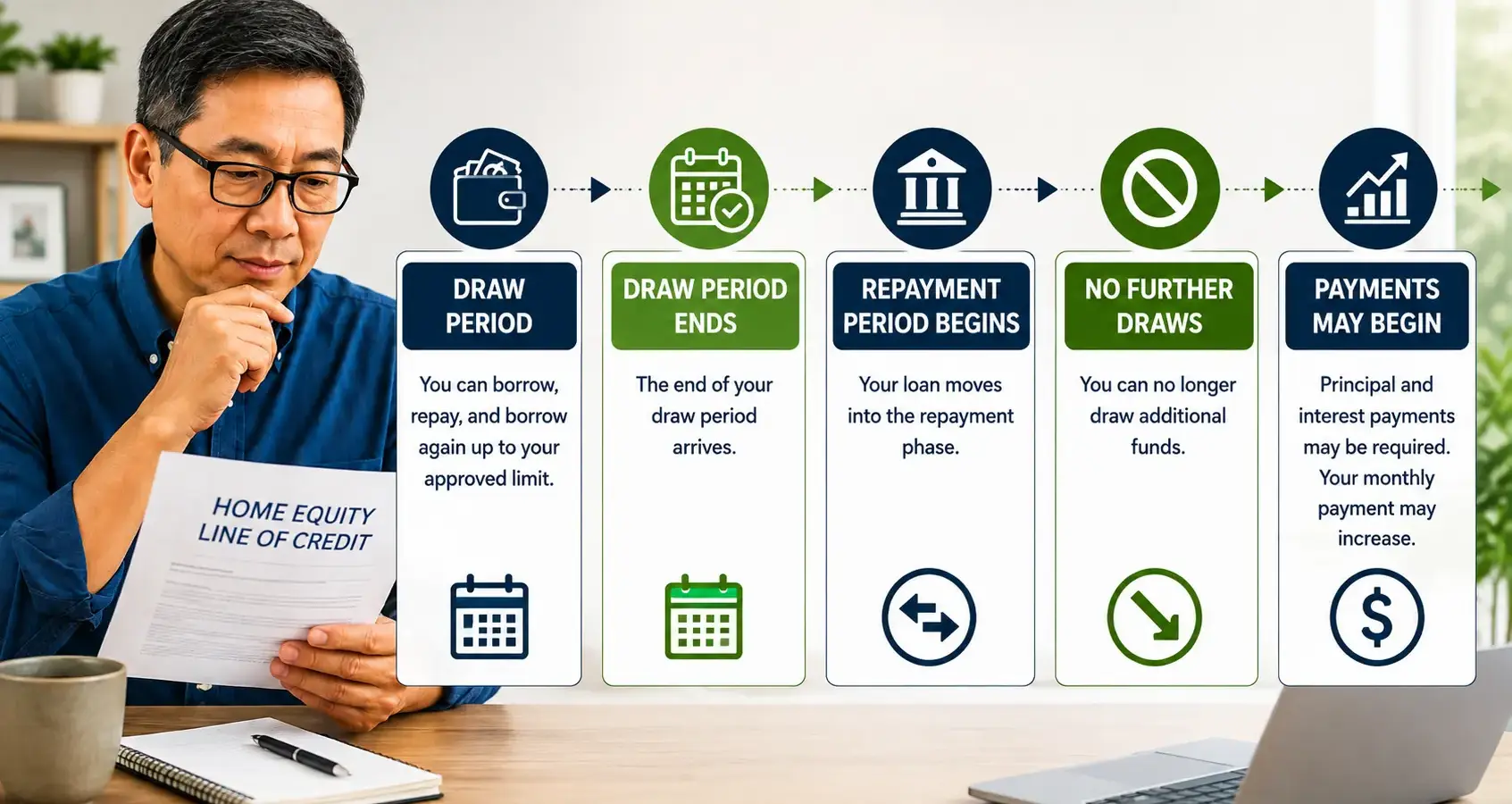
A home equity line of credit can be a useful financial tool during retirement. It provides access to home equity when needed and allows homeowners to borrow only what they choose to use.
But a HELOC does not necessarily provide that borrowing flexibility forever.
Most traditional HELOCs have two distinct phases: a draw period followed by a repayment period. When the HELOC draw period ends, the ability to borrow generally ends with it—and the way the outstanding balance must be repaid can change substantially.
For retirees living on Social Security, pensions, retirement-account withdrawals, or other relatively fixed resources, that transition deserves attention well before it occurs.
Quick Answer: What Happens When a HELOC Draw Period Ends?
When your HELOC draw period ends, you generally can no longer borrow additional money from the credit line. Any outstanding balance enters the repayment phase according to the terms of your HELOC agreement.
That can mean:
- You lose access to unused credit.
- Principal repayment may become required.
- Your monthly payment may increase significantly.
- A variable interest rate can continue affecting the payment.
- Some HELOCs may require a large balloon payment rather than providing a lengthy repayment period.
The Consumer Financial Protection Bureau specifically advises homeowners to understand both the draw and repayment provisions of their HELOC.
CFPB guide to Home Equity Lines of Credit
For a retiree, the important question isn’t simply when does my HELOC expire?
It’s also:
What will happen to my monthly cash flow when it does?
How Does a HELOC Draw Period Work?
During the draw period, a HELOC functions somewhat like a revolving credit account secured by your home.
You can generally borrow, repay and borrow again up to the available credit limit, subject to the terms of the account.
A draw period might last 10 years, for example, although the actual term depends on the lender and HELOC agreement.
During this phase, some HELOCs allow relatively low minimum payments. Depending on the loan, those payments may include principal and interest, or they may primarily or entirely cover interest.
That can make the HELOC payment appear quite manageable during the borrowing years.
But the draw-period payment isn’t necessarily a good indication of what the homeowner will pay later.
What Is the HELOC Repayment Period?
Once the draw period ends, the HELOC generally enters its repayment period.
You can no longer continue drawing against the available line, and the outstanding balance must be repaid according to the loan agreement.
The CFPB notes that a lender may establish a repayment schedule lasting, for example, 10 or 20 years. Other HELOC structures may require the outstanding balance to be paid when the draw period ends.
This is why homeowners should review their actual HELOC agreement rather than assume they know what will happen.
Two homeowners with similar HELOC balances could face very different repayment requirements.
Why Can HELOC Payments Increase When the Draw Period Ends?
There are two primary reasons.
Principal Repayment May Begin
If your payment during the draw period was interest-only or included relatively little principal, a substantial balance may remain when the repayment period begins.
Now the lender may require that balance to be amortized over the remaining repayment term.
Instead of primarily servicing interest, you’re now paying principal plus interest.
Your Interest Rate May Have Changed
Traditional HELOCs commonly have variable interest rates.
That means the rate—and therefore the payment—can change as the underlying index changes.
A homeowner who opened a HELOC during a lower-rate environment could therefore reach the repayment period with both:
- a substantial outstanding principal balance, and
- a higher interest rate than when the HELOC was originally established.
The combination can create a meaningful change in monthly cash flow.
What Is HELOC Payment Shock?
HELOC payment shock describes the financial strain that can occur when a homeowner’s required payment increases substantially after the draw period ends.
Imagine a homeowner who became accustomed to a relatively modest HELOC payment during the draw period.
When repayment begins, principal is now being repaid along with interest. The monthly obligation may rise considerably even though the homeowner hasn’t borrowed any additional money.
For someone still earning employment income, that may be manageable.
For someone several years into retirement, the situation can be very different.
A larger mortgage payment may mean taking more from retirement accounts, reducing discretionary spending, or redirecting money that had been earmarked for healthcare, home maintenance or other retirement needs.
That’s why the end of a HELOC draw period should be treated as a retirement cash-flow event, not merely a loan anniversary.
Can You Keep Using a HELOC After the Draw Period Ends?
Generally, no.
Once the contractual draw period ends, additional borrowing typically stops and the account moves into repayment.
A lender might offer a renewal, extension, refinance or new HELOC, but homeowners shouldn’t assume that will happen automatically.
A new credit decision may depend on factors such as:
- Income
- Credit history
- Debt obligations
- Property value
- Available equity
- Current lending guidelines
This can be especially important for retirees.
A HELOC that was easy to qualify for while working may not necessarily be as easy to replace after retirement.
What About the Unused Portion of Your HELOC?
This is one of the most overlooked aspects of the HELOC draw period ending.
Suppose you have a $150,000 HELOC but have only borrowed $50,000.
The remaining $100,000 might feel like part of your financial safety net.
But when the draw period ends, that unused borrowing capacity generally isn’t cash sitting in an account waiting for you. Your ability to make new draws ends according to the terms of the HELOC.
That’s an important distinction when homeowners use a HELOC as an emergency reserve.
Access to home equity and ownership of cash are not the same thing.
Can a Bank Freeze or Reduce a HELOC Before the Draw Period Ends?
Under certain circumstances, yes.
The CFPB notes that a lender may restrict additional borrowing if the home’s value declines significantly or if the lender reasonably believes a change in the borrower’s financial circumstances may affect the ability to make payments.
We’ll cover this subject more thoroughly in a separate guide in this HELOC series.
For retirement planning purposes, however, the lesson is important:
A traditional HELOC should not automatically be treated as guaranteed future liquidity.
What Should Retirees Do Before the HELOC Draw Period Ends?
The best time to evaluate a HELOC isn’t the month before repayment begins.
Understanding how a HELOC fits into retirement before the repayment period begins can make it easier to evaluate your options.
Ideally, start reviewing your options well in advance.
1. Find the Exact End Date
Locate your HELOC agreement or contact your servicer.
Ask:
- When does my draw period end?
- When does repayment begin?
- How long is the repayment period?
- How will my payment be calculated?
- Is there a balloon payment?
- Is renewal or extension available?
Federal HELOC disclosure requirements address the length of the draw and repayment periods and how minimum payments are determined.
2. Ask for an Estimated Repayment Payment
Don’t simply estimate it from today’s payment.
Ask your servicer what your payment could look like when the repayment phase begins, recognizing that a variable rate can make the actual future payment different.
Then put that estimated payment into your retirement budget.
3. Look at the Outstanding Balance
How much have you actually borrowed?
A relatively small HELOC balance may be manageable through accelerated repayment or other resources.
A large balance deserves more advance planning.
4. Evaluate Your Future Cash Flow
Consider where the repayment money will come from.
Will it require:
- Larger retirement-account withdrawals?
- Reduced discretionary spending?
- Changes to your emergency reserves?
- Selling investments?
- Returning to work?
- Changing other retirement plans?
The objective isn’t simply to determine whether you can make the payment.
It’s to understand what making that payment does to the rest of your retirement plan.
What Are Your Options When a HELOC Draw Period Is Ending?
There isn’t one right solution for every homeowner.
Depending on your finances, goals, equity and eligibility, several possibilities may deserve consideration.
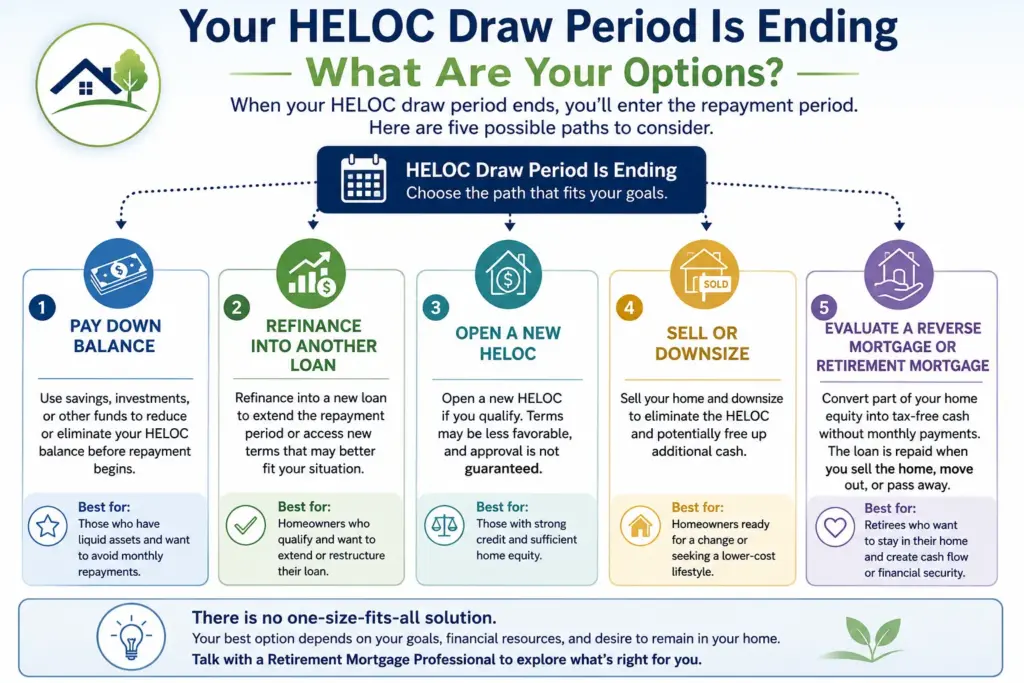
Pay Down or Pay Off the HELOC
For homeowners with sufficient liquid assets and a manageable balance, paying down the HELOC may be the simplest answer.
But retirees should consider the broader consequences before liquidating investments or withdrawing substantial amounts from retirement accounts.
Taxes, investment allocation, emergency reserves and long-term liquidity may all matter.
Refinance the HELOC
Some homeowners may qualify to refinance the balance into another HELOC, a home equity loan or another traditional mortgage product.
This can potentially extend repayment or restructure the debt.
However, refinancing isn’t guaranteed. Qualification, interest rates, closing costs and the new loan terms all need to be evaluated.
Consider a New HELOC
If the homeowner still qualifies, replacing an expiring HELOC with a new line may restore borrowing flexibility.
But it also starts another lending cycle.
For retirees, it’s worth asking whether repeatedly renewing short-term access to home equity still fits the long-term retirement plan.
Sell or Downsize
For someone already considering a move, selling the home may provide an opportunity to pay off the HELOC and reposition housing expenses.
But selling solely because a HELOC entered repayment may not be desirable—particularly for someone whose goal is to remain in the home.
Evaluate a Reverse Mortgage or Retirement Mortgage
For eligible older homeowners who intend to remain in their homes, a reverse mortgage may be another option to evaluate.
A reverse mortgage works very differently from a traditional HELOC.
Eligible homeowners can convert a portion of their home equity into available funds without required monthly principal and interest mortgage payments. The homeowner continues to own the home and remains responsible for property taxes, homeowners insurance, maintenance and other loan obligations.
A traditional first-position reverse mortgage generally requires existing mortgage liens to be satisfied at closing using available proceeds. Depending on the homeowner and available programs, certain proprietary or second-position retirement-mortgage products may also be available.
The goal isn’t simply to replace one loan with another.
It’s to determine which structure best supports the homeowner’s long-term retirement cash flow and housing goals.
HELOC Repayment vs. Reverse Mortgage: A Different Cash-Flow Structure
This distinction can become particularly important when a retiree is facing HELOC repayment.
With a traditional HELOC, the homeowner borrows money and makes required monthly payments according to the loan terms.
With an eligible reverse mortgage, required monthly principal and interest mortgage payments aren’t required while the loan remains in good standing.
The loan balance generally becomes due when the last borrower permanently leaves the home, sells it, refinances, or passes away, subject to the particular program terms.
That doesn’t automatically make a reverse mortgage better.
It makes the cash-flow structure different.
For some retirees, maintaining and paying down the HELOC may make perfect sense.
For others, reducing required monthly mortgage obligations may have greater value than preserving the traditional HELOC structure.
Don’t Wait Until the Payment Changes
One of the biggest mistakes homeowners can make is assuming they’ll deal with the HELOC when the draw period ends.
Retirement can change the equation.
Income may be lower. Qualification for another traditional loan may be more difficult. Investment markets may be unfavorable. Interest rates may be different. Healthcare expenses may have increased.
Having more time generally means having more choices.
If your HELOC draw period is approaching its end, understanding your options before the transition can help you make a deliberate decision rather than reacting to a new payment.
Key Takeaways
- A HELOC generally has a draw period followed by repayment.
- Once the draw period ends, additional borrowing typically stops.
- Monthly payments can increase significantly when principal repayment begins.
- Some HELOCs can require a balloon payment, depending on the agreement.
- Variable interest rates can further affect monthly payments.
- Unused HELOC borrowing capacity shouldn’t automatically be treated as permanent retirement liquidity.
- Retirees should review the HELOC’s terms well before the draw period expires.
- Paying down the balance, refinancing, obtaining another HELOC, selling or evaluating a retirement/reverse mortgage may all be possibilities depending on the homeowner’s circumstances.
- The best decision should be based on the homeowner’s entire retirement picture—not simply today’s interest rate.
Frequently Asked Questions
What happens when my HELOC draw period ends?
You generally lose the ability to make additional draws and begin repaying the outstanding balance according to your HELOC agreement. Monthly payments may increase because principal repayment may now be required.
How long is a typical HELOC draw period?
A 10-year draw period is common, but HELOC terms vary by lender and loan agreement. Always check your own loan documents rather than assuming your HELOC follows a standard schedule.
Why did my HELOC payment suddenly increase?
Your HELOC may have moved from its draw period into repayment, requiring you to begin repaying principal as well as interest. A change in a variable interest rate can also affect the payment.
Can I extend my HELOC draw period?
Possibly, depending on the lender and your HELOC terms. An extension or replacement may require lender approval or new qualification. Contact your lender well before the draw period expires.
Can I refinance a HELOC after I retire?
Potentially. Qualification will depend on the lender’s requirements, including income, debts, credit, property value and equity. Retirement itself does not automatically prevent someone from qualifying for traditional financing.
Can a reverse mortgage pay off a HELOC?
Potentially, for an eligible homeowner with sufficient available proceeds. With a traditional first-position reverse mortgage, existing required mortgage liens generally must be satisfied at closing. Eligibility and available proceeds depend on the reverse mortgage program and the homeowner’s circumstances.
Is a reverse mortgage better than renewing a HELOC?
Not necessarily. A HELOC may be appropriate for a homeowner who qualifies comfortably and wants traditional revolving credit while making monthly payments. A reverse mortgage may deserve consideration when reducing required monthly principal and interest mortgage payments and establishing longer-term access to home equity are more important objectives.
Final Thoughts
A HELOC can be a useful tool, but the end of the draw period can fundamentally change how that loan affects retirement cash flow.
The key is knowing what’s coming.
If your HELOC draw period will end within the next few years, this may be a good time to review the loan terms, estimate the future payment and compare your available options.
The right answer may be to keep the HELOC and pay it down. It may be refinancing. It may be moving. Or, for an eligible homeowner, it may be evaluating whether a reverse mortgage or another retirement-mortgage strategy better supports the years ahead.
If you’d like to understand how your existing HELOC compares with the home-equity options available to you in retirement, I can help you evaluate the choices based on your goals, home equity, and long-term cash-flow needs.
Have questions about this?
Talk to a Certified Reverse Mortgage Professional — directly.
When you call, you reach me — not a call center. Free 30-minute consult by phone, video, or in person. No SSN, no credit pull, no obligation.
Schedule a consult