

Family & Heirs
Are Your Parents Running Out of Money in Retirement? What Adult Children Should Know

If your parents are running out of money in retirement, the signs may be subtle at first. They may have always been careful with money, but retirement can change the financial picture.
They worked, saved for retirement, paid their bills and perhaps spent decades building equity in their home. From the outside, everything may appear fine.
But lately, you have noticed little things.
Maybe they don’t go out as often. They hesitate before making purchases they once wouldn’t have thought twice about. They complain more about groceries, utilities, insurance or property taxes. Home repairs keep getting postponed. Perhaps you’ve started picking up a bill here and there or helping with unexpected expenses.
None of these things necessarily means your parents are in financial trouble.
But taken together, they may be signs that your parents are running out of money in retirement—or that their retirement income is no longer keeping pace with the cost of living.
And that is a conversation worth having.
Quick Answer: What Should You Do If Your Parents Are Running Out of Money in Retirement?
If your parents appear to be running short of money in retirement, start by understanding their monthly income, expenses, savings, debts and future housing and care needs.
Then look at the resources available to them—including an asset families sometimes overlook: the equity in their home.
The goal shouldn’t be to immediately choose a financial product. It should be to understand the problem first and then determine which options could help your parents remain financially secure and maintain the quality of life they want.
Retirement Has Changed Since Your Parents First Planned for It
A traditional retirement plan was often built around three primary resources:
- Social Security
- Employer pensions
- Personal savings and investments
That was the premise when I originally wrote this article more than a decade ago, and much of it still applies.
But the numbers have changed considerably.
My original article cited an average Social Security check of just $1,002 per month.
Today, the Social Security Administration reports that the average retired-worker benefit was approximately $2,071 per month as of December 2025. Women receiving retired-worker benefits averaged about $1,872 per month, while men averaged approximately $2,282.
According to the Social Security Administration’s current benefit statistics, Social Security continues to provide an important foundation for millions of retirees.
That is considerably more than it was when I wrote the original article—but retirees are also facing today’s costs for housing, insurance, food, health care, home maintenance and assistance with daily living.
So the important question isn’t simply “How much Social Security do my parents receive?”
It’s:
“Is the income and savings they have enough to support the life they need and want throughout retirement?”
Warning Signs Your Parents May Be Running Out of Money in Retirement
Parents don’t always tell their adult children that money is becoming tight.
Sometimes it shows up in their behavior first.
You might notice that they are postponing necessary home repairs, putting expenses on credit cards, reducing activities they enjoy, becoming unusually worried about ordinary bills or asking family members for increasingly frequent financial help.
Another concern is what happens when an unexpected expense arrives.
A new roof is one thing.
Needing regular help at home is something entirely different.
Your parents might be getting by comfortably today, but what happens if one of them eventually needs help with cooking, bathing, transportation, medications or other everyday activities?
That question appeared in my original article, too. More than a decade later, I think it is even more important.
Don’t Overlook the House
This is where retirement planning can become interesting.
A parent can be cash-flow constrained and still have significant wealth.
The reason is simple: a large portion of that wealth may be sitting in the house.
That doesn’t automatically mean your parents should borrow against their home—or sell it.
It means the home deserves a place in the financial conversation.
This is particularly important because housing isn’t merely a financial asset for most older homeowners. It’s where they live and often where they want to remain.
AARP’s national research found that 75% of adults age 50 and older want to remain in their current home as they age, while 73% want to remain in their community.
You can read more in AARP’s Home and Community Preferences research.
That creates an important retirement-planning question:
Can the home that your parents spent decades paying for also help support their retirement goals?
Home Equity Can Be Used in More Than One Way
Using home equity doesn’t automatically mean getting a reverse mortgage.
Depending upon your parents’ circumstances, options could include selling and downsizing, refinancing, obtaining a traditional home equity line of credit (HELOC), or exploring a reverse mortgage or other retirement-focused home equity solution.
Each works differently.
A traditional HELOC, for example, generally requires monthly payments and qualification based on factors that can include income, debts and credit. The line also has a draw period followed by repayment.
That’s why I’ve written a separate piece on whether a HELOC makes sense for retirees.
A reverse mortgage works differently and may be appropriate for some older homeowners—but it isn’t right for everyone.
Most People Have Heard of Reverse Mortgages. Understanding Them Is Another Matter.
When I first wrote this article, I wrote, “If you haven’t heard of reverse mortgages…”
I certainly wouldn’t write that today.
Most people have heard of reverse mortgages.
The challenge today is different: many families have heard about them without really understanding how today’s reverse mortgages work.
Some perceptions also date back many years, while the programs, consumer protections and underwriting requirements have evolved.
The most common reverse mortgage is the FHA-insured Home Equity Conversion Mortgage (HECM), available to eligible homeowners age 62 and older.
Rather than requiring monthly principal and interest mortgage payments, a HECM allows eligible homeowners to convert a portion of their home equity into available funds. Depending on the program and circumstances, proceeds may be available through a line of credit, lump sum, monthly term or tenure advances, or a combination of options.
If an existing mortgage or other required lien is on the property, it generally must be paid off with available reverse mortgage proceeds at closing.
That can sometimes create additional monthly cash-flow flexibility by eliminating an existing required principal and interest mortgage payment.
What Responsibilities Come With a Reverse Mortgage?
However, a reverse mortgage is still a loan.
Interest and applicable charges accrue to the loan balance over time, and the homeowner remains responsible for property taxes, homeowners insurance, maintaining the property and occupying it as a principal residence. HECM lenders also conduct a financial assessment as part of determining the borrower’s ability and willingness to meet ongoing property obligations.
The Consumer Financial Protection Bureau explains reverse mortgage borrower responsibilities here.
HECMs also have closing costs, which can include an FHA mortgage insurance premium, origination charges and third-party expenses. Some costs may be financed from available loan proceeds rather than paid out of pocket, but financing them reduces the proceeds available to the borrower.
The Consumer Financial Protection Bureau provides additional information about reverse mortgage costs.
A Reverse Mortgage Isn’t Automatically the Answer
This is one area where my perspective has evolved since I wrote the original article.
Back then, I wrote:
“A reverse mortgage may be the answer.”
Today, I would say:
A reverse mortgage may be one of the options worth evaluating.
That’s an important distinction.
If your parents plan to move soon, selling or downsizing might make more sense.
For parents with sufficient income to comfortably make monthly payments who want short-term access to equity, a HELOC might deserve consideration.
Parents who want to remain in the home, have substantial equity, and could benefit from reducing their required monthly mortgage payments or accessing additional funds may want to explore a reverse mortgage.
The decision should start with your parents’ goals—not the loan product.
For a deeper comparison, see HELOC vs. Reverse Mortgage: Which Is Better for Retirees?.
Adult Children Should Be Part of the Conversation—When Parents Want Them There
Over the years, I have spoken with many adult children about their parents’ reverse mortgage decisions.
One thing has become very clear to me:
Most adult children aren’t primarily worried about their inheritance.
They’re worried about Mom and Dad.
They want to know whether their parents are making a good decision, whether they’ll be financially secure, whether they can safely remain in their home and whether today’s decision could create a problem later.
Those are exactly the questions families should be asking.
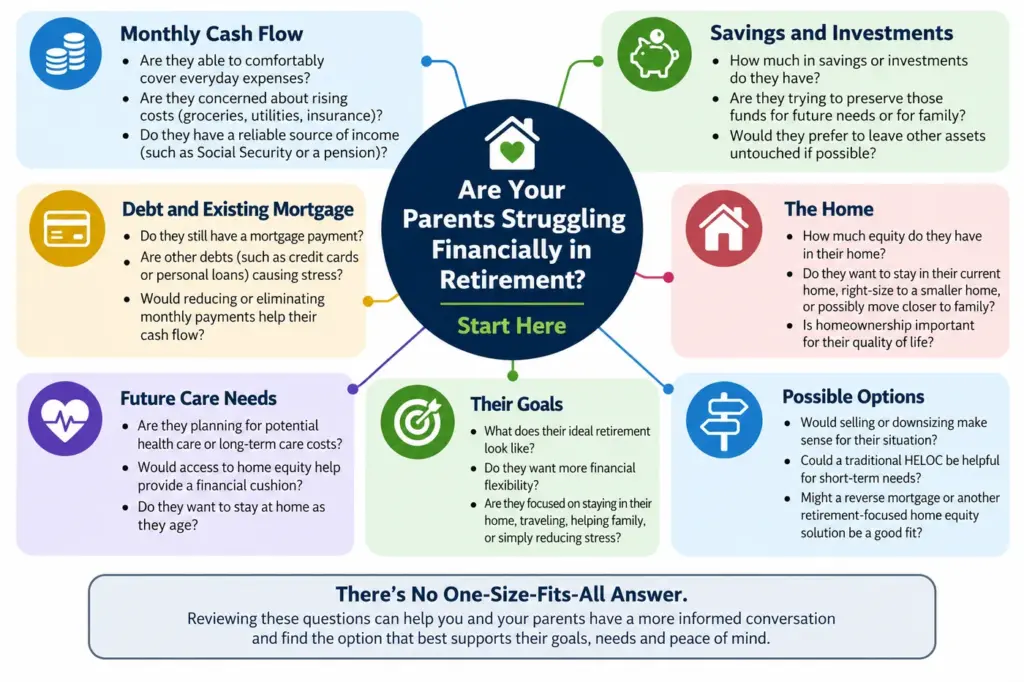
A productive family conversation might include:
- How much does it cost your parents to live each month?
- Is their retirement income covering those expenses?
- Are they drawing down savings faster than expected?
- Do they have outstanding mortgage, HELOC or credit-card debt?
- Does the house need repairs or modifications?
- Do they want to remain in the home?
- Could they afford help at home if they eventually need it?
- Would downsizing improve their financial situation?
- How important is preserving home equity for future needs or heirs?
The objective isn’t for adult children to make the decision for their parents.
It’s to help make sure the family understands the choices and the potential consequences.
Sometimes the Best Solution Isn’t More Money
This is also important.
If maintaining the house has become physically difficult, the home no longer fits your parents’ needs, property expenses are becoming unsustainable or they really want to live closer to family, accessing more equity may not solve the underlying problem.
Selling or downsizing may be the better conversation.
For parents who want to stay, however, understanding how their home fits into their larger retirement plan can be extremely valuable.
That’s why I view home equity as part of a broader retirement discussion rather than as a stand-alone lending decision.
You can read more in How Home Equity Fits Into a Retirement Income Plan.
Key Takeaways for Adult Children
If you’re concerned that your parents may be running out of money in retirement, don’t wait for a financial crisis before talking about it.
Start with their goals.
Understand their income and expenses.
Look at savings, debt, housing costs and potential future care needs.
And don’t overlook home equity simply because the house has traditionally been viewed as something to preserve rather than something that can potentially be used strategically.
Your parents spent decades building that equity.
The question is whether some of it could help them live the retirement they worked so hard to achieve.
Final Thought
More than a decade ago, I wrote the first version of this article because I was meeting older homeowners who had worked hard their entire lives yet were quietly struggling to make retirement work.
That hasn’t changed.
What has changed are the numbers, the financial tools available and our understanding of how home equity can fit into a retirement plan.
If you’re beginning to notice that your parents are cutting back, worrying about money or struggling with expenses, don’t assume there’s nothing that can be done.
Start the conversation.
Sometimes simply understanding all of the options can make the future feel much more manageable.
Frequently Asked Questions
What should I do if my parents are running out of money in retirement?
Start by helping them understand their monthly income, expenses, savings, debts and housing costs. Then consider whether expenses can be reduced and whether other resources—including home equity—could be used strategically.
Can my parents use home equity to help with retirement expenses?
Potentially. Depending on their circumstances, options may include selling or downsizing, a HELOC, refinancing or a reverse mortgage. Each option has different qualification requirements, costs, risks and long-term consequences.
Can Social Security income be used to qualify for a home equity loan?
Social Security may be considered qualifying income, subject to the lender’s underwriting requirements and documentation.
Do my parents have to pay off their mortgage before getting a reverse mortgage?
Not necessarily. An existing mortgage can generally be paid off with reverse mortgage proceeds at closing if sufficient proceeds are available. Homeowners therefore don’t necessarily need to own their home free and clear.
Do reverse mortgages require monthly mortgage payments?
HECM reverse mortgages do not require monthly principal and interest mortgage payments. Interest and applicable charges accrue to the loan balance. Borrowers must continue meeting loan requirements, including paying property taxes and homeowners insurance and maintaining the home.
Will a reverse mortgage leave nothing for the children?
Not necessarily. The amount of remaining equity depends on factors including the home’s future value, how much is borrowed, interest and charges accrued, and how long the loan remains outstanding. HECMs are non-recourse loans, which provides important protections when the loan is ultimately repaid.
Should adult children be involved when parents consider a reverse mortgage?
When parents want their children involved, having adult children participate can be helpful. It gives the family an opportunity to understand the parents’ goals, how the loan works and how the decision may affect future housing and estate considerations.
Have Questions About Your Parents’ Options?
If you’re concerned about your parents’ retirement finances and aren’t sure where to begin, I’m happy to help you understand the available home-equity options.
The first conversation doesn’t have to be about getting a loan.
It can simply be about understanding what’s possible.
Have questions about this?
Talk to a Certified Reverse Mortgage Professional — directly.
When you call, you reach me — not a call center. Free 30-minute consult by phone, video, or in person. No SSN, no credit pull, no obligation.
Schedule a consult