

hecm lender
How to Evaluate a HECM Lender Without Relying on Rankings

Start with the participant you are trying to evaluate
A lender for a Home Equity Conversion Mortgage (HECM) is the FHA-approved lender through which this FHA-insured program is available.
For evaluation purposes, focus on the organization connected to this program, not every business that uses the words reverse mortgage. The word HECM identifies the FHA-insured program, while the word lender identifies the FHA-approved organization through which it is available. Those labels do not establish eligibility, approval, a borrowing amount, terms, or suitability for a particular household. They help you ask whether the information in front of you concerns the product you are researching. If an answer mentions HECM for Purchase, a jumbo or proprietary program, a hybrid retirement mortgage, or a traditional HELOC, record it separately rather than treating it as a HECM answer. These paths are not interchangeable, and a comparison only works when each question is tied to the product named. Before you record a cost, payment feature, or eligibility point, ask the organization to identify the full product name and the role it is describing. Use a three-part check when a lender appears in a search result or conversation:
- Product: Is the answer about an FHA-insured HECM, or a different path?
- Participant: Is the speaker the lender, a HUD-approved counselor, or a broker or advisor?
- Evidence: Is the statement a general HECM explanation, that organization’s cost or process information, or an item that still needs personal review?
This order prevents a product label from becoming a conclusion about the organization and prevents one participant’s explanation from being treated as another participant’s answer. It also gives you a clean way to explain the discussion to an adult child or professional advisor: name the product, name the speaker, and preserve the limits of the statement. If any part is missing, record the question as unresolved rather than filling the gap with a ranking, assumption, or conclusion about your household.
A HUD-approved reverse-mortgage counselor does not promote, represent, or recommend a specific lender. To obtain an HECM, you must receive counseling from a HUD-approved reverse-mortgage counseling agency.
Use the distinction before you compare organizations. Ask what each participant can explain, which information is specific to one organization, and which questions belong in an independent counseling session. The useful starting point is the role, not a ranking label. The distinction also gives you a way to sort what you hear. A lender-specific statement concerns that organization’s offering. A counseling question concerns your goals, household needs, alternatives, or homeowner responsibilities and belongs in the required counseling conversation. A general explanation can help you prepare for either conversation, but it cannot become a personal result simply because it came from a lender, counselor, or article. Keep the source and the question together in your notes so you do not carry a lender-specific answer into an independent counseling discussion or treat counseling as a lender comparison. This is a role check, not a judgment about which organization you should use. It also helps an adult child or professional advisor explain why the same question may need to be asked in more than one setting, with each participant answering only within that participant’s role.
Keep the HECM label separate from other retirement-lending paths
An FHA-insured HECM is a specific reverse-mortgage program, so its rules and calculations should not be transferred to another product. Keep HECM for Purchase, jumbo programs, proprietary programs, hybrid retirement mortgages, and traditional HELOCs in separate comparison columns.
A traditional HELOC is also a different form of borrowing. When its draw period ends, monthly payments can increase substantially as the loan enters repayment. That payment transition belongs in a HELOC comparison; it should not be presented as an HECM feature. Ask which product every answer describes before you use the information. Use a separate product line in your notes for each path, and keep the FHA-insured HECM label attached to every note about costs, payment features, or homeowner responsibilities. Put HECM for Purchase, jumbo, proprietary, hybrid, and HELOC answers in separate rows rather than adding them to the HECM row. This prevents a feature of one path from becoming an assumed feature of another. It also gives the next participant a precise starting point: the product discussed is visible, and unanswered product-specific questions remain visible. A clean product label is part of the evidence in your comparison, not just a heading.
A product comparison should use the same questions for each path:
- How would the payment obligation work?
- What existing mortgage or other debt would need to be considered?
- Which costs belong to the product and which may come from third parties?
- How do your age, income, cash-flow needs, and long-term goals affect the discussion?
- What information still requires a personal review?
Neither is “better.” The right outcome depends on your cash flow, income, existing mortgage, age, long-term goals, and desire to make monthly payments. We have access to the full reverse-mortgage market and prepare personalized comparisons rather than recommending the same solution for everyone. Keep the products separate before you compare them.
Separate lender information from HUD-approved counseling
The counselor does not promote, represent, or recommend a specific lender. The lender is the participant to ask about the origination and servicing fees and third-party closing costs that it charges.
Counseling is required to obtain an HECM. You can use the two conversations for different purposes instead of asking either participant to replace the other. The lender can explain its terms; the counselor can help you examine the decision and the questions that matter to your household.
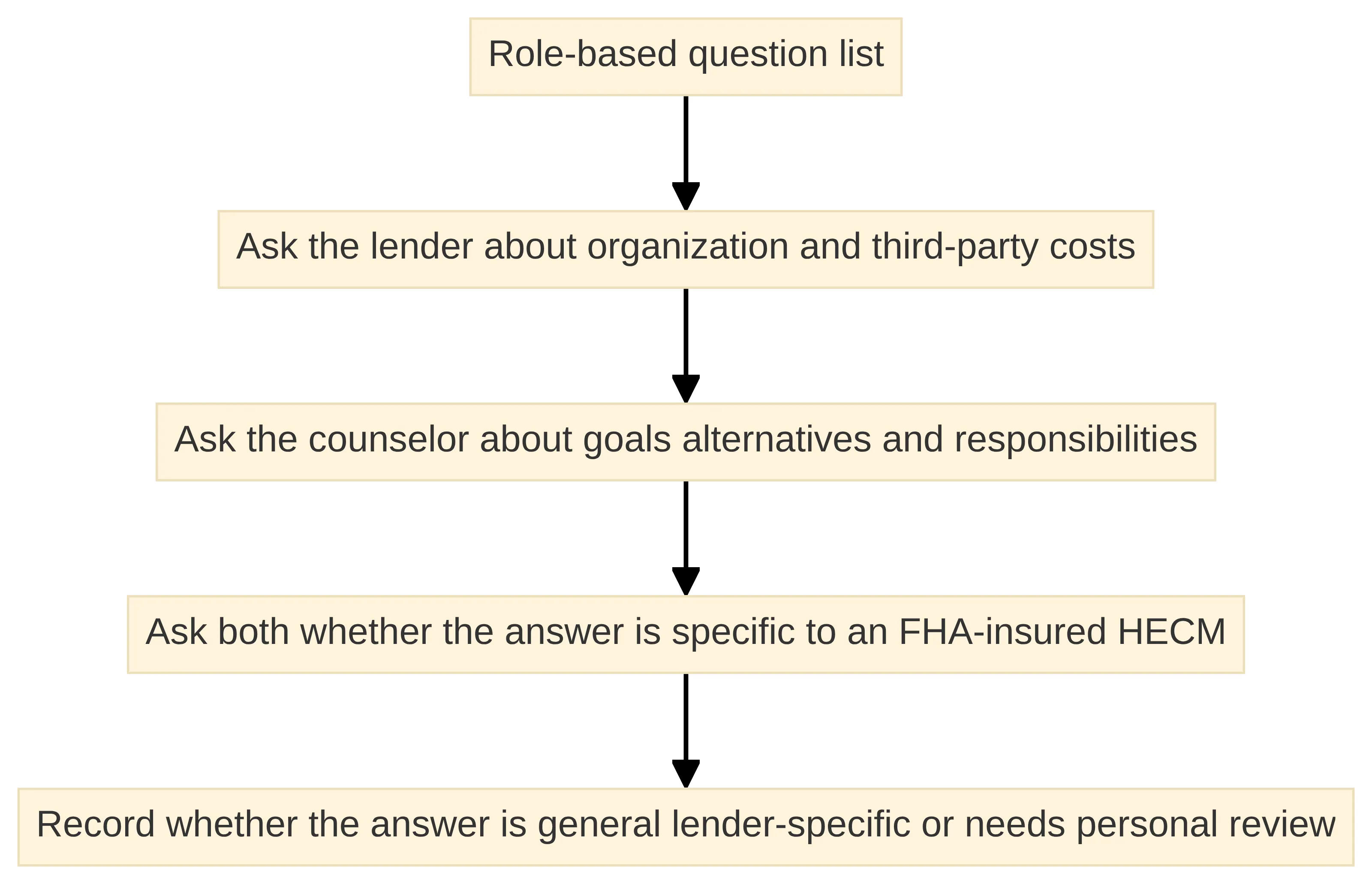
A role-based question list can keep the conversations in their proper lanes:
- Ask the lender: Which cost categories come from your organization, and which come from third parties?
- Ask the counselor: Which questions should I raise about my goals, household, alternatives, and responsibilities?
- Ask both: Is this answer specific to an FHA-insured HECM?
- Record whether each answer is a general explanation, a lender-specific term, or a question requiring personal review.
The purpose is not to make the counselor price the loan or make the lender provide independent counseling. The purpose is to know which participant can answer which question. Before either conversation, divide your notes into two lanes. Put lender-specific cost questions in the lender lane, including which origination, servicing, and third-party closing costs the organization charges. Put household goals, alternatives, and ongoing responsibilities in the counseling lane. If the same product-identification question belongs in both conversations, ask it in both places and label each answer as general or lender-specific. Do not ask the counselor to supply a lender’s fee information, and do not treat a lender’s explanation as a replacement for the required HECM counseling session. This simple separation preserves the boundary even when the conversations occur close together.
Understand why the lender cannot choose the counselor
A lender is not permitted to recommend a specific HECM counselor. A lender can provide a list of HUD-approved counselors you may contact, but the counseling relationship remains separate from the lender’s role. A HUD-approved counselor does not promote, represent, or recommend a specific lender.
That boundary matters when you evaluate the process. A counselor should not direct you toward one lender. Keep product information and independent education distinct.
A counseling preparation list can make the session more useful:
- Write down your financial needs and retirement goals.
- Note your spouse or partner’s future housing and financial needs.
- Include other household members or dependents whose housing needs matter.
- Describe why you are considering a reverse mortgage.
- List alternatives you have considered.
- If you are helping a parent, identify which questions your family wants explained without asking the counselor to choose a lender.
After counseling, compare your notes with the lender’s explanation. A counselor list is a way to locate approved counseling; it is not a recommendation of a lender or a product.
Use HUD’s lender search as a starting verification step
HUD’s lender search can limit results to lenders that have done an FHA HECM within the past 12 months. That filter gives you a practical starting point when you build a list of organizations to contact, but it is not a ranking and it does not establish a lender’s fit for your circumstances.
The search criteria may change. Treat the result as a dated starting point, save the search context with your notes, and ask the organization whether the conversation concerns an FHA-insured HECM. A search result helps you locate a relevant participant; it does not tell you which terms, costs, or outcome would apply to you.
A practical HUD search checklist has five steps:
- Select the FHA HECM search option.
- Record the organizations that appear under that filter.
- Ask each organization to identify the product being discussed.
- Request lender-specific cost and process information.
- Take unresolved questions to HUD-approved counseling.
Keep other retirement-lending products in a separate record. The search is a verification step for locating organizations with recent HECM activity, not a substitute for comparing explanations or examining your own circumstances. Read the result narrowly: it can show that an organization falls within the selected FHA HECM activity filter, but it does not answer which costs that organization charges, which product terms will be discussed, or whether any information applies to a particular borrower. Record the search date and the filter used beside each organization. Then ask the organization to confirm that your conversation concerns an FHA-insured HECM and request its own cost categories in writing or in your notes. Keeping the search result separate from the lender’s explanation prevents a verification result from becoming an implied endorsement or a personal conclusion.
Ask every lender for the costs it can explain
HECM interest rates, origination and servicing fees, and third-party closing costs can vary from lender to lender. These HECM costs may also vary by borrower and may be negotiable. Ask each lender for information about the origination, servicing, and third-party closing costs it charges instead of relying on a general estimate from another organization.
A single total can hide which charge belongs to the lender, which charge belongs to a third party, and which item may change with your circumstances. Request an explanation for each category before you compare one organization’s information with another’s.
A cost worksheet for each organization should ask:
- What interest-rate information applies to this FHA-insured HECM?
- Which origination fees would your organization charge?
- Which servicing fees would your organization charge?
- Which third-party closing costs should I discuss?
- Can any listed cost vary by borrower or be negotiable?
- Which figures are specific to your organization, and which require information from another party?
- What assumptions were used to describe the cost?
- Which details could change before a personal review?
Keep each answer beside the date and product name. Do not compare HECM information with a figure for a proprietary, jumbo, hybrid, or HELOC product. A useful comparison begins with matching product labels and matching cost categories. Read the worksheet in two directions. First, compare the same category across organizations: interest-rate information with interest-rate information, origination fees with origination fees, servicing fees with servicing fees, and third-party closing costs with third-party closing costs. Then read down one organization’s column to identify the assumptions behind its information. If one organization provides a single total while another separates the categories, ask for the components before treating the totals as comparable. A difference may reflect borrower-specific variation, negotiability, or a charge from a third party, so it is not automatically evidence that one organization is preferable. Preserve those explanations beside the figures rather than reducing them to a single ranking.
Test the lender’s explanation against HECM responsibilities
A reverse mortgage keeps the homeowner’s title in the homeowner’s name while the home secures the loan. An HECM has no required monthly principal and interest payments, but you must keep property taxes and homeowners insurance current, use the home as your principal residence, and maintain the property.
A lender’s explanation should place payment flexibility beside these ongoing homeowner responsibilities. If an explanation mentions the absence of required monthly principal and interest payments without explaining the continuing property duties, ask for the missing part before you draw a conclusion. The lender does not take ownership of the home merely because the home secures the loan.
A responsibility check during the conversation should ask:
- Does the explanation say who keeps title to the home?
- Does it explain that the home secures the loan?
- Does it state that property taxes and homeowners insurance must remain current?
- Does it address the principal-residence requirement?
- Does it address maintaining the property?
- Does it distinguish no required monthly principal and interest payments from having no homeowner responsibilities?
These questions test whether the explanation covers the major ongoing duties. They do not determine whether an HECM is suitable for your household. Add one question about when the loan becomes due. For an HECM, that event occurs when the last borrower permanently leaves the home, sells the property, or passes away; it is an event, not a deadline stated as a fixed loan term. Ask the lender to explain that event alongside the home’s role as security and the ongoing homeowner responsibilities. This keeps the discussion from treating payment flexibility as the whole product. It also gives you a clear way to identify whether an explanation has covered both what happens during occupancy and what event brings the loan due.
Ask what general information still cannot establish
General information cannot establish your HECM eligibility, approval likelihood, borrowing amount, loan terms, or suitability. A lender can explain the costs and terms it charges, and a HUD-approved counselor can provide the required counseling, but a general comparison is not a decision about your household.
This boundary changes how you use each answer. Treat a published explanation as a question guide, not as a personal result. Treat a lender’s product description as information about that lender’s offering, not as a promise that the same terms apply to you. Treat a cost illustration as a set of stated assumptions, not as a quote.
A three-column note can separate what you know from what still needs attention:
- Explained: the general HECM rule or product term that was described.
- Lender-specific: the cost, process, or program detail supplied by one organization.
- Still open: the question that requires counseling, documentation, or a personal review.
Use the open column to decide what to ask next. Do not fill it with an assumption about approval, borrowing amount, or suitability. A well-organized question list gives you a clearer next conversation than a ranking label when the facts affecting your situation have not been reviewed. Use the three columns as decision boundaries, not as a way to fill gaps. In the Explained column, keep general HECM information that has been stated clearly. In Lender-specific, keep the organization, product name, cost categories, and assumptions attached to the answer. In Still open, record anything that requires a personal review, required counseling, or clarification from another participant. Do not move an item into Explained merely because it sounds familiar, and do not move a lender-specific statement into a personal result. This record makes it easier to ask a focused follow-up question while preserving the limits of general information.
Place a broker or advisor in the comparison process without confusing the roles
A lender, HUD-approved counselor, and broker or advisor answer different questions. Use this role map before you ask for help:
| Participant | What to ask this participant about | Boundary to keep clear |
|---|---|---|
| Lender | Its FHA-insured HECM information, costs, and process | Its explanation is specific to its offering and does not establish your personal outcome |
| HUD-approved counselor | Required counseling and independent education about the reverse-mortgage decision | The counselor does not promote, represent, or recommend a specific lender |
I represent clients rather than lenders and work as an independent reverse-mortgage broker. I provide clear, unbiased education to help families understand reverse-mortgage options. I have access to the full reverse-mortgage market and can help organize a comparison, but my role does not replace the independent HUD-approved counseling required for an HECM.
That is why we prepare personalized comparisons instead of recommending the same solution for everyone. Keep the request specific: ask which products are being compared, which assumptions are being used, which costs belong to each option, and which questions remain open for counseling or individual review. The comparison becomes more useful when every participant’s boundary stays visible.
Turn the research into questions for the next conversation
A focused question list gives you a practical way to evaluate an organization without relying on rankings. Bring each question to the participant who can answer it:
- Is this information for an FHA-insured HECM?
- Does the organization appear in HUD’s lender search under the FHA HECM option?
- Which interest rates, origination fees, servicing fees, and third-party closing costs apply to the discussion?
- Which costs may vary by borrower or be negotiable?
- How does the explanation address title, the home securing the loan, and ongoing homeowner responsibilities?
- Which questions belong with a HUD-approved counselor?
- If a broker or advisor is involved, what products and assumptions will the comparison include?
- What information remains open instead of being treated as an eligibility or approval answer?
Use matching product labels, separate notes for each participant, and a clear list of unresolved questions. That method keeps an FHA-insured HECM distinct from other retirement-lending paths. Before a conversation, sort the list by participant. Put lender-specific cost and process questions together, put household-goal and alternative questions in the counseling list, and mark product-identification questions for either conversation. Then keep unanswered items visible rather than filling them with a guess about approval, amount, terms, or suitability. This makes the next exchange easier to review without turning a general guide into an individualized conclusion. It also gives an adult child or professional advisor a common set of product names and open questions to discuss with the homeowner, lender, counselor, or broker. Preserve qualifiers such as “may vary by borrower” and “may be negotiable” when those qualifiers belong to the cost information.
A useful lender evaluation is a role-and-information check: identify the FHA-insured product, separate lender explanations from independent counseling, use HUD’s search as a starting point, and compare costs by category rather than by a ranking label. I provide clear, unbiased education to help families understand reverse-mortgage options.
What should I ask a HECM lender before moving forward?
What should I ask a HECM lender when evaluating options?
You should ask about the specific costs associated with the HECM, including origination fees, servicing fees, and third-party closing costs, as well as how these costs may vary by borrower.
What responsibilities do I have as a borrower with a HECM?
As a borrower, you must keep property taxes and homeowners insurance current, use the home as your principal residence, and maintain the property in good condition.
Can I negotiate the costs associated with a HECM?
Yes, HECM costs, including interest rates and fees, may vary by lender and borrower, and some costs may be negotiable.
How can I verify if a lender is approved for HECM loans?
You can use HUD’s lender search tool to find FHA-approved lenders that have done HECM loans within the past 12 months.
Have questions about this?
Talk to a Certified Reverse Mortgage Professional — directly.
When you call, you reach me — not a call center. Free 30-minute consult by phone, video, or in person. No SSN, no credit pull, no obligation.
Schedule a consult