

what disqualifies you from getting a reverse mortgage
What Disqualifies You From Getting a Reverse Mortgage? A Preliminary HECM Screening Guide

Separate a possible HECM barrier from a final eligibility decision
Not every concern in a reverse-mortgage file has the same result. I separate a possible HECM barrier into three decision points: a preliminary borrower or occupancy item under the applicable rule; a property-acceptability condition that may call for repair or a permitted repair-completion escrow; and an ongoing property-charge duty that may require a specified arrangement. This focuses on what can change the review rather than treating every question as a final disqualifier.
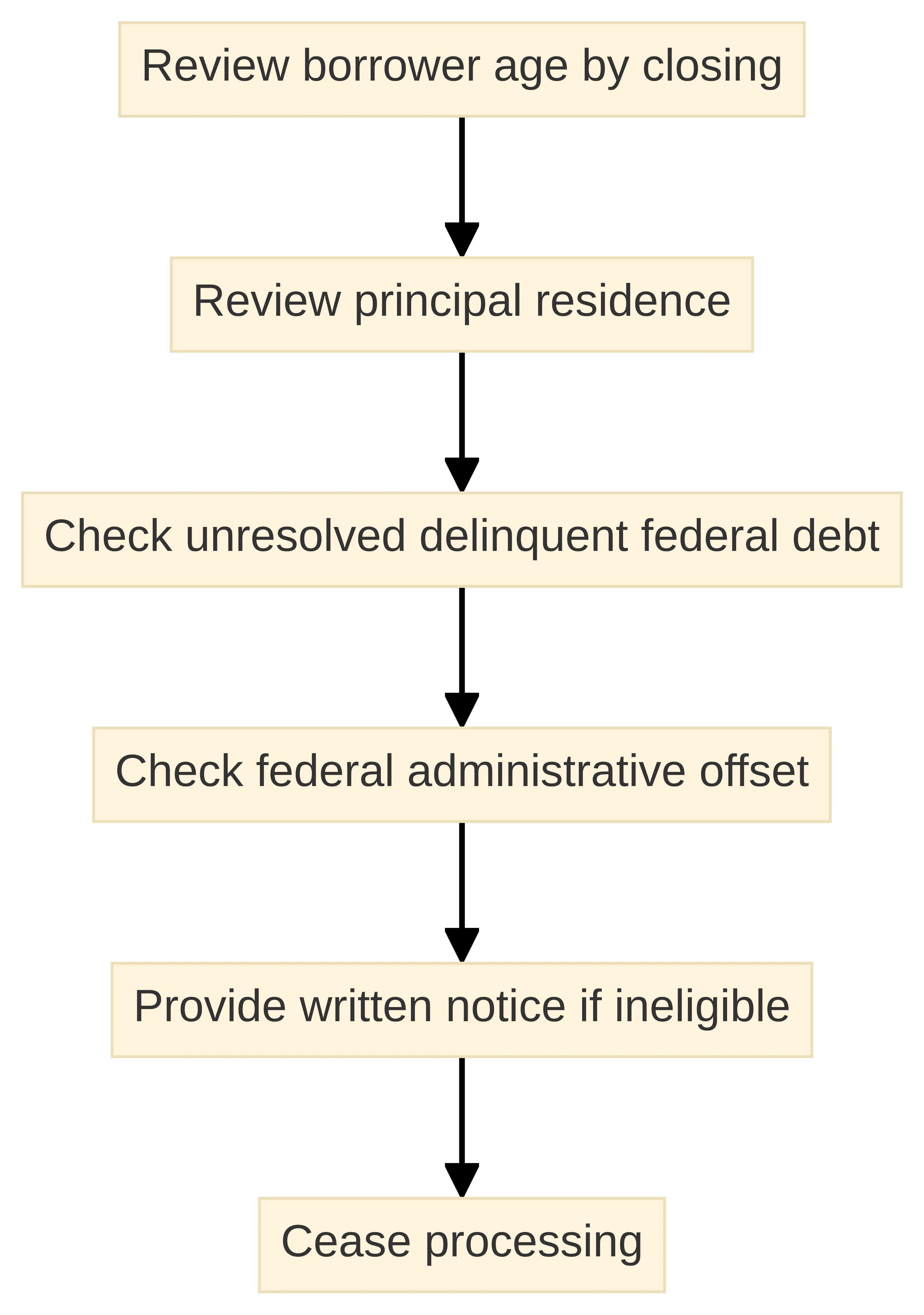
The supplied HUD draft describes preliminary review of borrower-age, certain federal-obligation, and principal-residence conditions. Because that material is a draft, I treat those points as matters to verify under the final applicable HUD rule, not as a conclusion about any particular reader.
Property questions follow a separate path. The current rule and lender review determine whether a condition can be addressed or whether it prevents the property from proceeding.
Ongoing homeowner duties are another part of the review. HUD guidance also provides set-aside or authorized-payment mechanisms in specified circumstances when financial assessment indicates limited capacity or willingness to meet certain property-charge obligations. Those mechanisms do not erase the underlying homeowner duties.
The focused question is therefore which current requirement is at issue, what part of the home or borrower record it concerns, and whether the applicable rules provide a way to address it. Whether a concern prevents a loan from proceeding depends on current requirements and a case-specific lender review. This article does not label any particular reader eligible or ineligible.
A preliminary HECM screen also separates loan eligibility from ongoing homeowner responsibilities. Financial assessment may lead to a specified property-charge arrangement in some circumstances, while every borrower remains responsible for obligations such as property taxes, homeowners insurance, principal-residence use, and property condition. A payment arrangement does not erase those duties.
Use the sections below as a map. They cover the borrower, the home, the debt record, and the documents that help a lender decide what happens next.
Identify the FHA-insured HECM being screened
The screening questions in this guide are organized around the HECM program. A HECM is not the same as every loan marketed as a reverse mortgage. The CFPB states that most reverse mortgages today are HECMs, while HUD’s handbook notes that other reverse mortgage products may use different age requirements and different calculations. Do not transfer an HECM rule to a separate proprietary, jumbo, or hybrid program.
A HECM also does not change the ownership question into a bank-ownership question. You keep title to the home. The home secures the loan, as it does with a traditional mortgage, and the loan balance is handled under the repayment terms that apply when the borrower no longer lives in the home.
This distinction prevents two common screening errors. First, a general statement about “reverse mortgages” may combine different products. Second, a fact about one part of the review—such as age or income—does not answer the property, title, or obligation questions. Keep the FHA-insured HECM label attached to each question.
An FHA-insured HECM screen asks whether the borrower and property meet the requirements for that program. The screen does not promise a particular loan amount, payment option, or approval. It identifies the subjects that need a formal review: who will borrow, where the borrower lives, what federal obligations appear in the record, how ongoing charges will be handled, and whether the property meets FHA criteria.
Write the product name at the top of your question list. Then keep separate notes for borrower eligibility, financial assessment, homeowner obligations, title and liens, and property condition. That simple separation makes it easier to see which question is about the HECM and which question belongs to another product or another stage of review.
Check the borrower’s age, occupancy, and federal-obligation record
Borrower age is one of the first HECM screening questions. HECM borrowers are generally age 62+, with provisions for eligible non-borrowing spouses under 62. A 2026 HUD draft eligibility rule says the lender must preliminarily review whether the borrower will be at least 62 by closing. The relevant date is tied to closing, so do not rely on a general statement that you are “almost” old enough.
Occupancy is a separate question. The same HUD draft lists use of the property as the borrower’s principal residence among the preliminary items a lender must review. Principal residence means the home where you live as your primary home under the applicable program rules. A second home, rental property, or a planned move can require a different analysis. Put your actual living arrangement and any planned change on the question list rather than assuming the property meets the occupancy requirement.
A non-borrowing spouse can change how the age and occupancy review is handled. Give the lender the complete household and title information so the applicable provision can be considered. Avoid reducing the review to the age of the person who makes the first inquiry.
Federal obligations form another screening category. The 2026 HUD draft lists unresolved delinquent federal debt and ineligibility caused by a federal administrative offset for delinquent child support. The draft treats these as preliminary review items, so ask what record the lender needs and whether the obligation is resolved, documented, or still active.
Do not turn this category into a rule about every debt or every missed payment. The relevant question is the nature of the obligation and the status shown in the applicable record. Gather notices, payment arrangements, release information, or other records that explain the situation. A lender can then determine whether the item needs documentation, resolution, or a formal eligibility decision.
The draft also says that a lender finding a prospective borrower ineligible after preliminary review must provide written notice and cease processing. That statement belongs to the lender’s review process; it does not allow this article to predict your result. Ask for the specific reason and the governing requirement if a preliminary review identifies a problem.
Separate income eligibility from financial-assessment review
HECM income eligibility is different from financial assessment. HUD’s April 2024 handbook stated that the HECM program does not have an income eligibility requirement, but the lender still reviews documented income, assets, and resources to evaluate your capacity to meet financial obligations. No income threshold in this statement means no financial review.
The lender may ask for documents such as tax returns, pay stubs, evidence of Social Security income, bank statements, and retirement-account records. Those records help establish the resources available for obligations connected with the home and the loan. Prepare the records that describe your actual financial picture rather than trying to fit yourself into a simple income category.
Separate three questions when you review your finances:
- Is there a stated HECM income requirement? The handbook says there is not one.
- What income, assets, and resources can you document? The lender reviews those items during financial assessment.
- Can ongoing property charges be handled under the applicable rules? The assessment may affect whether a specified funding arrangement is required.
The first answer does not answer the second or third. A low or irregular income pattern is not automatically the same as HECM ineligibility, and a documented income source is not an approval assurance.
Financial assessment can affect how certain property charges are handled. HUD guidance provides for a life-expectancy set-aside or an authorized-payment arrangement in specified circumstances when the assessment indicates limited capacity or willingness to meet certain property-charge obligations.
Ask which charge is being reviewed, what documentation supports the assessment, and what arrangement the applicable rules permit. Keep the answer tied to the FHA-insured HECM under review. Do not assume that a financial-assessment issue has only two outcomes—automatic approval or automatic rejection—when the applicable rules may provide a specific funding mechanism.
Review the homeowner obligations that remain in place
Homeowner obligations remain part of an FHA-insured HECM review. Those duties continue even though the loan does not require monthly principal and interest payments.
“No required monthly principal and interest payments” is narrower than “no monthly payments.” Taxes, insurance, maintenance, utilities, association charges, and other household costs may still exist. The HECM payment structure does not transfer those responsibilities to the lender.
Use four questions to examine this category:
- Are property taxes paid and documented?
- Is homeowners insurance in place for the property?
- Is the home your principal residence under the applicable rules?
- Can you maintain the property and address required repairs?
A problem in this category may call for records, a payment arrangement, a repair, or a deeper eligibility review. It is not useful to label every obligation a disqualifier before the lender identifies the exact issue. The financial-assessment guidance may allow a specified set-aside or authorized-payment mechanism for certain property charges, but the underlying homeowner duty remains.
The loan balance also changes over time. The CFPB explains that interest and fees are added to the balance, while the homeowner keeps title. That balance growth is a program feature to understand, not a reason to treat the absence of required principal-and-interest payments as the absence of financial obligations.
Put your property-charge records and your questions about balance growth together. A clear review considers both what must be paid while you live in the home and what happens to the loan balance under the applicable repayment event.
Ask what the title, liens, and existing mortgage record require
Title and loan security are separate questions. The CFPB states that title to the home remains in your name while the home serves as security for the reverse mortgage. The lender places a lien as part of securing the loan; the lender does not become the owner of the home.
Start the title review with the names on the deed and the names of the intended borrower or borrowers. Then ask whether any spouse, co-owner, trust, estate, or other title arrangement needs separate review. The answer depends on the actual documents, so do not treat a general explanation of title as a determination about your property.
Existing mortgage and lien records deserve their own checklist. Ask:
- What existing mortgage balance appears in the current statement?
- What other liens or recorded claims appear against the property?
- Which person or entity holds each lien?
- What documentation shows the balance, status, or release of each item?
- How would each item be addressed before or at an FHA-insured HECM closing?
These questions keep title, debt, and closing treatment distinct. An existing mortgage record is not the same question as whether you keep title, and a title arrangement is not the same question as whether the property meets FHA property criteria.
An existing mortgage or lien should be discussed with the lender before you rely on an estimate of available proceeds. Bring the latest statements and any recorded-lien information you have. The lender can identify what must be documented and how the record fits the HECM closing review.
Do not describe a reverse mortgage as the bank taking the house. The homeowner keeps title. Do not describe an existing lien as an automatic personal disqualifier without the record and the applicable closing requirements. The practical next step is a document-based review of title, balances, and lien treatment.
Classify property conditions as repairable or potentially blocking
Property condition is a separate FHA-insured HECM screening category. FHA property-acceptability criteria include minimum property requirements and minimum property standards. An appraisal or qualified inspection can identify conditions that need attention before the property is eligible for FHA-insured financing.
The mortgagee determines which repairs are required when an appraisal or qualified inspection identifies a problem. That means a visible defect is not automatically a final rejection, and a clean appearance is not a substitute for the appraisal and inspection process. Put the property condition into one of three working groups:
- No identified repair: The appraisal and applicable review do not identify a required correction.
- Repair or documentation needed: The mortgagee identifies a repair, inspection, or record needed to meet the property-acceptability criteria.
- Potentially blocking defect: The property has a defective condition that cannot feasibly be corrected under the applicable policy.
The property decision belongs to the mortgagee applying the applicable FHA standard to the appraisal and inspection.
An escrow is a specific funding and completion arrangement; it is not a promise that every repair can be deferred.
Ask for the exact repair, the deadline, the party responsible for completion, and the rule governing any escrow. Also ask whether the condition affects the property’s eligibility or only the timing and documentation of the file. Keep the answers tied to the inspection and appraisal rather than making a personal approval prediction from a photograph or a general property description.
Separate a possible HECM barrier from an issue that may be correctable
A possible reverse-mortgage disqualifier is not the same as a final eligibility decision. For a focused review, sort each concern by the question it raises:
- Possible program barrier: Which current HECM requirement applies to the borrower, the home, or occupancy?
- Record or documentation issue: Which document or fact would confirm the concern and support a case-specific review?
- Condition that may be addressed: Is there a correction or payment arrangement that the applicable requirements permit?
- Unresolved review question: What exact reason or governing requirement should the reader ask about before treating the issue as final?
This approach keeps the article focused on the reason a concern was raised rather than treating every concern as an automatic disqualifier. It does not determine eligibility. A lender or qualified advisor must review the individual facts and the applicable HECM requirements.
Use the self-check in three passes. First, mark each item documented, missing, or needs explanation. Second, mark each property or payment issue possibly correctable, subject to an arrangement, or potentially blocking. Third, write one question beside every item that does not have a clear answer.
A useful question sounds specific: “Which document shows the status of this federal obligation?” “Which property repair does the appraisal require?” “What happens to this lien in the closing review?” Specific questions produce a more useful review than a broad request to know whether you qualify.
Use counseling and personalized review to resolve the remaining questions
A HUD-approved reverse-mortgage counselor can help you understand how the loan works before you sign, and the CFPB recommends considering borrowing and housing alternatives as part of that process. Bring the self-check, your documents, and the questions that remain open.
Final HECM eligibility depends on a case-specific review of the borrower, property, title, obligations, and applicable program requirements. A preliminary screen cannot establish eligibility or approval. A lender must apply the requirements to your actual file, and a lender’s preliminary finding can affect whether processing continues.
Use the review to ask for a clear classification of each issue:
- What needs only documentation?
- What needs correction or a permitted funding arrangement?
- What may prevent eligibility under the applicable rule?
- What additional record or review would resolve the question?
That process gives you a fact-based next step without turning a general article into individualized financial advice. It also keeps the FHA-insured HECM separate from other retirement-lending products that use different rules.
I treat the question of what may disqualify you from getting a reverse mortgage as a review of conditions, not a prediction. Age, principal residence, federal obligations, financial assessment, homeowner duties, title, liens, and property condition each call for a different question. Gather the record, identify what may be corrected or arranged, and leave the final eligibility decision to the lender applying the applicable requirements to your file.
A written list of questions gives the next conversation a clear starting point.
What should I verify before asking whether I qualify for a HECM?
What homeowner responsibilities remain after obtaining a reverse mortgage?
Borrowers must continue to pay property taxes, homeowners insurance, and maintain the property in good condition, even though there are no required monthly principal and interest payments.
What should I do if my property needs repairs before applying for a reverse mortgage?
If repairs are needed, the lender may allow a repair-completion escrow, but you should confirm which repairs are required and ensure they are addressed before closing.
How can I prepare for a conversation with a lender about my reverse mortgage eligibility?
Gather documentation related to your age, occupancy, financial obligations, and property condition. Prepare specific questions about any unresolved issues or requirements.
What is the role of a HUD-approved counselor in the reverse mortgage process?
A HUD-approved counselor can help you understand how a reverse mortgage works, discuss alternatives, and ensure you are making an informed decision before signing any loan documents.
Have questions about this?
Talk to a Certified Reverse Mortgage Professional — directly.
When you call, you reach me — not a call center. Free 30-minute consult by phone, video, or in person. No SSN, no credit pull, no obligation.
Schedule a consult