

Retirement Planning
Is Your Home Still Working for Your Retirement?

For many retirees, home equity in retirement can be an important part of their overall financial picture. Their home is much more than a place to live—it may also represent one of the largest assets they own.
But there is an important difference between having home equity and having home equity that is helping support your retirement.
During your working years, the goal may have been straightforward: buy a home, make the mortgage payments and build equity. In retirement, the question changes:
Is your home—and the equity you’ve built in it—still working for the retirement you want to live?
For some homeowners, the answer is absolutely yes. For others, high housing expenses, an existing mortgage, home maintenance or a large amount of inaccessible equity may be limiting retirement cash flow.
That doesn’t automatically mean selling your home or taking out another loan.
It means understanding how home equity in retirement fits alongside your savings, investments, Social Security, pensions and other financial resources.
Quick Answer: How Can You Use Home Equity in Retirement?
Homeowners can generally access home equity by selling the home or borrowing against it. Depending on the homeowner’s age, finances and goals, borrowing options may include a HELOC, home equity loan, cash-out refinance or reverse mortgage.
But accessing equity isn’t always the right decision.
Before choosing any option, consider your monthly cash flow, how long you expect to remain in the home, existing mortgage debt, future expenses and how using the equity could affect your long-term financial plan.
The goal isn’t simply to get money out of your house. The goal is to determine whether your home can help support the retirement you want.
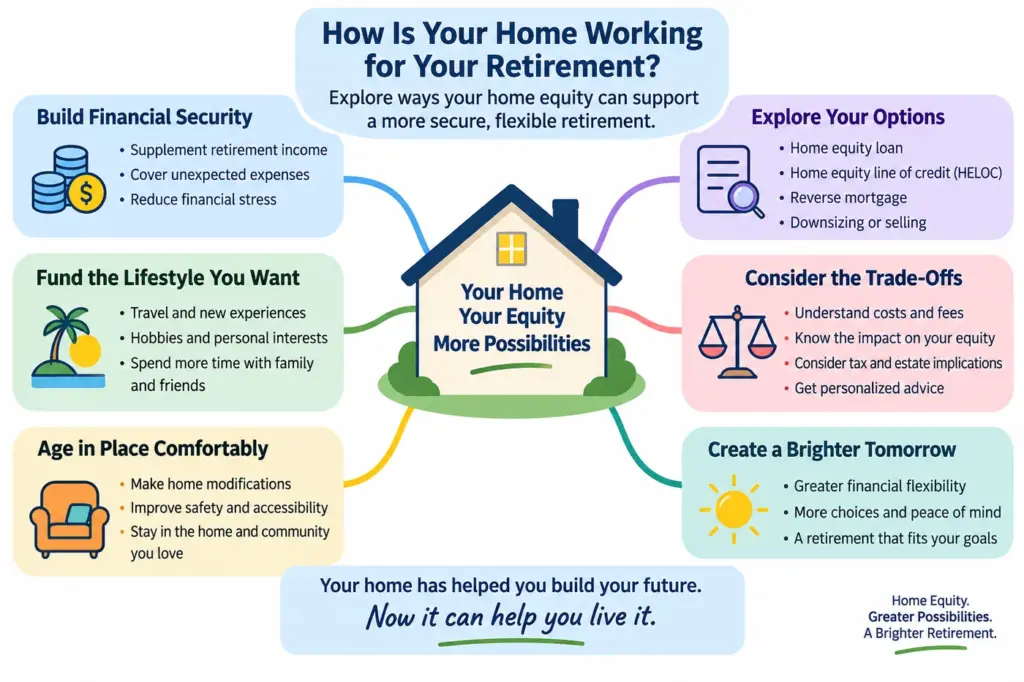
Is Your Home Part of Your Retirement Plan?
It probably should be.
Retirement planning often focuses on Social Security, pensions, 401(k)s, IRAs and investments. Yet for many homeowners, a substantial portion of their net worth may be sitting in their home.
That makes the home both a lifestyle asset and a financial asset.
As a lifestyle asset, your home provides shelter, familiarity, community and independence.
As a financial asset, it may contain equity accumulated over decades.
Understanding how home equity fits into a retirement income plan can help you evaluate your home alongside your other retirement resources rather than treating it as something separate from your financial plan.
How Much Is Your Home Really Costing You in Retirement?
A paid-off mortgage doesn’t mean housing is free.
Consider the complete cost of keeping your home:
- Mortgage payment, if applicable
- Property taxes
- Homeowners insurance
- HOA dues
- Utilities
- Routine maintenance
- Major repairs
- Landscaping
- Accessibility improvements
Then compare those expenses with your expected retirement cash flow.
A house that was comfortably affordable during your working years can feel very different when employment income stops.
The question isn’t simply, “Can I afford my house?”
A better question may be:
“Does the amount I’m spending on my home still make sense for the life I want to live?”
Does Your Home Still Fit the Way You Want to Live?
Finances aren’t the only consideration.
Think about how you actually use your home today.
Are there bedrooms or entire floors you rarely use? Are stairs becoming inconvenient? Is the yard becoming more work than enjoyment? Are healthcare, family, shopping and activities nearby?
Or perhaps the opposite is true.
Maybe you love your neighborhood, your friends are nearby, the home is manageable and you can’t imagine living anywhere else.
If staying is important to you, planning may focus on making the property safer, more accessible and financially sustainable.
Our guide to aging in place and the financial tools that can help explores that decision in greater detail.
What If Most of Your Wealth Is Tied Up in Your Home?
Consider a homeowner with substantial home equity but relatively modest liquid retirement savings.
On paper, that person may have significant net worth.
But home equity doesn’t normally pay for groceries, replace a roof or cover an unexpected expense unless the homeowner sells the property or chooses a way to access the equity.
That creates an important retirement-planning distinction:
Having wealth and having accessible financial resources aren’t necessarily the same thing.
This is one reason researchers and financial professionals have studied ways home equity can be incorporated into retirement-income strategies rather than automatically leaving it outside the retirement plan.
Should You Pay Off Your Mortgage in Retirement?
There isn’t one answer for everyone.
A low-interest mortgage with an affordable payment may be perfectly reasonable to keep.
For another retiree, eliminating a substantial mortgage payment could materially improve monthly cash flow.
But using a large portion of retirement savings to pay off a mortgage can also reduce liquidity.
Before making that decision, consider:
- Your mortgage interest rate
- Remaining loan balance
- Monthly payment
- Available savings
- Emergency reserves
- Investment and tax considerations
- How long you expect to stay in the home
The objective isn’t necessarily to enter retirement without a mortgage.
It’s to have a housing strategy that works with your retirement cash flow.
Could Your Home Equity Provide a Retirement Safety Net?
Retirement doesn’t always cooperate with the spreadsheet.
A new roof, major home repair, vehicle replacement, healthcare expense or family emergency can suddenly require substantial cash.
Where would that money come from?
If the automatic answer is “I’ll take it from my retirement account,” it may be worth understanding your alternatives.
Home equity can sometimes serve as another financial resource.
Research has examined strategies involving reverse-mortgage credit lines as a potential buffer alongside an investment portfolio, particularly when avoiding portfolio withdrawals during unfavorable markets may be valuable.
Our 4-Bucket Retirement Strategy explains this concept further.
How Can Retirees Access Home Equity Without Selling Their Home?
This is an important search question, so I want it as an H2 rather than burying it in the article.
Several financing options may allow a homeowner to access equity without selling. They work very differently.
HELOC
A home equity line of credit (HELOC) provides a revolving credit line secured by the home.
A HELOC can be useful when a homeowner wants flexible access to funds and can comfortably qualify for and manage the required payments.
However, retirees should understand that HELOCs commonly have variable interest rates and separate draw and repayment periods.
If you’re considering one, read HELOC for Retirees: Is a Home Equity Line of Credit a Good Idea in Retirement?.
Home Equity Loan
A home equity loan generally provides a lump sum with scheduled monthly principal and interest payments.
It may be useful when someone needs a known amount of money and wants a predictable repayment schedule.
Cash-Out Refinance
A cash-out refinance replaces the existing mortgage with a larger loan and provides the homeowner with the difference, subject to available equity and qualification.
This deserves particular consideration when someone already has a low-rate mortgage because refinancing means replacing that existing loan.
Reverse Mortgage
For qualifying older homeowners, a reverse mortgage provides another way to access a portion of home equity without selling the home.
The FHA-insured Home Equity Conversion Mortgage, or HECM, is available to qualifying homeowners age 62 and older.
Depending on the HECM and payment plan selected, available proceeds may be taken through a lump sum, line of credit, term or tenure advances, or certain combinations.
Unlike a traditional mortgage or HELOC, a HECM does not require monthly principal and interest mortgage payments while loan requirements are met.
Borrowers must continue paying property taxes and homeowners insurance, maintain the home and meet other loan obligations.
HELOC vs. Reverse Mortgage: What’s the Difference for Retirees?
Both can provide access to home equity without immediately selling the property, but the cash-flow structures are quite different.
A HELOC generally requires monthly payments and qualification based on factors including income, credit and debt obligations.
A reverse mortgage does not require monthly principal and interest mortgage payments, although the homeowner remains responsible for property charges and other loan requirements.
Reverse mortgages also generally have higher upfront costs than HELOCs, while HELOC payments can change because of variable interest rates and the eventual transition into repayment.
That’s why the better question isn’t:
“Which loan is better?”
It’s:
“Which structure fits this homeowner’s retirement cash flow, goals and expected time in the home?”
For a detailed comparison, see HELOC vs. Reverse Mortgage: Which Is Better for Retirees?.
Current search results confirm that this side-by-side decision remains a prominent way consumers research the two products.
Should You Sell or Downsize Instead of Borrowing Against Home Equity?
Sometimes, yes.
Selling can unlock equity without taking on additional debt.
Right-sizing may also reduce maintenance, utilities or other housing expenses.
But downsizing isn’t automatically the least expensive solution.
Consider:
- Real estate commissions and selling expenses
- Moving costs
- Cost of the replacement home
- Current mortgage rates
- Property taxes
- HOA fees
- Maintenance expenses
- Location
- Emotional and lifestyle considerations
For some retirees, moving creates greater freedom.
For others, remaining in a familiar home and community is far more important.
Neither choice is inherently better.
Are You Staying in Your Home Because You Want To—or Because You Think You Have To?
This may be the most important question.
There is no retirement rule saying you must sell your home.
There is also no rule saying you should stay forever.
Your home should support the life you’re trying to create.
For one person, that may mean staying exactly where they are.
For another, it could mean remodeling for aging in place.
Someone else might use a HELOC for a short-term need.
Another homeowner may determine that a reverse mortgage provides a cash-flow structure better suited to their situation.
And someone else may happily sell the house and move closer to grandchildren.
The strategy should serve the retirement—not the other way around.
A Simple Home Equity in Retirement Checkup
Once a year, ask yourself:
- Is my home still affordable?
- Do I still enjoy living here?
- Can I comfortably maintain it?
- Will it work for me physically five or ten years from now?
- How much home equity have I accumulated?
- How much of my overall net worth is tied up in the house?
- Do I have sufficient liquid savings for unexpected expenses?
- Is my mortgage affecting my monthly retirement cash flow?
- Do I have a HELOC, and do I understand when its draw period ends?
- Would accessing equity strengthen my plan or simply create unnecessary debt?
- Would selling genuinely improve my finances or lifestyle?
- What do I want my home to make possible during retirement?
You don’t need to change anything simply because you ask the questions.
Sometimes the review confirms that your current strategy is already working.
That’s a good answer, too.
Key Takeaways: Making Home Equity Work in Retirement
Your home may be one of your largest retirement assets.
But the goal isn’t simply to access as much equity as possible.
It’s to determine whether your home, housing expenses and home equity are working together with the rest of your retirement plan.
That could mean:
- Staying exactly where you are
- Paying down a mortgage
- Preserving liquidity instead of paying off the house
- Using a HELOC
- Considering a reverse mortgage
- Modifying the home for aging in place
- Right-sizing or relocating
The appropriate choice depends on your finances, goals and the life you want your retirement resources to support.
Frequently Asked Questions About Home Equity in Retirement
How can I use home equity in retirement?
Homeowners may use home equity by selling or downsizing, taking a home equity loan, opening a HELOC, completing a cash-out refinance or, for eligible older homeowners, obtaining a reverse mortgage. Each option has different costs, payment requirements and long-term consequences.
Can I access home equity without selling my house?
Yes. A HELOC, home equity loan, cash-out refinance or reverse mortgage may allow an eligible homeowner to access equity without selling. Qualification, monthly payment requirements and loan terms differ substantially.
Is a HELOC a good idea for retirees?
A HELOC can work well for some retirees who qualify and can comfortably manage the required payments. Retirees should pay particular attention to variable rates, the length of the draw period and what happens when repayment begins. Our guide explains what happens when a HELOC draw period ends.
Is a reverse mortgage better than a HELOC?
Neither is universally better. A HELOC generally has required monthly payments and often lower upfront costs. A reverse mortgage has different eligibility requirements and does not require monthly principal and interest mortgage payments while loan obligations are met. The homeowner’s cash flow, age, equity, borrowing needs and plans for the property should guide the comparison.
Can Social Security income be used to qualify for a HELOC?
Retirement does not automatically prevent someone from qualifying for a HELOC. Lenders evaluate qualifying income, credit, debt obligations, home equity and their own underwriting requirements. This is a subject we’ll cover separately because it deserves a detailed explanation.
Should I use retirement savings or home equity for a large expense?
That decision can have tax, investment, borrowing-cost and long-term retirement consequences. Rather than automatically drawing from one resource, it can be useful to compare the cost and consequences of each available source of funds.
Final Thoughts: Is Your Home Still Working for Your Retirement?
Your home has worked hard for you over the years.
Maybe now is a good time to ask whether it’s still doing the job you need it to do.
You may discover that nothing needs to change.
Or you may find that your mortgage, HELOC, available home equity or future housing plans deserve another look.
If you’d like to understand your home equity options, I can help you compare HELOC and reverse mortgage strategies and explain how each may affect your monthly cash flow and long-term plans.
Sometimes the best solution is a new strategy.
And sometimes the best solution is knowing that the one you already have is working.
Have questions about this?
Talk to a Certified Reverse Mortgage Professional — directly.
When you call, you reach me — not a call center. Free 30-minute consult by phone, video, or in person. No SSN, no credit pull, no obligation.
Schedule a consult