

Home Equity & HELOC
Can You Get a HELOC on Social Security Income? What Retirees Need to Know

If Social Security income provides most or all of your monthly cash flow in retirement, you may wonder whether you can qualify for a HELOC on Social Security income or whether lenders require other sources of retirement income.
The short answer is yes, potentially. Receiving Social Security does not automatically prevent you from qualifying for a HELOC.
Federal fair-lending rules generally prohibit lenders from discriminating against applicants because they receive income from public assistance programs, including Social Security. Lenders can, however, evaluate the amount, stability and expected continuation of that income along with your debts, credit history, home equity and other underwriting requirements.
That distinction is important for retirees because having substantial equity in your home does not necessarily mean you will qualify for a traditional HELOC.
Quick Answer: Can Social Security Income Be Used to Qualify for a HELOC?
Yes. Social Security can generally be considered when a lender evaluates your income for a HELOC.
The Consumer Financial Protection Bureau explains that lenders generally cannot discount or refuse to consider income simply because it comes from Social Security or another public assistance program. A lender may still consider whether the income is sufficient and likely to continue.
In other words, the question usually isn’t:
“Are you retired?”
It’s:
“Does your overall financial profile meet the lender’s requirements?”
That can include your income, existing debts, credit history, available home equity and the monthly payment associated with the new credit line.
Why Retirees Sometimes Assume They Can’t Qualify for a HELOC
Many homeowners spent decades qualifying for mortgages while they were working.
During those years, proving income may have meant providing pay stubs, W-2s and employment information.
Retirement looks different.
Your monthly resources might now come from several places:
- Social Security
- Pension income
- IRA or retirement-account distributions
- Annuity payments
- Investment income
- Part-time employment
- Other eligible recurring income
Not receiving a paycheck doesn’t necessarily mean you don’t have qualifying income.
For example, current Fannie Mae guidance recognizes Social Security, pensions, annuities and other retirement income as potential qualifying income when applicable documentation and other requirements are satisfied.
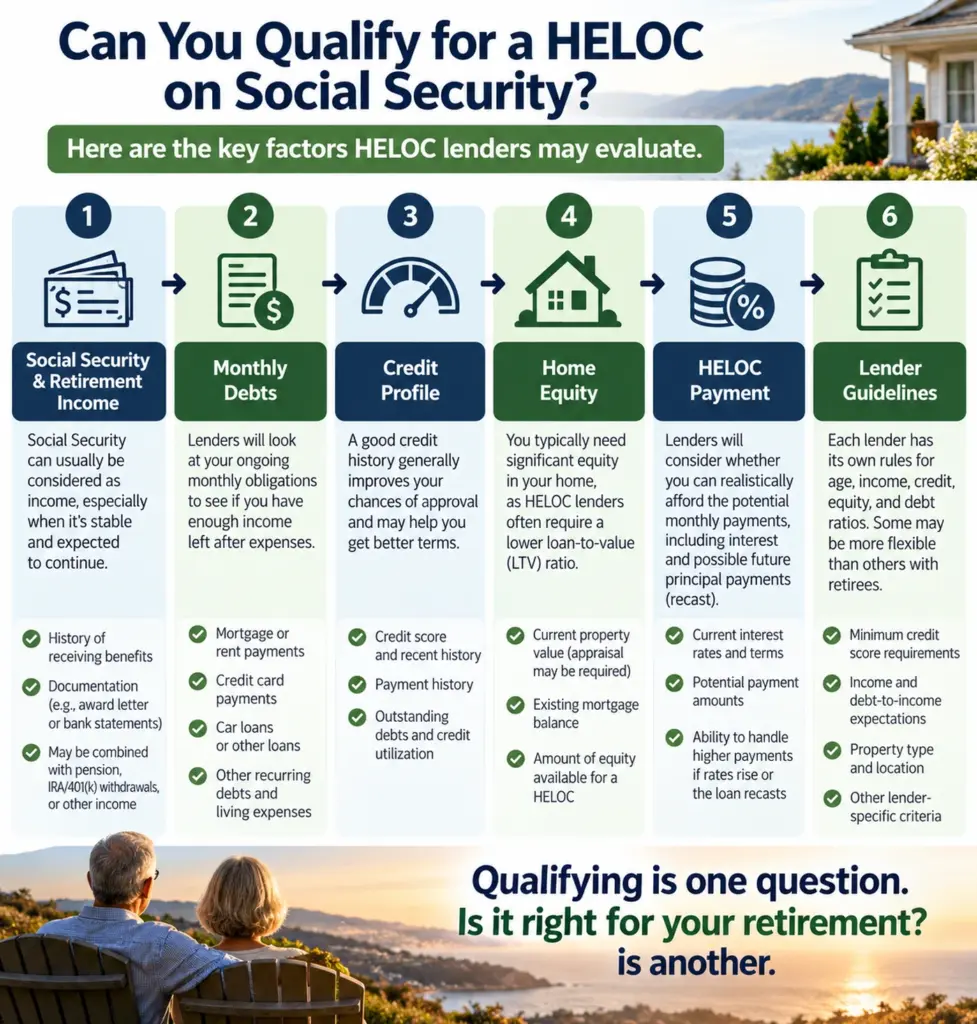
What Do HELOC Lenders Look at Besides Social Security Income?
Qualifying for a HELOC generally involves much more than proving that you own a home with equity.
Lender requirements vary, but several factors commonly matter.
Your Income
The lender will generally want to determine whether you have sufficient qualifying income to support your existing obligations and the anticipated HELOC payment.
Social Security may be part—or potentially all—of that income, depending on the lender’s underwriting requirements and your overall financial circumstances.
Your Debt-to-Income Ratio
Your debt-to-income ratio (DTI) compares your monthly debt payments with your gross monthly income.
The CFPB defines DTI as total monthly debt payments divided by gross monthly income. Different lenders and loan products can have different acceptable DTI limits.
For retirees, this can become particularly important.
Someone may have considerable wealth in home equity but relatively modest monthly income. A traditional HELOC is still a loan with required payments, so the lender generally needs to determine whether those payments are manageable.
Your Credit
HELOC lenders typically evaluate credit history and credit scores as part of underwriting.
Individual requirements vary by lender.
Your Home Equity
Because a HELOC is secured by your home, the amount of equity you have also matters.
Generally, the more you owe relative to your home’s value, the less equity is available to support another loan.
But equity alone doesn’t necessarily determine whether you qualify.
That is one of the biggest misunderstandings retirees encounter:
You can be equity-rich and still have difficulty qualifying for a traditional home-equity loan if your income, debts or credit don’t meet the lender’s requirements.
Does Social Security Get “Grossed Up” When Qualifying for a Loan?
Sometimes nontaxable income can receive special treatment when calculating qualifying income.
For example, Fannie Mae’s current Social Security guidance permits certain nontaxable Social Security income to be increased—or “grossed up”—for qualifying purposes under its guidelines. Its 2026 guidance provides an example in which qualifying income is calculated above the actual benefit amount because part of the Social Security income is nontaxable.
However, HELOC underwriting guidelines are lender- and product-specific.
Don’t assume a particular bank or credit union will calculate your Social Security income exactly the same way another lender does.
This is one reason retirees shouldn’t automatically assume they won’t qualify based only on the amount deposited into their bank account each month.
What Documentation Might You Need for Social Security Income?
Requirements vary by lender, but documentation may include evidence such as:
- A Social Security award or benefit letter
- An SSA-1099
- Bank statements showing receipt of benefits
- Tax returns or tax transcripts when applicable
- Documentation of other retirement income
For comparison, Fannie Mae’s current guidance allows several forms of documentation for Social Security retirement benefits, including an SSA award letter, SSA-1099, tax documentation or proof of current receipt, depending on the circumstances.
Your HELOC lender may have different requirements, so ask exactly what documentation is needed before applying.
Can You Qualify for a HELOC If Social Security Is Your Only Income?
Potentially.
There is no general rule saying that someone whose only income is Social Security is automatically ineligible for credit.
What matters is whether the income and the rest of the borrower’s financial profile satisfy the lender’s underwriting requirements.
For example, two retirees could receive exactly the same Social Security benefit but have very different financial pictures.
One might have no mortgage, little monthly debt and substantial home equity.
The other might have a mortgage, car payment, credit-card balances and other obligations.
The source of their income is the same. Their ability to qualify could be very different.
Why Monthly Payments Matter When Considering a HELOC in Retirement
Qualifying for a HELOC is only part of the decision.
The larger question is whether the HELOC fits your retirement plan.
A HELOC is revolving debt secured by your home. During the draw period, you can generally borrow up to the available credit limit, subject to the terms of the account. Many HELOCs have variable interest rates, so payments can change.
Eventually, the draw period ends and the repayment period begins.
At that point, you can no longer make additional draws, and payments may increase significantly as principal must be repaid.
We explain that transition in detail in What Happens When Your HELOC Draw Period Ends?
For a retiree living primarily on Social Security or other relatively fixed monthly resources, the potential for changing payments deserves careful consideration.
Is a HELOC a Good Idea If You’re Living on Social Security?
It can be appropriate for some retirees.
A HELOC may be useful when you need flexible access to home equity, expect to repay what you borrow and are comfortable with the required monthly payments and potentially variable interest rate.
But it shouldn’t be evaluated solely on whether a lender approves you.
Ask yourself:
- How much would I actually need to borrow?
- How would the payment affect my monthly retirement cash flow?
- What happens if interest rates rise?
- How long do I expect to keep the home?
- What happens when the draw period ends?
- Would I still be comfortable with the payment several years from now?
For a broader look at these questions, see HELOC for Retirees: Is a Home Equity Line of Credit a Good Idea in Retirement?
What If You Have Plenty of Home Equity but Don’t Qualify for a HELOC?
This is where retirement home-equity planning becomes especially important.
A traditional HELOC isn’t the only way to access home equity.
Depending on your situation, alternatives may include:
A Home Equity Loan
A home equity loan generally provides a lump sum with scheduled monthly payments. This may provide more payment predictability than a variable-rate HELOC, although qualification is still required.
Cash-Out Refinancing
A cash-out refinance replaces your existing mortgage with a new, larger mortgage and provides the difference in cash.
This deserves careful analysis if your existing first mortgage has a significantly lower interest rate than current market rates.
We’ll examine this option more closely in the next article in this series.
Selling or Downsizing
For some homeowners, selling and purchasing a smaller or less expensive property may free home equity without adding another loan payment.
The decision may involve lifestyle, family, location and aging-in-place considerations in addition to finances.
A Reverse Mortgage
For eligible older homeowners, a reverse mortgage offers a fundamentally different way of accessing home equity.
Instead of qualifying based on the ability to make required monthly principal and interest mortgage payments, an eligible homeowner may be able to convert a portion of home equity into available funds without required monthly principal and interest mortgage payments.
Borrowers remain responsible for property taxes, homeowners insurance, applicable HOA charges and maintaining the home, and must meet the loan’s other requirements.
This doesn’t automatically make a reverse mortgage preferable to a HELOC. They are different financial tools designed for different circumstances.
For a side-by-side comparison, see HELOC vs. Reverse Mortgage: Which Is Better for Retirees?
Don’t Let the Source of Your Income Make the Decision for You
One of the most important points for retirees to understand is that retirement income is still income when it meets applicable lending requirements.
Federal law provides protections against credit discrimination based on age and receipt of public assistance such as Social Security. At the same time, lenders are permitted to evaluate legitimate factors such as income amount, debts, credit history and whether income is likely to continue.
So don’t assume that being retired—or receiving Social Security instead of a paycheck—automatically prevents you from qualifying for a HELOC.
And don’t assume qualifying means a HELOC is necessarily the right solution.
Those are two separate questions.
Key Takeaways: HELOCs and Social Security Income
- Social Security income can potentially be considered when qualifying for a HELOC.
- A lender generally cannot reject income simply because it comes from Social Security.
- Lenders may evaluate the amount and expected continuation of the income.
- Debt, credit, home equity and other underwriting factors can affect qualification.
- Some nontaxable Social Security income may receive different qualifying treatment under applicable underwriting guidelines.
- Having significant home equity does not by itself guarantee HELOC approval.
- Retirees should consider the long-term payment structure—not just whether they qualify.
- If a HELOC doesn’t fit, other home-equity strategies may be worth evaluating.
Frequently Asked Questions About Getting a HELOC on Social Security Income
Can Social Security income be used to qualify for a HELOC?
Potentially, yes. Federal fair-lending protections generally prevent lenders from refusing to consider income simply because it comes from Social Security. The lender can still evaluate the amount, stability and expected continuation of the income, along with its other underwriting criteria.
Can I get a HELOC if Social Security is my only income?
Potentially. The lender will generally evaluate whether your qualifying income and overall financial profile meet its requirements. Existing debts, credit history, available equity and the anticipated HELOC payment can all affect the decision.
Does a lender count gross or net Social Security income?
The treatment can vary by lender and program. Certain underwriting guidelines permit nontaxable Social Security income to be “grossed up” for qualification. Ask the lender how it will calculate your specific Social Security benefits.
Does being retired make it harder to get a HELOC?
Retirement itself should not disqualify you. Lenders generally cannot discriminate based on age, although they can evaluate income, debt, credit and other legitimate measures of creditworthiness.
What credit score do retirees need for a HELOC?
There is no single universal HELOC credit-score requirement. Requirements vary by lender and product, so it is better to compare actual underwriting requirements rather than assume one score applies everywhere.
What if I can’t qualify for a HELOC?
Depending on your circumstances, alternatives could include a home equity loan, cash-out refinance, selling or downsizing, or—for eligible older homeowners—a reverse mortgage. The appropriate option depends on your goals, cash flow, existing mortgage, available equity and how long you expect to remain in the home.
Final Thoughts: Social Security Doesn’t Automatically Close the Door on a HELOC
Living on Social Security doesn’t automatically mean that accessing home equity through a traditional HELOC is off the table.
But retirement changes the way a borrowing decision should be evaluated.
The goal isn’t simply to ask, “Can I qualify?”
A better question may be:
“Which way of accessing my home equity best fits my retirement cash flow and long-term plans?”
Understanding the differences before borrowing can help you make a more informed decision about how—and whether—to use your home’s equity during retirement.
If you’d like to compare a HELOC, reverse mortgage or other home-equity option based on your individual situation, I can help you understand how the alternatives work so you can decide which approach fits your retirement goals.
Have questions about this?
Talk to a Certified Reverse Mortgage Professional — directly.
When you call, you reach me — not a call center. Free 30-minute consult by phone, video, or in person. No SSN, no credit pull, no obligation.
Schedule a consult