

why are reverse mortgages a bad idea dave ramsey
Why a Reverse Mortgage May Be a Bad Idea—and When the Warning Fits

Treat a blanket warning as a question about fit
A blanket warning cannot decide whether a reverse mortgage fits your household. It can point you toward the subjects that deserve careful attention: the way funds are received, the costs that accompany the loan, the responsibilities that continue, the effect on people who share your home, and the alternatives you could compare. CFPB guidance tells you to discuss those subjects before applying, rather than treating the product name alone as the conclusion.
The search question “why are reverse mortgages a bad idea dave ramsey” reflects a broad concern, but this article does not assign a specific claim to Dave Ramsey without a sourced statement from him. Instead, use the concern as a starting point for a conditions-based review. Ask whether the concern is about cost, debt, home equity, household plans, ongoing duties, or the possibility that another form of borrowing may fit your purpose more closely.
A reverse mortgage may be unsuitable when its structure conflicts with what you need from your home, your cash flow, or your future housing plans. It may also deserve further investigation when the structure addresses a defined purpose and you can meet the continuing responsibilities. That is a different question from whether the product is universally good or bad.
Start by writing down three things: why you are considering home equity, what you need the arrangement to do, and which future event would make you reconsider. Then test those notes against the product, its obligations, and at least one alternative. This keeps a strong opinion from replacing the questions your situation requires.
Define the FHA-insured HECM before judging it
In this guide, the product under review is the FHA-insured Home Equity Conversion Mortgage (HECM), often called a reverse mortgage. Eligible homeowners can access a portion of their home equity through a cash lump sum, line of credit, monthly payments, or a combination of these options. A HECM is one type of reverse mortgage, not a name that automatically describes every program. That boundary matters when you review eligibility, costs, payment choices, homeowner duties, and household effects: each point needs to be tied to the specific product under consideration. The definition identifies the loan structure, but it does not establish a particular amount, approval result, or fit for a household. It also explains why a statement about a non-HECM product cannot settle a question about an FHA-insured HECM. The product name is a starting point for checking the relevant rules, not a substitute for reading them. HUD identifies single-purpose, proprietary, and HECM products, and proprietary reverse mortgages are not insured by the FHA. Non-HECM reverse mortgages may have different requirements and features, so HECM rules should not automatically be applied to them.
This definition also prevents a common shortcut: treating access to equity as free money. A HECM is a loan secured by the home. The useful question is not merely whether funds are available, but what the loan changes now and what obligations remain later.
Overview
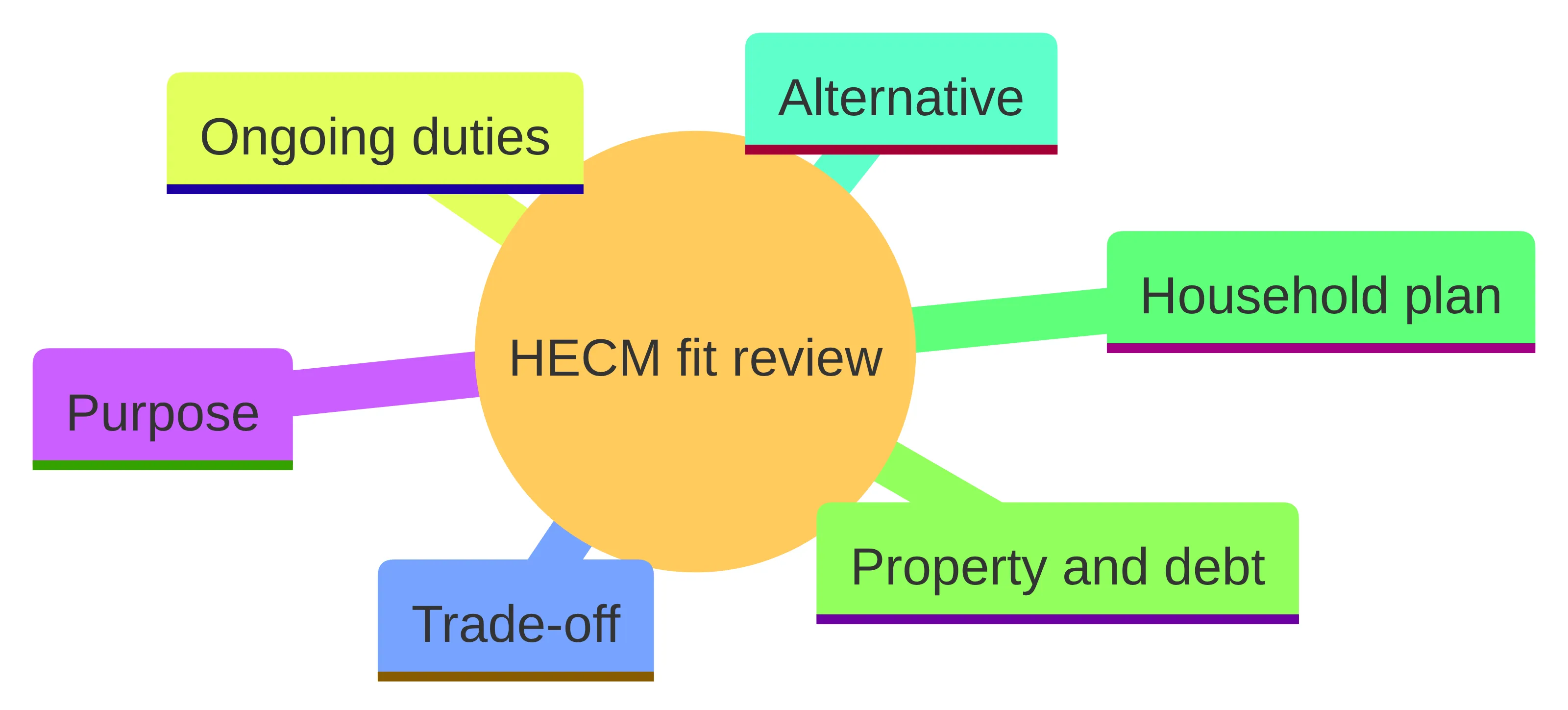
A fit review works best when you examine the decision through several connected lenses. Each lens answers a different question, and a conclusion usually depends on how the answers interact.
- Purpose: What do you want the proceeds to accomplish, and would a lump sum, line of credit, monthly payments, or a combination match that purpose?
- Trade-off: What changes in your present cash flow, loan balance, available equity, and future repayment planning?
- Ongoing duties: Can you continue paying property taxes and homeowners insurance, maintain the home, and keep it as your principal residence?
- Property and debt: Does the home meet the relevant property standards, and can an existing mortgage be paid off when the HECM closes?
- Household plan: How could the arrangement affect a spouse, another person living with you, a move, a nursing-home stay, a sale, or what happens after death?
- Alternative: What obligation would another borrowing arrangement create, and how would its qualification process differ?
The purpose of this framework is practical. It turns a general warning into a record of questions you can take to HUD-approved counseling and a later product comparison. If one answer is already unacceptable to you—such as an inability to meet an ongoing homeowner duty—you have a clear reason to pause without needing to settle every other issue first.
The sections that follow do not produce a recommendation for your household. They show where a reverse mortgage may conflict with your plans and where a broad warning may need a closer look.
Identify the borrowing purpose and payment tradeoff
A reverse mortgage deserves scrutiny when the purpose for borrowing is vague. “Use the equity” is not a plan. Write the expense, timing, and payment format you are considering. HUD describes reverse-mortgage proceeds as funds drawn from accumulated home equity, and CFPB lists payment format—including a line of credit, monthly installments, or a lump sum—as a subject to discuss before applying.
Try this short purpose record:
- The need: Name the expense or cash-flow gap without combining several unrelated goals.
- The timing: Note whether you need funds once, periodically, or only if a future expense arises.
- The amount: Use a planning estimate rather than assuming a lender will provide a particular sum.
- The payment format: Consider whether a lump sum, line of credit, monthly payments, or a combination matches the timing of the need.
- The exit question: Record what event would require repayment or a new housing decision.
The central trade-off is access to home equity now in exchange for a loan balance that generally does not require repayment until a future time. Treat each format as a question for the specific HECM terms. Payment format does not answer the fit question by itself. A line of credit, monthly payments, lump sum, or combination should be considered alongside the purpose, costs, existing mortgage, ongoing responsibilities, and alternatives. CFPB identifies these as subjects to discuss before applying, so the payment choice belongs in a connected review rather than a separate promise about the result. The selected format also does not establish the amount available or what a particular household will qualify for. The useful record is therefore not a preference for one format in the abstract, but an explanation of why its timing and obligations match the defined purpose being examined. An undefined purpose makes comparison difficult because an alternative would not be tested against the same need or timing. Recording the purpose first lets the household ask the same question of the HECM and the alternative without treating either product label as the answer.
A purpose may point away from a reverse mortgage when the need is temporary, the amount is not defined, or the household does not want a loan secured by the home. It may point toward further investigation when the need is clear and the household wants to examine a payment structure that does not require monthly principal-and-interest payments. That phrase does not mean there are no costs or homeowner responsibilities.
Before judging the product, finish this sentence in your own words: “I am considering a HECM because I want the loan to address…” If you cannot complete it without naming a general hope rather than a defined purpose, pause and clarify the purpose first.
Check the costs and homeowner duties that continue
Costs are a legitimate reason to examine a reverse mortgage closely, but the relevant question is not simply whether fees exist. CFPB directs you to ask about upfront costs and ongoing costs and fees. The same guidance identifies ongoing property charges, maintenance, and repairs as subjects that belong in the review. These categories can affect a household at different points, so a cost page should distinguish an initial charge from a continuing property obligation and from money needed for repairs. For each item, the useful question is what is due, when it is due, how it is paid, and which term of the specific HECM explains it. The review should also separate a confirmed term from an item that still needs an answer. A general statement that a reverse mortgage has fees does not explain the costs under consideration, and a list of costs is not a personal estimate. Keeping these categories visible helps the household compare the loan obligation with the obligations created by an alternative.
HECM borrowers remain responsible for property charges such as taxes and insurance, plus maintenance and repairs; funds may need to be set aside for them. Under FHA HECM financial-assessment rules, a life-expectancy set-aside for property charges may be fully funded, partially funded, or not required, depending on the financial assessment. That classification helps with a cost review. A set-aside is a program-specific treatment of funds for property charges under the FHA HECM financial assessment; it does not remove the underlying responsibility for those charges. Record whether it is fully funded, partially funded, or not required, and ask how that treatment relates to the payment option being considered. Keeping the set-aside beside taxes, insurance, maintenance, and repairs prevents one funding mechanism from being mistaken for a waiver of homeowner duties.
The continuing duties deserve the same attention as the initial proceeds. A HECM may be a poor fit if you do not have a reliable way to pay taxes and insurance, keep the home maintained, or keep it as your principal residence. The loan’s payment structure does not remove those homeowner responsibilities.
Build a cost-and-duty page with these headings:
- Upfront costs and how they would be paid.
- Ongoing costs and fees.
- Property taxes and homeowners insurance.
- Repairs and ordinary maintenance.
- Any funds set aside for property charges.
- The effect of each item on the amount available through the chosen payment option.
- The condition under which a missed duty could affect the loan.
Leave a space beside each item for the exact program explanation. A checklist helps you ask about the right subjects; it does not establish a complete cost estimate.
Do not treat the absence of required monthly principal-and-interest payments as the absence of financial work. The useful comparison includes every continuing charge and the future loan obligation, not only the monthly payment question.
Test occupancy, property condition, and mortgage payoff
For an HECM, the home must generally be your principal residence, meaning you live there for most of the year. That condition matters if you expect to divide your time between homes, move for an extended period, or change your housing plan. CFPB also identifies moving to a nursing home as a question to raise before applying.
Property condition is another practical screening point. If an HECM home does not meet required property standards, the lender may require repairs before the loan can be obtained. Do not assume a repair requirement will be waived or that a particular repair will be accepted without review.
An existing mortgage also needs a clear answer. If you have an existing mortgage, you must be able to pay it off when the HECM closes, using your own funds or reverse-mortgage funds. This does not mean you must pay it off before you can explore the HECM. It means the payoff has to be addressed as part of closing. This makes the existing balance a transaction question, not only an eligibility label. Ask how the payoff fits into the HECM closing and how it affects the funds remaining for the defined purpose and selected payment option. Record which figures still require review under the specific loan terms. The article cannot calculate that result, but the question keeps a general concern about existing debt tied to the actual transaction.
The CFPB also says HECM applicants cannot owe certain federal debts, although reverse-mortgage funds may be used to pay qualifying debt. Put federal debt, liens, the current mortgage balance, and property charges on the same review page. Each item can affect how the transaction is structured, and none should be left to an assumption.
These checks can produce a clear boundary. If the home will not remain your principal residence, the property cannot meet the applicable standards, or the existing mortgage cannot be paid off at closing, pause the HECM discussion until that condition has an answer.
Separate screening questions from a personal conclusion
A screening question tells you what to examine. It does not tell you that a reverse mortgage is suitable or unsuitable. Age, occupancy, mortgage payoff, federal debt, property condition, and property charges are screening subjects. They become part of a personal conclusion only after the facts, documents, program, and household plan have been reviewed together.
Use two columns in your notes:
- Known fact: “The home is where I live for most of the year.”
- Question requiring review: “Would the expected time away affect principal-residence requirements?”
Other examples include the current mortgage balance versus the exact payoff process, known repairs versus applicable property standards, and a general need for funds versus the payment format that addresses its timing. Use a third label: Household boundary: a condition the household will not accept without a different answer or plan. For example, the household may need an explanation of how an expected absence affects the principal-residence requirement, or how a required repair would be handled. Keep the boundary separate from a prediction about approval. It gives the family a clear pause point while leaving the product-specific answer to the appropriate review.
That statement describes our role; it does not turn an article into an approval decision or tell you what to do with your home. The useful next step is to bring a documented question, not to seek a predetermined answer.
A personal review becomes more useful when you can explain both sides of the decision: what the HECM might address and what condition could make it unacceptable. Write one sentence for each. This makes the conversation about fit rather than about defending or rejecting a product category.
If the only conclusion you have is “reverse mortgages are bad,” return to the facts that produced that conclusion. Name the specific cost, duty, household effect, or alternative obligation. Then ask whether that point applies to the FHA-insured HECM under consideration and to your documented circumstances.
Put household and future-event questions on the record
A reverse-mortgage decision affects more than the person signing the application when a spouse, partner, dependent, or other household member relies on the home. CFPB recommends discussing a spouse or partner’s future housing and financial needs and the needs of other people living with you. The same guidance points to questions about selling the home, moving to a nursing home, and what happens after death. These subjects belong together because the household may need to consider both who depends on the home now and what event would change the housing arrangement later. A household record can identify each person’s expected housing plan, the possibility of a sale or move, and the questions that would arise if a borrower enters a nursing home or dies. It can also note the existing mortgage, payment format, and continuing responsibilities that the household wants explained. This preparation does not predict a future event or decide suitability; it makes the questions available for counseling and family discussion. Recording the household view before an application also keeps a later conversation focused on the people and plans connected to the home.
A CFPB borrower guide says borrowers should understand loan requirements, payoff, moving out or dying, default, and what heirs may need to know. Turn those subjects into a household record rather than waiting for a future event to force the discussion.
Invite the people whose housing or financial plans could be affected to learn the same basic facts. Family participation can also surface questions about timing, housing plans, and the responsibilities that need to continue.
Use this household meeting outline:
- What does each person understand about the loan and the home?
- Who expects to live in the home, and what changes could alter that plan?
- What should happen if the home is sold or a borrower moves elsewhere?
- Which documents and contacts would the household need if a future event requires payoff or a housing decision?
- Which questions should go to HUD-approved counseling before any application?
The point is not to predict a future event. It is to make the household’s expectations visible before a loan is considered. If the people who depend on the home cannot accept the possible housing and repayment questions, record that boundary and pause.
Compare the obligation created by an alternative
A reverse mortgage should not be judged in isolation. CFPB includes alternatives among the questions to consider before applying. The comparison should focus on the obligation each option creates for your household, not on a claim that one product is universally better.
| Question | FHA-insured HECM | Traditional HELOC |
|---|---|---|
| What is being accessed? | Loan proceeds drawn from accumulated home equity. | Ask how the line would access equity under its specific terms. |
| What payment question comes first? | Ask how the selected lump sum, line of credit, monthly payments, or combination affects the loan balance and future repayment. | Ask when payments begin, how they are calculated, and what changes over the life of the line. |
| What qualification path applies? | Review HECM-specific conditions, including principal residence, mortgage payoff, property standards, federal debt, and property charges. | Qualification is different from qualification for a traditional retirement mortgage and must be reviewed under the HELOC’s terms. |
| What continuing duties need attention? | Taxes, insurance, maintenance, repairs, and the principal-residence condition remain part of the review. | Ask which property, payment, and line-maintenance duties apply and how they fit your cash flow. |
| What future event needs a plan? | Ask what happens if you sell, move, enter a nursing home, or die. | Ask what happens if you sell, move, repay the line, or can no longer meet its payment terms. |
Neither is “better.” The right comparison depends on cash flow, income documentation, the existing mortgage, age, long-term goals, and whether you want to make monthly payments. Those factors can point in different directions, so do not treat a general product description as a personal result.
We have access to the full reverse-mortgage market and choose the program that fits your situation. That does not replace a comparison with a HELOC or another option. It means the comparison should leave each alternative in its own lane, with its own qualification rules, costs, payment obligations, and future-event questions.
For each option, write the answer to one practical question: “What must my household keep paying, doing, or accepting for this arrangement to remain workable?” If the answer is unclear, that option has not been compared enough to support a decision.
What a Broad Warning Does—and Does Not—Establish
I do not treat the phrase “bad idea” as a product definition. I first identify the product: A Home Equity Conversion Mortgage (HECM)—commonly known as a reverse mortgage—is an FHA-insured loan that allows eligible homeowners to access a portion of their home equity through a cash lump sum, line of credit, monthly payments, or a combination of these options.
For an HECM, there are no required monthly principal and interest payments, and the loan generally does not require repayment until a future time. The homeowner remains responsible for property taxes, homeowners insurance, maintenance, repairs, and keeping the home as the primary residence. An existing mortgage balance must be paid off when the HECM closes. I keep these terms separate from non-HECM reverse mortgages, which may have different requirements and features.
I then ask what the warning addresses: household needs, moving or selling, payment options, ongoing responsibilities, or alternatives. HUD-approved counseling is required before taking out a reverse mortgage and can help a homeowner examine those questions.
I treat the label as a prompt to identify a specific term or household circumstance, not as a conclusion about every homeowner. If it does not identify what feature or circumstance makes the product a poor fit, I would need that question answered before deciding whether to rule out an HECM or investigate it further.
Use independent counseling to test the warning
Before counseling, prepare to discuss:
- Your financial needs and goals.
- Your spouse or partner’s future housing and financial needs.
- Other household members or dependents and their future housing needs.
- Why you are considering the loan.
- Alternatives you have already considered.
- The payment format you want to understand.
- The future housing or repayment event that concerns your household.
Take your cost questions and future-event questions with you. CFPB identifies upfront and ongoing costs, existing mortgages, ongoing responsibilities, moving or selling, what happens after death, and alternatives as subjects to ask about. A borrower guide also identifies payoff, moving out or dying, default, and family information as subjects to understand.
Counseling is an information checkpoint, not a substitute for reading the specific terms of the loan under consideration. After counseling, update your record: mark which questions were answered, which require documents, and which conditions remain unacceptable. Sort the notes into three groups: answered by the counselor, requiring a document or product-specific explanation, and still unacceptable to the household. The second group is not a conclusion; it identifies what must be clarified before comparing options. The third group is a stated boundary, not a prediction about eligibility. This sorting keeps counseling connected to the decision without turning general information into individualized advice. Carry unresolved items into any later comparison instead of treating an unanswered point as evidence for or against the product.
If the warning still fits after you have identified the product, purpose, costs, duties, household effects, and alternative obligations, you have a reason to rule out further review. If the warning becomes a set of questions with workable answers, you can investigate without treating that investigation as a commitment.
Turn the evaluation into practical questions
Bring questions that require specific answers rather than broad reassurance. The following list follows the subjects CFPB identifies for discussion before applying and adds the product distinctions needed to keep an FHA-insured HECM separate from other reverse mortgages.
Product and purpose
- Is the product under discussion an FHA-insured HECM, a single-purpose reverse mortgage, or a proprietary reverse mortgage?
- Which rules and features apply to this product, and which HECM rules do not apply?
- What defined purpose am I trying to address?
- Would a lump sum, line of credit, monthly payments, or a combination match the timing of that purpose?
- What would change if I used less than the available amount?
Costs and ongoing responsibilities
- What are the upfront costs and ongoing costs and fees?
- Which property taxes, homeowners insurance, maintenance, and repair duties continue?
- Could funds be set aside for property charges, and how would that affect the selected payment option?
- What must happen if a property charge is not paid?
- What property standards apply, and are repairs required before the HECM can be obtained?
- Which items are estimates, and which are fixed by the specific loan terms?
Home, mortgage, and household
- Does the home meet the principal-residence condition, meaning I live there for most of the year?
- How will the existing mortgage be paid off when the HECM closes?
- Are there federal debts or other liens that need to be addressed?
- How could the loan affect my spouse, partner, dependents, or other people living in the home?
- What happens if I sell the home, move elsewhere, or enter a nursing home?
- What happens after death, and what would the household need to know about payoff or the home?
Alternatives and next steps
- How does qualification for a traditional HELOC differ from qualification for this retirement mortgage?
- What payment obligations would the HELOC create, and when would they begin or change?
- What costs and property duties would apply to each option?
- Which alternative addresses the same defined purpose without creating an obligation the household cannot accept?
- Which questions should I take to HUD-approved counseling before any application?
- What documents would make the later comparison more precise?
Do not ask every question at once if that makes the discussion difficult to follow. Start with the product, purpose, and non-negotiable household conditions. Then move to costs, duties, alternatives, and future events. Keep the written answers with your planning records so a later conversation begins with the same facts. If you are an adult child helping a parent, keep the parent’s purpose and housing plan distinct from your own assumptions. Ask which facts the parent wants documented, invite the parent and relevant family members to learn the same information, and mark questions that require the homeowner’s documents or preferences. Family participation can clarify the record, but it does not replace the parent’s circumstances or required counseling. For a professional advisor serving a client, the same separation helps distinguish general education from the client’s individual documents and goals.
Choose whether to rule it out or investigate further
Further investigation may make sense when you have a defined purpose, understand that a HECM is an FHA-insured loan, can examine the costs and ongoing duties, have included the household, and are willing to compare another option without assuming the result. Complete required reverse-mortgage counseling before taking out a reverse mortgage.
A qualified professional must determine individual suitability from your documents, goals, household, and the specific program terms; this article cannot make that determination.
You do not have to accept a blanket warning or dismiss it outright. Name the condition behind it, test that condition against the FHA-insured HECM and the alternatives, and keep the decision tied to facts your household can explain and accept.
What should you ask before deciding whether a reverse mortgage fits?
What are the ongoing responsibilities of a HECM borrower?
HECM borrowers are responsible for ongoing property charges such as property taxes and homeowners insurance, as well as maintenance and repairs. They must also keep the home as their principal residence.
What are the eligibility requirements for a HECM?
The selected guide identifies age as one HECM eligibility consideration.
How does a reverse mortgage differ from a traditional mortgage?
Unlike a traditional mortgage, a reverse mortgage does not require monthly principal and interest payments.
What should I discuss during reverse mortgage counseling?
During counseling, you should discuss your financial needs and goals, the future housing needs of your spouse or partner, any other household members, the reasons for considering a reverse mortgage, and alternatives you have considered.
What are the potential costs associated with a reverse mortgage?
Costs can include upfront fees, ongoing property charges, and potential costs for repairs if the home does not meet required property standards. It’s important to ask about these costs before applying.
What alternatives should I consider instead of a reverse mortgage?
Consider alternatives such as selling the home, downsizing, or exploring a Home Equity Line of Credit (HELOC). Each option has different implications for cash flow, obligations, and future housing plans.
Have questions about this?
Talk to a Certified Reverse Mortgage Professional — directly.
When you call, you reach me — not a call center. Free 30-minute consult by phone, video, or in person. No SSN, no credit pull, no obligation.
Schedule a consult