

Home Equity & HELOC
Credit Scores Are Changing: What Homeowners Need to Know in 2026

Credit Scores Are Changing: What Homeowners Need to Know in 2026
Why your credit score may be different from what your mortgage lender sees—and how new scoring models could affect your borrowing options.
Have you ever checked your credit score online, felt pretty good about the number, and then discovered that your mortgage lender was looking at something completely different?
You’re not alone.
You might see a 740 on your credit card app, a 710 through a credit-monitoring service, and a different score when applying for a mortgage.
How can all three numbers be correct?
The answer is that you don’t have just one credit score. And with important changes taking place in mortgage credit scoring, understanding those differences is becoming increasingly valuable.
Whether you’re buying a home, considering a home equity loan or HELOC, or evaluating retirement mortgage options, your credit history can influence which financial solutions are available to you.
Let’s look at how credit scores really work, what’s changing, and what you can do to prepare.
Why Do I Have So Many Different Credit Scores?
Most people are familiar with the three major credit reporting agencies:
- Equifax
- Experian
- TransUnion
These companies collect information about your credit accounts, payment history, balances, and other credit-related activity.
But here’s where things get interesting.
The credit bureaus maintain your credit information. Different scoring models then use that information to calculate a number intended to help lenders evaluate credit risk.
Two major names in credit scoring are FICO and VantageScore.
Even within FICO, there are different versions designed for different lending purposes.
That means the score you see when checking your credit card account may not be the same score used to evaluate your mortgage application.
A real-world example
During a recent credit education presentation, Stephen Robert of Bedrock Credit America described a borrower whose credit card statement displayed a FICO score of 696.
When the mortgage lender obtained the borrower’s mortgage credit scores, one score was approximately 602.
That’s nearly a 100-point difference!
This was an unusually large difference, but it illustrates an important point: A credit score is only meaningful when you understand which scoring model produced it.
The number on your banking app isn’t necessarily wrong. It may simply be measuring your credit history differently.
How Is a Credit Score Calculated?
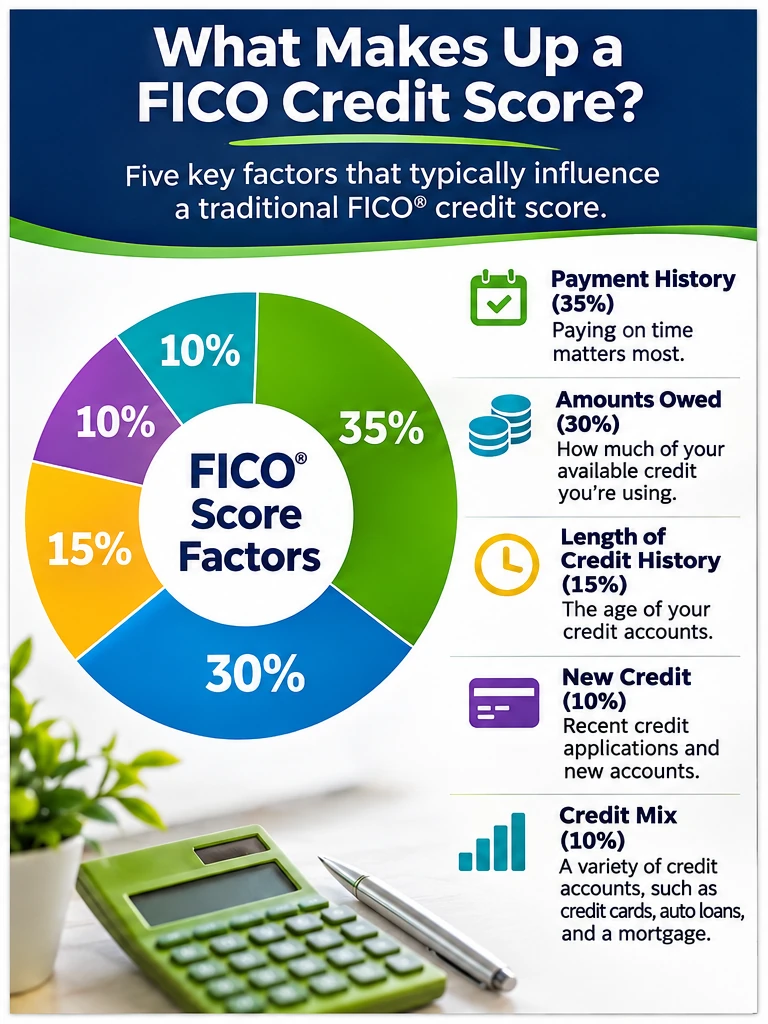
Although different scoring models use different formulas, traditional FICO scores generally emphasize five major categories.
| Credit scoring factor | Typical FICO weighting |
|---|---|
| Payment history | 35% |
| Amounts owed | 30% |
| Length of credit history | 15% |
| New credit | 10% |
| Credit mix | 10% |
These percentages describe the traditional FICO framework. Other scoring models may evaluate information differently, and the influence of individual factors varies by credit profile.
Let’s break down the factors that matter most.
1. Payment history: Paying on time matters
Your payment history is generally the largest component of a traditional FICO score.
A late mortgage payment, auto loan payment, or credit card payment can negatively affect your score.
How much?
That depends on your overall credit history, the severity of the delinquency, and how recently it occurred.
A single recent late payment can have a substantial impact, particularly for someone who previously maintained excellent credit.
Late payments can generally remain on a credit report for up to seven years, although their scoring impact often diminishes with time.
What you can do: Set up automatic minimum payments or payment reminders to help avoid accidental late payments.
2. Credit utilization: Your balances matter more than you might think
Credit utilization measures how much of your available revolving credit you’re using.
For example:
- Credit card limit: $10,000
- Outstanding balance: $8,000
- Credit utilization: 80%
Even if you make every payment on time, consistently carrying balances close to your credit limits may hurt your credit score.
Now consider the same account with a $1,000 balance.
Your utilization would drop to 10%.
That difference can matter.
The credit card statement-date surprise
Here’s something many homeowners don’t realize.
Paying your credit card in full by its due date doesn’t necessarily mean the credit bureaus will see a zero balance.
Many credit card issuers report balances around the statement closing date.
Suppose your statement closes on the 15th of each month.
You have a $5,000 balance when the statement closes, but you pay the entire amount on the 20th—well before the payment due date.
You may avoid interest, depending on your card’s grace-period terms, but the credit bureaus may still receive the $5,000 statement balance.
If you’re preparing for a mortgage application, paying down your balance before the statement closes may help a lower balance appear on your next credit report.
Reporting practices vary by issuer, so check your individual billing cycle.
Important: Always make at least the required payment by the due date. Paying before the statement closing date is an additional strategy, not a substitute for paying on time.
3. Length of credit history: Older accounts can be valuable
Credit scoring models generally consider how long you’ve been managing credit.
That includes the age of your oldest accounts and the overall age of your credit history.
This is one reason opening several new credit cards immediately before applying for a mortgage may not be a good idea.
And it’s also why closing an older credit card deserves some thought.
4. New credit: Be selective about applications
Applying for a new credit card or loan can generate a hard credit inquiry.
A hard inquiry may temporarily affect your credit score.
However, checking your own credit report or score is considered a soft inquiry and does not lower your score.
Mortgage and auto-loan rate shopping also receive special treatment under many scoring models, which generally group qualifying inquiries made within a designated shopping period.
The length of that period depends on the scoring model.
5. Credit mix: Different types of credit
Scoring models may consider your experience managing different types of accounts, such as credit cards, auto loans, and mortgages.
But don’t open a loan simply to improve your credit mix.
Managing the credit you already have responsibly is generally more important.
The Big Change: Mortgage Credit Scoring Is Entering a New Era
For many years, mortgage lenders selling conventional loans to Fannie Mae and Freddie Mac relied on older versions of FICO scores, often referred to as Classic FICO.
Now that system is changing.
The Federal Housing Finance Agency has approved two newer scoring models:
VantageScore 4.0 and FICO Score 10T.
As of September 2026, approved lenders can choose VantageScore 4.0 or Classic FICO for eligible loans sold to Fannie Mae and Freddie Mac.
FICO 10T has also been approved, but its implementation for those loan deliveries is still pending.
This doesn’t mean every lender has switched models or that every mortgage program uses the same scoring rules.
It means the mortgage industry is moving toward a broader range of credit scoring options.
Why is this important?
The newer models are designed to provide a more detailed picture of how consumers manage credit over time.
One particularly significant development is the use of trended credit data.
What Is Trended Credit Data—and Why Should You Care?
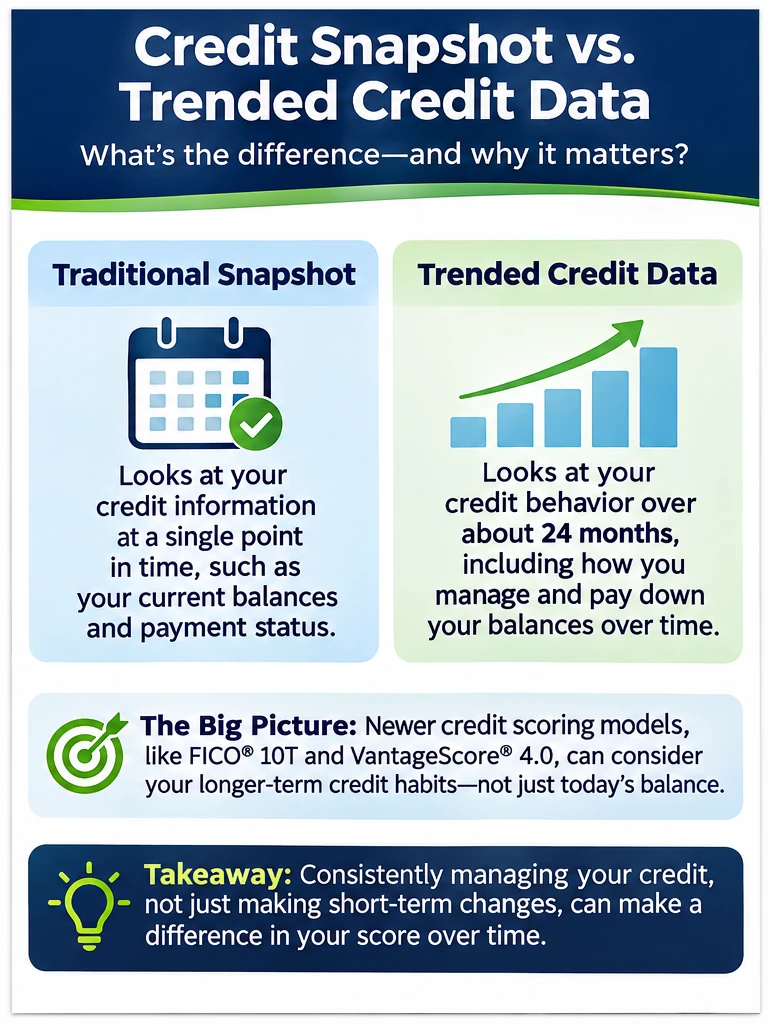
Traditionally, many credit scoring calculations placed significant emphasis on your currently reported balances.
For example, someone with several nearly maxed-out credit cards might pay those balances down, wait for the lower balances to be reported, and potentially see a meaningful score improvement.
Newer models such as FICO 10T and VantageScore 4.0 can also examine patterns in credit behavior over approximately 24 months.
Instead of focusing only on today’s reported balance, these models may consider whether you’ve consistently paid balances down or repeatedly accumulated debt.
An example
Imagine two homeowners.
Homeowner A regularly carries high credit card balances but pays them down shortly before applying for a mortgage.
Homeowner B consistently maintains relatively low balances and manages debt carefully over an extended period.
Even if both homeowners show similar balances on the day their credit is reviewed, a model using trended data may evaluate their credit histories differently.
That doesn’t automatically mean Homeowner A will receive a lower score. The outcome depends on the full credit profile and the particular scoring model.
But it does mean that long-term credit habits may become more important than short-term adjustments alone.
Does this mean paying down credit cards no longer helps?
Absolutely not.
Reducing credit card balances can still be beneficial.
The difference is that newer models may also consider your historical borrowing and repayment patterns.
If you’re planning a home purchase or other financing in the next year, developing healthy credit habits now may be more useful than waiting until the month before applying.
Can Closing a Credit Card Hurt Your Score?
It can.
Suppose you have three credit cards:
| Card | Credit limit | Balance |
|---|---|---|
| Card A | $10,000 | $4,000 |
| Card B | $10,000 | $2,000 |
| Card C | $10,000 | $0 |
| Total | $30,000 | $6,000 |
Your overall credit utilization is 20%.
Now imagine closing Card C.
If the remaining available credit drops to $20,000, your utilization rises to 30%, even though you haven’t borrowed another dollar.
That increase could negatively affect your score.
Of course, there are situations where closing an account makes sense, particularly if it carries expensive annual fees or creates financial risk.
The point is to understand the potential consequences before making changes.
What About Being an Authorized User on Someone Else’s Credit Card?
Being added as an authorized user to another person’s credit card may help establish or strengthen a credit history.
But it isn’t guaranteed to improve your score.
The age of the account, payment history, balance, and whether the card issuer reports authorized-user information can all matter.
Being added to an older account with a strong payment history and low utilization may be beneficial.
Being added to a heavily utilized account with late payments may provide little benefit or potentially hurt your score.
Newer scoring models may also evaluate authorized-user accounts differently.
If you’re considering this strategy, understand the account’s history and discuss it with a qualified credit professional before proceeding.
Collections and Charge-Offs: What Homeowners Should Understand
One of the most important discussions in the credit presentation concerned collection accounts and charged-off debts.
These accounts can complicate a mortgage application, but there are several misconceptions worth addressing.
Does paying a collection automatically remove it from your credit report?
No.
Paying or settling a collection generally does not automatically erase an accurate account from your credit history.
The account may remain on your report with an updated status.
Different credit scoring models also treat paid collections differently.
For that reason, the effect of paying a collection isn’t identical for every borrower.
Can paying an old collection lower your score?
The answer is more complicated than a simple yes or no.
The presentation emphasized situations in which an older collection was updated after payment and a borrower subsequently experienced a score decrease.
However, paying an old collection does not universally cause a score reduction, and payment does not restart the original seven-year credit-reporting period.
The result depends on the scoring model, the account’s reporting history, and other information in the credit file.
The practical takeaway: If you’re applying for a mortgage soon, ask your loan professional how an outstanding collection will be evaluated before making decisions solely to change your credit score.
This isn’t a reason to ignore a valid debt or delay legally required payments.
What if a collection account is incorrect?
You have the right to dispute inaccurate information with the credit reporting agency and the company reporting it.
Keep copies of your supporting documents.
Accurate negative information generally cannot be removed simply because you would prefer it not appear.
Be cautious of anyone promising guaranteed credit-score increases or automatic deletion of legitimate debts.
Be careful when negotiating debt settlements
Before paying a collection or negotiating a settlement:
- Verify that the debt and collector are legitimate.
- Request the settlement terms in writing.
- Understand whether the payment resolves the debt in full.
- Keep proof of payment and confirmation of the remaining balance.
- Ask a qualified tax professional whether any forgiven debt could have tax consequences.
These precautions help protect you from misunderstandings, improper collection practices, and unexpected financial consequences.
Where Can You Check Your Credit Reports and Scores?
There are two useful resources to understand.
AnnualCreditReport.com
Visit https://www.annualcreditreport.com/
This is the official website for accessing free credit reports from Equifax, Experian, and TransUnion.
You can currently review your reports online weekly.
Checking your own reports does not hurt your credit score.
These reports are especially useful for identifying:
- Accounts you don’t recognize
- Incorrect late payments
- Outdated account information
- Duplicate collections
- Incorrect balances
However, the free reports generally do not include your credit scores.
myFICO.com
Visit https://www.myfico.com/
myFICO offers access to FICO credit scores, including mortgage-related versions through certain paid products.
If you’re planning a mortgage application, this may help you understand why your lender’s score differs from the one displayed by your credit card company.
Check the specific product, scoring versions, and current price before purchasing. Not every subscription or report includes every mortgage scoring model.
And remember: the lender’s actual credit report and underwriting requirements ultimately determine how your application is evaluated.
How Does Your Credit Score Affect Retirement Mortgage Options?
For homeowners approaching or already enjoying retirement, credit can influence financial flexibility.
But here’s an important distinction:
Not every retirement mortgage uses credit scores the same way.
Traditional home equity loans and HELOCs
These products commonly evaluate credit scores, income, existing debt, and available home equity.
A stronger credit profile may improve eligibility or pricing, depending on the lender and program.
If you’re comparing these options, my article on HELOCs for retirees explains how these credit lines work and what to consider before borrowing.
HECM reverse mortgages
A Home Equity Conversion Mortgage (HECM) is different.
HECM loans generally do not have a minimum credit score requirement under HUD program rules.
Instead, lenders perform a financial assessment that reviews factors such as credit history, property-charge payment history, income, and financial obligations.
The goal is to evaluate the borrower’s ability and willingness to meet ongoing responsibilities, including property taxes, homeowners insurance, and applicable property charges.
That means a homeowner with less-than-perfect credit may still have options.
However, financial assessment results can affect loan structure and whether a Life Expectancy Set-Aside is required.
For a broader comparison of how these borrowing options differ, read HELOC vs. Reverse Mortgage: Understanding Your Options.
Proprietary and hybrid retirement mortgages
Private retirement mortgage products may use different credit-score requirements, financial assessments, and underwriting guidelines.
Some products have minimum credit score thresholds; others evaluate creditworthiness differently.
Program availability and requirements vary.
The important message is that a single credit score doesn’t tell the entire story of your retirement financing options.
For homeowners who want to access equity while preserving an existing low mortgage rate, I’ve also written about five ways to access home equity without refinancing.
Seven Smart Credit Moves Before Applying for a Mortgage
If you’re considering using your home equity, buying a home, or restructuring debt, a little preparation can go a long way.
- Review all three credit reports. Look for inaccurate information and unfamiliar accounts.
- Pay every obligation on time. Payment history remains an essential part of responsible credit management.
- Reduce high credit card balances when possible. Lower utilization may help improve your credit profile.
- Understand your statement closing dates. Your reported balance may differ from the amount you currently owe.
- Think before closing older credit cards. Closing an account can change your available credit and utilization.
- Avoid unnecessary new credit applications. Particularly when you’re preparing for a major financing decision.
- Discuss collections and credit concerns before making major changes. Your mortgage professional can help you understand the program’s requirements and whether additional credit guidance may be helpful.
Frequently Asked Questions About Credit Scores
Why is my Credit Karma score different from my mortgage score?
Credit Karma generally provides VantageScore credit scores, while your mortgage lender may use a different model, such as Classic FICO or VantageScore 4.0. Different models, versions, reporting agencies, and reporting dates can produce different results.
Does checking my own credit hurt my score?
No. Checking your own credit is considered a soft inquiry and does not lower your score.
Will paying off credit cards improve my mortgage credit score?
It may. Lower credit utilization can help, but the impact depends on your overall credit profile and the scoring model used.
Are mortgage lenders using VantageScore now?
Yes, for certain eligible conventional loans. As of September 2026, Fannie Mae and Freddie Mac allow approved lenders to use VantageScore 4.0. Adoption varies by lender and loan program.
Does a reverse mortgage require good credit?
For a HECM reverse mortgage, HUD does not establish a minimum credit score requirement. However, lenders conduct a financial assessment, and credit history can affect eligibility and loan structure. Proprietary and other retirement mortgage products may have different requirements.
How long does negative information stay on my credit report?
Many types of negative credit information can generally remain for up to seven years. Certain bankruptcies may remain for up to ten years. Specific reporting rules depend on the type of information.
Your Credit Score Is Important—but It’s Not Your Entire Financial Story
Credit scoring is evolving, and homeowners have more reason than ever to understand what their credit reports actually say.
The biggest lesson?
Don’t assume the score you see on your phone is the same score a mortgage lender will use.
And don’t assume that one number determines every financing option available to you.
Whether you’re planning to purchase a home, preserve your existing low mortgage rate, access home equity, or create more flexibility in retirement, understanding your credit is an important first step.
If you’re exploring how your home could support your retirement goals, my article on home equity in retirement planning offers additional ideas and considerations.
You don’t have to figure out all your options on your own.
I help homeowners understand how their home equity fits into their broader retirement plans, including reverse mortgages, home equity lines of credit, and other retirement mortgage solutions.
If you’d like to explore what’s available for your situation, I’d be happy to have a conversation.
Angella Conrard | Retirement Mortgage Professional
Call or text: 949-439-7030
Schedule a conversation: https://calendly.com/reverse-mortgages
Educational information only. Credit scoring models, mortgage underwriting requirements, and product eligibility vary by lender and program. No particular credit-score improvement, loan approval, or financing outcome is guaranteed. Consult qualified credit, tax, or legal professionals regarding individual circumstances.
Sources and further reading
- Federal Housing Finance Agency — Credit Score Models: https://www.fhfa.gov/credit-scores
- Consumer Financial Protection Bureau — Understanding Credit Scores: https://www.consumerfinance.gov/consumer-tools/credit-reports-and-scores/understand-your-credit-score/
- Consumer Financial Protection Bureau — Free Credit Reports: https://www.consumerfinance.gov/ask-cfpb/how-do-i-get-a-free-copy-of-my-credit-reports-en-5/
- Fannie Mae — Credit Score Models and Reports Initiative: https://singlefamily.fanniemae.com/originating-underwriting/credit-score-models
- Credit education presentation featuring Stephen Robert, Bedrock Credit America, November 3, 2026.
Have questions about this?
Talk to a Certified Reverse Mortgage Professional — directly.
When you call, you reach me — not a call center. Free 30-minute consult by phone, video, or in person. No SSN, no credit pull, no obligation.
Schedule a consult